Medium MCAT Stoichiometry Practice Questions

Medium MCAT Stoichiometry Practice Questions
Mastering MCAT stoichiometry is essential for scoring high on the Chemical and Physical Foundations of Biological Systems section, as it forms the quantitative backbone of general chemistry. These medium-level practice questions focus on the relationships between reactants and products in chemical reactions, requiring you to navigate molar masses, limiting reagents, and percent yields with speed and accuracy.
Concept Explanation
MCAT stoichiometry is the quantitative study of the relative amounts of reactants and products involved in chemical reactions based on the conservation of mass and the law of definite proportions. To solve these problems effectively, you must convert given quantities—usually mass, volume, or concentration—into moles, which serve as the universal currency of chemical equations. The coefficients in a balanced chemical equation provide the stoichiometric ratios needed to bridge the gap between different species in a reaction. For instance, in the combustion of methane , the ratio of oxygen to methane is 2:1. Understanding these ratios is critical when identifying the limiting reagent, which is the reactant that is completely consumed first and determines the maximum amount of product that can be formed (the theoretical yield). Successful students often use retrieval practice for medical students to internalize common molar masses and unit conversion shortcuts, ensuring they can perform these calculations under the strict time constraints of the MCAT. Mastering these foundations also aids in understanding complex biological processes, such as metabolic pathways, where stoichiometry dictates the flux of metabolites.
Solved Examples
Review these worked examples to understand the step-by-step logic required for medium-difficulty stoichiometry problems.
- Limiting Reagent Calculation: If 24 grams of magnesium (atomic weight ) react with 16 grams of oxygen gas (, molecular weight ) to form magnesium oxide (), which is the limiting reagent?
- Write and balance the equation: .
- Calculate moles of Mg: .
- Calculate moles of : .
- Check stoichiometric needs: According to the 2:1 ratio, 1.0 mole of Mg requires moles of . Since we have exactly moles, both are consumed entirely; however, if oxygen were slightly less, it would be limiting. In this perfect ratio, there is no excess.
- Theoretical Yield: How many grams of water are produced from the combustion of 4.0 grams of hydrogen gas () with excess oxygen?
- The balanced equation is .
- Calculate moles of : .
- Use the molar ratio: The ratio of to is 2:2 (or 1:1). Therefore, 2.0 moles of produce 2.0 moles of .
- Convert to grams: .
- Percent Yield: A student reacts 100 grams of calcium carbonate (, MW ) to produce calcium oxide () and . If they collect 44 grams of (MW ), what is the percent yield?
- Equation: .
- Theoretical yield: 1 mole of (100g) should produce 1 mole of (56g).
- Calculate percent yield: .
Practice Questions
Test your knowledge with these MCAT stoichiometry practice questions. Remember to balance equations first and use approximate values for atomic weights to simulate the MCAT environment.
1. In the reaction , how many grams of ammonia are produced if 28 grams of nitrogen gas react with excess hydrogen?
2. A sample of 10 grams of sodium hydroxide (, MW ) is neutralized by hydrochloric acid (). How many moles of water are formed?
3. Carbon disulfide () burns in oxygen to produce carbon dioxide and sulfur dioxide. If 1 mole of reacts with 2 moles of , which reactant is limiting?
Create your MCAT study system.
Get a personalized MCAT study experience with quizzes, active recall tools, and intelligent study guidance.
Build My Study Plan4. Consider the reaction: . If 54 grams of aluminum (AW ) react with 71 grams of chlorine gas (MW ), what is the maximum mass of (MW ) that can be produced?
5. What volume of is required to completely react with 5.3 grams of sodium carbonate (, MW ) according to the following equation?
6. A reaction has a theoretical yield of 50 grams but only produces 35 grams. What is the percent yield?
7. If 3.0 moles of ethane () undergo complete combustion, how many moles of oxygen gas are consumed?
8. How many molecules of are produced from the decomposition of 2 moles of calcium carbonate?
9. A mixture contains 2 moles of and 2 moles of . After the reaction to form water is complete, how many moles of the excess reagent remain?
10. In the synthesis of aspirin, 2.0 grams of salicylic acid (MW ) reacts with excess acetic anhydride. If the actual yield is 1.8 grams of aspirin (MW ), what is the percent yield?
Answers & Explanations
Detailed explanations for each practice question are provided below to help you identify areas for improvement. Utilizing retrieval practice vs practice tests can help you decide which method best reinforces these calculation steps.
- 1. 34 grams: 28g of is 1 mole. The ratio of to is 1:2. Thus, 2 moles of are produced. .
- 2. 0.25 moles: . The reaction is 1:1, so 0.25 moles of water are formed.
- 3. Oxygen (): The balanced equation is . 1 mole of requires 3 moles of . Since only 2 moles of are present, it is limiting.
- 4. 89 grams: Moles of Al . Moles of . The ratio is 2 Al : 3 . 1 mole of reacts with only moles of Al. Thus, is limiting. 1 mole of produces moles of . .
- 5. 200 mL: Moles of . Requires . , which is 200 mL.
- 6. 70%: .
- 7. 10.5 moles: Balanced combustion: . Ratio is 7:2. .
- 8. : . 2 moles of produce 2 moles of . molecules.
- 9. 1 mole of : . 2 moles of react with 1 mole of . Remaining .
- 10. 69%: Moles salicylic acid . Theoretical yield aspirin . Percent yield .
1. Which of the following is the first step in solving any stoichiometry problem?
Frequently Asked Questions
What is the most common mistake in MCAT stoichiometry?
The most common mistake is failing to balance the chemical equation before performing calculations. This leads to incorrect molar ratios, which invalidates every subsequent step in the problem-solving process.
How do I identify the limiting reagent quickly?
To identify the limiting reagent quickly, divide the number of moles of each reactant by its respective coefficient in the balanced equation. The reactant with the smallest resulting value is the limiting reagent.
Do I need to memorize Avogadro's number for the MCAT?
Yes, you should know that Avogadro's number is approximately . While it is sometimes provided, knowing it allows you to quickly convert between moles and the number of atoms or molecules, as explained on Wikipedia's Avogadro constant page.
What is the difference between theoretical yield and actual yield?
Theoretical yield is the maximum amount of product that can be formed based on stoichiometry, assuming 100% efficiency. Actual yield is the amount of product physically obtained from an experiment, which is usually less due to side reactions or loss during purification.
How does stoichiometry apply to gas laws on the MCAT?
Stoichiometry applies to gas laws through the molar volume of an ideal gas; at Standard Temperature and Pressure (STP), one mole of any ideal gas occupies 22.4 liters. This allows for direct conversion between gas volume and moles in a chemical reaction, a concept often detailed in Khan Academy's stoichiometry resources.
Is density ever used in MCAT stoichiometry problems?
Yes, density is frequently used as a conversion factor to move between the volume of a liquid reactant and its mass. Once you have the mass, you can use the molar mass to find the number of moles for stoichiometric calculations.
Create your MCAT study system.
Get a personalized MCAT study experience with quizzes, active recall tools, and intelligent study guidance.
Build My Study PlanReviewed by
Michael Danquah, MS, PhD
Dr. Michael Danquah is a professor of pharmaceutical sciences and founder of several educational technology platforms focused on improving student learning and performance.
Enjoyed this article?
Share it with others who might find it helpful.
Related Articles
Hard MCAT Stoichiometry Practice Questions
Hard MCAT Stoichiometry Practice Questions
May 9, 2026
Easy MCAT Stoichiometry Practice Questions
Easy MCAT Stoichiometry Practice Questions
May 9, 2026

Easy MCAT Amino Acid Practice Questions
Easy MCAT Amino Acid Practice Questions
May 14, 2026

Easy MCAT Biochemistry Practice Questions
Easy MCAT Biochemistry Practice Questions
May 14, 2026
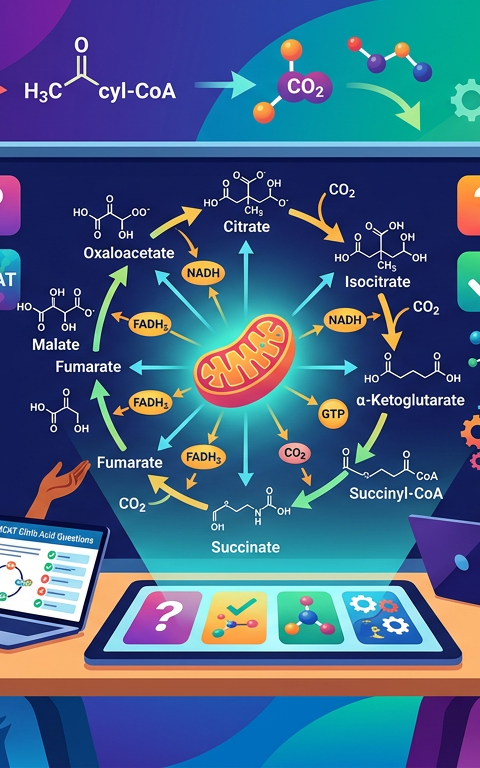
MCAT Citric Acid Practice Questions with Answers
MCAT Citric Acid Practice Questions with Answers
May 14, 2026

MCAT Biochemistry Practice Questions with Answers
MCAT Biochemistry Practice Questions with Answers
May 14, 2026

Solving High-Yield MCAT Stereochemistry: Beyond R and S Basics
Hard MCAT Stereochemistry Practice Questions
May 11, 2026
Hard MCAT Organic Chemistry Practice Questions
Hard MCAT Organic Chemistry Practice Questions
May 11, 2026