Easy MCAT Stoichiometry Practice Questions

Easy MCAT Stoichiometry Practice Questions
Mastering Easy MCAT Stoichiometry Practice Questions is a fundamental step for any pre-medical student aiming to excel in the Chemical and Physical Foundations of Biological Systems section. Stoichiometry is the quantitative study of reactants and products in chemical reactions, relying on the law of conservation of mass to relate the amounts of substances through balanced chemical equations. By understanding how to convert between grams, moles, and liters, you can navigate complex passages with ease and precision.
Concept Explanation
Stoichiometry is the method of using balanced chemical equations to calculate the relative quantities of reactants and products involved in a chemical reaction. At its core, it treats chemical equations like recipes, where the coefficients represent the molar ratios needed to produce a specific outcome. To succeed on the MCAT, you must be comfortable with the "Mole Bridge," which allows you to transition from the mass of one substance to the mass of another using the following pathway: Mass A → Moles A → Moles B → Mass B.
Key concepts involved in stoichiometry include:
- The Mole: A unit representing particles, serving as the link between the microscopic world of atoms and the macroscopic world of grams.
- Molar Mass: The mass of one mole of a substance (g/mol), found by summing atomic weights from the periodic table.
- Molar Ratios: The coefficients in a balanced equation that tell you how many moles of one substance react with or produce another.
- Limiting Reagents: The reactant that is completely consumed first, thereby determining the maximum amount of product that can be formed.
- Percent Yield: A measure of efficiency calculated by .
Since the MCAT is a timed exam without a calculator, practicing retrieval practice for STEM subjects is essential to internalize these conversion factors and perform mental math quickly. Understanding these relationships allows you to predict physiological outcomes, such as how much carbon dioxide is produced during cellular respiration or the concentration of a drug in the bloodstream.
Solved Examples
Example 1: Basic Mole-to-Mole Conversion
Given the reaction:
How many moles of are produced from 6 moles of , assuming excess ?
- Identify the molar ratio between and from the balanced equation. The ratio is 3:2.
- Set up the conversion:
- Calculate the result: .
Example 2: Mass-to-Mass Conversion
How many grams of water (, molar mass ) are produced by the combustion of 16 grams of methane (, molar mass )?
Reaction:
- Convert grams of to moles:
- Use the molar ratio (1:2) to find moles of :
- Convert moles of back to grams: .
Example 3: Limiting Reagent Identification
If 2 moles of react with 2 moles of to form , which is the limiting reagent?
Reaction:
- Determine the moles of product each reactant can make.
- For : .
- For : .
- Since produces less product, is the limiting reagent.
Practice Questions
1. In the reaction , how many moles of oxygen are required to fully react with 10 moles of hydrogen gas?
2. Calculate the molar mass of glucose (). (Atomic weights: )
3. If a reaction has a theoretical yield of 50 grams but only produces 40 grams in the lab, what is the percent yield?
Create your MCAT study system.
Get a personalized MCAT study experience with quizzes, active recall tools, and intelligent study guidance.
Build My Study Plan4. How many grams of (molar mass 44 g/mol) are produced from the decomposition of 2 moles of ?
Reaction:
5. A student mixes 4 moles of with 6 moles of to form . Which reactant is limiting?
Reaction:
6. How many moles of sodium chloride are in a 117-gram sample? (Molar mass of )
7. According to the equation , how many moles of are produced from 12 moles of iron?
8. What volume (in Liters) would 0.5 moles of an ideal gas occupy at Standard Temperature and Pressure (STP)? (Note: )
9. If 3 moles of react with 1 mole of to produce 2 moles of , how many moles of are produced from 9 moles of ?
10. Calculate the mass of 0.25 moles of . (Molar mass: )
Answers & Explanations
- Answer: 5 moles. Using the ratio from , for every 2 moles of , you need 1 mole of . Therefore, .
- Answer: 180 g/mol. Calculation: . This is a common value to memorize for the MCAT.
- Answer: 80%. Percent yield is . So, .
- Answer: 88 grams. The ratio of to is 1:1. So 2 moles of reactant produce 2 moles of product. Mass = .
- Answer: Both are in stoichiometric proportion (Neither is limiting). For 4 moles of , you need . Since exactly 6 moles are provided, both are consumed entirely.
- Answer: 2 moles. Moles = . .
- Answer: 6 moles. The ratio of to is 4:2 (or 2:1). So, .
- Answer: 11.2 L. Using the molar volume of a gas at STP: .
- Answer: 6 moles. The ratio of to is 3:2. Set up the calculation: .
- Answer: 10 grams. First, find molar mass of : . Then, .
1. Which of the following is required to convert the mass of Reactant A to the mass of Product B?
Frequently Asked Questions
What is the most important step in a stoichiometry problem?
The most critical step is ensuring you have a balanced chemical equation, as the coefficients provide the necessary molar ratios to convert between different substances. Without a balanced equation, all subsequent mass and mole calculations will be mathematically incorrect.
Do I need to use Avogadro's number in every stoichiometry question?
No, you only need Avogadro's number () if the question specifically asks for the number of individual atoms, molecules, or ions. Most MCAT stoichiometry problems focus on mass-to-mole or mole-to-mole conversions.
How do I identify the limiting reagent quickly?
Divide the number of moles of each reactant by its respective coefficient in the balanced equation; the reactant with the smallest resulting value is the limiting reagent. This quick comparison allows you to identify which substance will run out first without calculating the full product yield twice.
What is the difference between theoretical yield and actual yield?
Theoretical yield is the maximum amount of product that can be formed based on stoichiometry, assuming perfect conditions. Actual yield is the amount of product physically obtained in a lab, which is usually lower due to side reactions or experimental loss.
How does stoichiometry relate to the MCAT?
Stoichiometry appears frequently in the context of titration, gas laws, and metabolic pathways, requiring students to calculate reactant requirements or product outputs. Practicing retrieval practice in medical education helps students recall these mathematical relationships under the pressure of the actual exam.
Can I assume gases are at STP on the MCAT?
You should only assume STP (0°C and 1 atm) if the question explicitly states it or implies it through context. If conditions are different, you must use the Ideal Gas Law () to relate moles to volume, as described by Khan Academy's gas stoichiometry resources.
Create your MCAT study system.
Get a personalized MCAT study experience with quizzes, active recall tools, and intelligent study guidance.
Build My Study PlanReviewed by
Michael Danquah, MS, PhD
Dr. Michael Danquah is a professor of pharmaceutical sciences and founder of several educational technology platforms focused on improving student learning and performance.
Enjoyed this article?
Share it with others who might find it helpful.
Related Articles
Hard MCAT Stoichiometry Practice Questions
Hard MCAT Stoichiometry Practice Questions
May 9, 2026
Medium MCAT Stoichiometry Practice Questions
Medium MCAT Stoichiometry Practice Questions
May 9, 2026

Easy MCAT Amino Acid Practice Questions
Easy MCAT Amino Acid Practice Questions
May 14, 2026
Easy MCAT Biochemistry Practice Questions
Easy MCAT Biochemistry Practice Questions
May 14, 2026
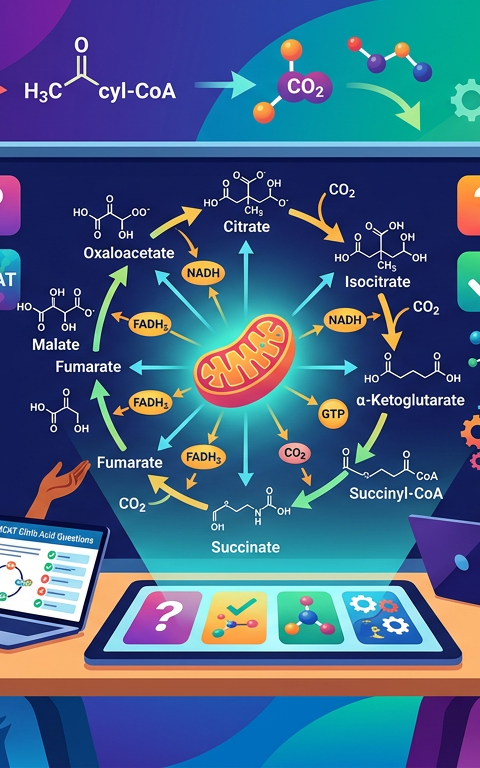
MCAT Citric Acid Practice Questions with Answers
MCAT Citric Acid Practice Questions with Answers
May 14, 2026

MCAT Biochemistry Practice Questions with Answers
MCAT Biochemistry Practice Questions with Answers
May 14, 2026

Solving High-Yield MCAT Stereochemistry: Beyond R and S Basics
Hard MCAT Stereochemistry Practice Questions
May 11, 2026
Hard MCAT Organic Chemistry Practice Questions
Hard MCAT Organic Chemistry Practice Questions
May 11, 2026