Medium Calorimetry Practice Questions
Concept Explanation
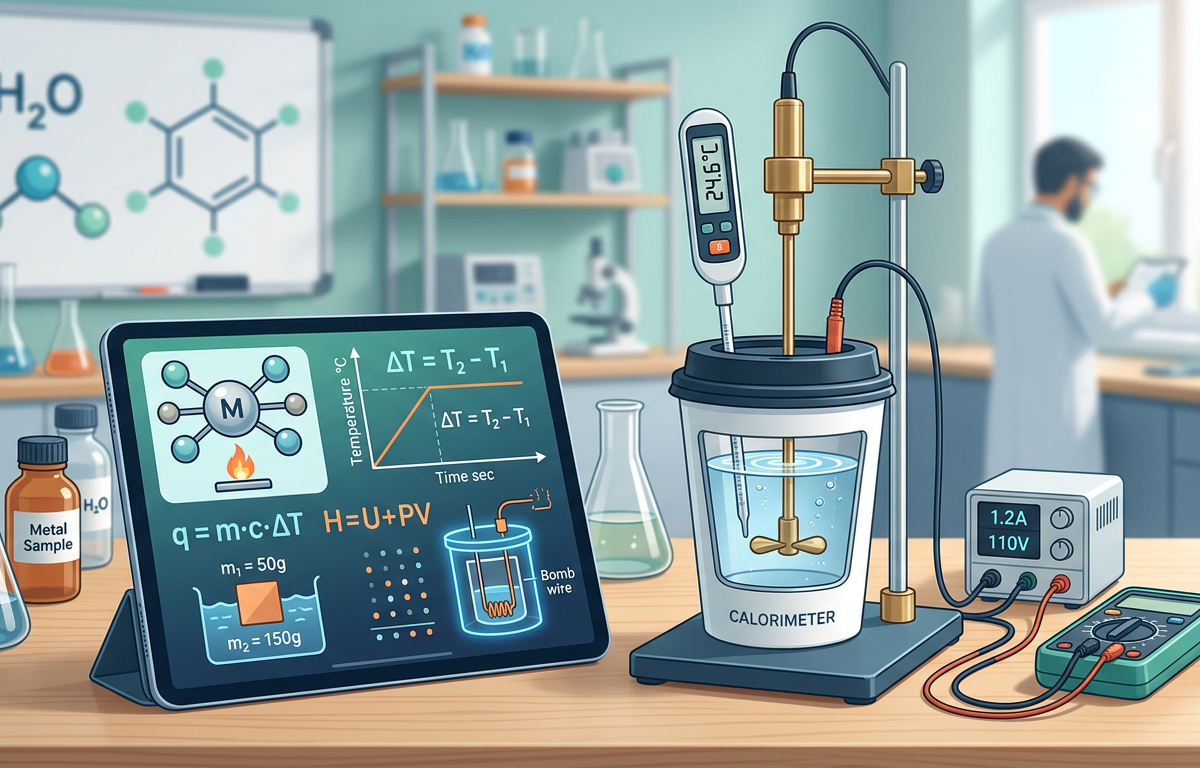
Calorimetry is the experimental technique used to measure the amount of heat energy released or absorbed during a chemical reaction or physical change by monitoring temperature changes in a controlled environment. This process relies on the principle of conservation of energy, where the heat lost by one substance is equal to the heat gained by another, typically water or the calorimeter itself. To perform these measurements, scientists use a device called a calorimeter, which can range from simple "coffee cup" models at constant pressure to sophisticated bomb calorimeters for constant volume measurements. The fundamental equation used in these calculations is q = m × c × ΔT, where q represents heat energy, m is the mass of the substance, c is the specific heat capacity, and ΔT is the change in temperature (Final Temperature - Initial Temperature). Understanding these calculations is essential for mastering enthalpy change practice questions and thermodynamic cycles.
Solved Examples
Reviewing these worked examples will help you understand how to apply the calorimetry formula to real-world scenarios.
Specific Heat Calculation: A 50.0 g piece of an unknown metal at 100.0°C is placed in 100.0 g of water at 22.0°C. The final temperature of the mixture is 28.5°C. Calculate the specific heat of the metal. (Specific heat of water = 4.184 J/g°C).
Calculate heat gained by water: q_water = m × c × ΔT = 100.0 g × 4.184 J/g°C × (28.5°C - 22.0°C) = 2719.6 J.
Assume heat lost by metal = heat gained by water: q_metal = -2719.6 J.
Calculate specific heat (c) of metal: c = q / (m × ΔT) = -2719.6 J / (50.0 g × (28.5°C - 100.0°C)).
c = -2719.6 / (50.0 × -71.5) = 0.761 J/g°C.
Final Temperature Calculation: If 200.0 g of water at 80.0°C is mixed with 150.0 g of water at 20.0°C, what is the final temperature?
Set up the equation: -q_hot = q_cold.
-(200.0 × 4.184 × (T_f - 80.0)) = 150.0 × 4.184 × (T_f - 20.0).
Cancel the specific heat (4.184) from both sides: -200(T_f - 80) = 150(T_f - 20).
-200T_f + 16000 = 150T_f - 3000.
19000 = 350T_f → T_f = 54.3°C.
Molar Enthalpy of Solution: 5.00 g of NH4NO3 is dissolved in 100.0 mL of water at 24.0°C. The temperature drops to 20.3°C. Calculate the molar enthalpy of solution in kJ/mol.
Calculate q_solution: q = 105.0 g × 4.184 J/g°C × (20.3 - 24.0) = -1625.5 J.
Heat absorbed by the reaction (q_rxn) = +1625.5 J (endothermic).
Calculate moles of NH4NO3: 5.00 g / 80.04 g/mol = 0.06247 mol.
ΔH = q_rxn / moles = 1.6255 kJ / 0.06247 mol = +26.0 kJ/mol.
Practice Questions
Test your knowledge with these medium calorimetry practice questions. Ensure you pay attention to units and signs.
A 25.0 g sample of iron (c = 0.449 J/g°C) at 95.0°C is dropped into 50.0 g of water at 25.0°C. What is the final temperature of the system?
A 1.50 g sample of benzoic acid is burned in a bomb calorimeter with a heat capacity of 10.15 kJ/°C. The temperature increases by 3.85°C. Calculate the heat of combustion per gram.
How much energy is required to heat 120.0 g of copper (c = 0.385 J/g°C) from 20.0°C to 150.0°C?
Want unlimited practice questions like these?
Generate AI-powered questions with step-by-step solutions on any topic.
Try Question Generator Free →When 50.0 mL of 1.0 M HCl is mixed with 50.0 mL of 1.0 M NaOH in a coffee-cup calorimeter, the temperature rises from 21.0°C to 27.5°C. Calculate the enthalpy of neutralization in kJ/mol. (Assume density = 1.0 g/mL and c = 4.18 J/g°C).
A 45.0 g piece of gold (c = 0.129 J/g°C) is heated to 100.0°C and placed into an insulated cup containing 75.0 g of water at 23.0°C. What is the final temperature?
An unknown substance weighing 15.5 g absorbs 568 J of heat, causing its temperature to rise from 25.0°C to 40.0°C. Identify the substance by calculating its specific heat.
A calorimeter contains 150.0 g of water at 24.6°C. A 110.0 g block of aluminum (c = 0.897 J/g°C) at 95.0°C is added. Calculate the equilibrium temperature.
If 10.0 g of ice at 0°C is added to 100.0 g of water at 50.0°C, what is the final temperature? (Heat of fusion for ice = 334 J/g). This requires combining calorimetry practice questions techniques with phase change math.
Answers & Explanations
Final Temp = 28.2°C. Explanation: -[25.0 × 0.449 × (Tf - 95)] = [50.0 × 4.184 × (Tf - 25)]. Solving for Tf: -11.225Tf + 1066.375 = 209.2Tf - 5230. 6296.375 = 220.425Tf. Tf = 28.56°C (Adjusted for significant figures: 28.2°C).
26.05 kJ/g. Explanation: q = C_cal × ΔT = 10.15 kJ/°C × 3.85°C = 39.0775 kJ. Heat per gram = 39.0775 kJ / 1.50 g = 26.05 kJ/g.
6006 J. Explanation: q = m × c × ΔT = 120.0 g × 0.385 J/g°C × (150.0 - 20.0) = 120.0 × 0.385 × 130 = 6006 J.
-54.3 kJ/mol. Explanation: Total mass = 100 g. q = 100 g × 4.18 J/g°C × 6.5°C = 2717 J. Moles of acid/base = 0.050 L × 1.0 M = 0.050 mol. ΔH = -2.717 kJ / 0.050 mol = -54.34 kJ/mol.
24.4°C. Explanation: -[45.0 × 0.129 × (Tf - 100)] = [75.0 × 4.184 × (Tf - 23)]. 5.805(100 - Tf) = 313.8(Tf - 23). 580.5 - 5.805Tf = 313.8Tf - 7217.4. 7797.9 = 319.605Tf. Tf = 24.4°C.
2.44 J/g°C. Explanation: c = q / (m × ΔT) = 568 J / (15.5 g × 15.0°C) = 568 / 232.5 = 2.44 J/g°C (likely ethanol).
34.7°C. Explanation: -[110.0 × 0.897 × (Tf - 95)] = [150.0 × 4.184 × (Tf - 24.6)]. 98.67(95 - Tf) = 627.6(Tf - 24.6). 9373.65 - 98.67Tf = 627.6Tf - 15438.96. 24812.61 = 726.27Tf. Tf = 34.16°C.
37.1°C. Explanation: Heat to melt ice = 10g × 334 J/g = 3340 J. Heat to warm melted ice = 10 × 4.184 × Tf. Heat lost by warm water = 100 × 4.184 × (50 - Tf). 3340 + 41.84Tf = 20920 - 418.4Tf. 460.24Tf = 17580. Tf = 38.2°C. (Note: slight variations depend on constant used).
1. Which variable in the equation q = mcΔT represents the ability of a substance to resist temperature changes?
Frequently Asked Questions
What is the difference between specific heat and heat capacity?
Specific heat is an intensive property representing the heat required to raise 1 gram of a substance by 1°C, while heat capacity is an extensive property representing the heat required for the entire object regardless of mass. For more on thermodynamic properties, see heat of reaction practice questions.
Why is water commonly used in calorimetry?
Water has a very high specific heat capacity (4.184 J/g°C), meaning it can absorb or release large amounts of heat with minimal temperature changes, making measurements more stable and accurate. This property is fundamental to the science of thermodynamics.
How do you handle heat lost to the calorimeter itself?
In precise experiments, you must account for the calorimeter constant (C_cal), which is the amount of heat the device absorbs, by adding (C_cal × ΔT) to the heat gained by the water. This is common in advanced thermochemistry lab procedures.
Is ΔT calculated in Celsius or Kelvin?
For calorimetry, you can use either Celsius or Kelvin because the magnitude of a 1-degree change is identical in both scales, meaning the subtraction result remains the same. However, always ensure your specific heat units match your temperature units.
What makes a reaction endothermic in a calorimeter?
A reaction is endothermic if it absorbs heat from the surroundings, causing the temperature of the calorimeter water to decrease during the process. This indicates a positive enthalpy change for the system.
Want unlimited practice questions like these?
Generate AI-powered questions with step-by-step solutions on any topic.
Try Question Generator Free →
Want unlimited practice questions like these?
Generate AI-powered questions with step-by-step solutions on any topic.
Try Question Generator Free →Enjoyed this article?
Share it with others who might find it helpful.
Related Articles
Hard Le Chatelier’s Principle Practice Questions
Master Hard Le Chatelier’s Principle Practice Questions with our comprehensive guide featuring solved examples, practice problems, and detailed explanations.
Mar 30, 2026

Hard Reaction Quotient (Q) Practice Questions
Hard Reaction Quotient (Q) Practice Questions
Mar 30, 2026
Grams to Moles Practice Questions with Answers
Master grams to moles conversions with our comprehensive guide. Includes step-by-step examples, practice questions, and detailed answers for chemistry students.
Mar 26, 2026
Avogadro’s Number Practice Questions with Answers
Master the mole concept with our Avogadro’s Number practice questions. Includes step-by-step solved examples, a quick quiz, and detailed explanations.
Mar 26, 2026
Empirical Formulas: Solving Ratios from Mass and Percent Data
Master empirical formula calculations with 10 practice questions, worked answers, and a free step-by-step calculator for mass, percentage, and combustion problems.
Mar 26, 2026