MCAT General Chemistry Practice Questions with Answers
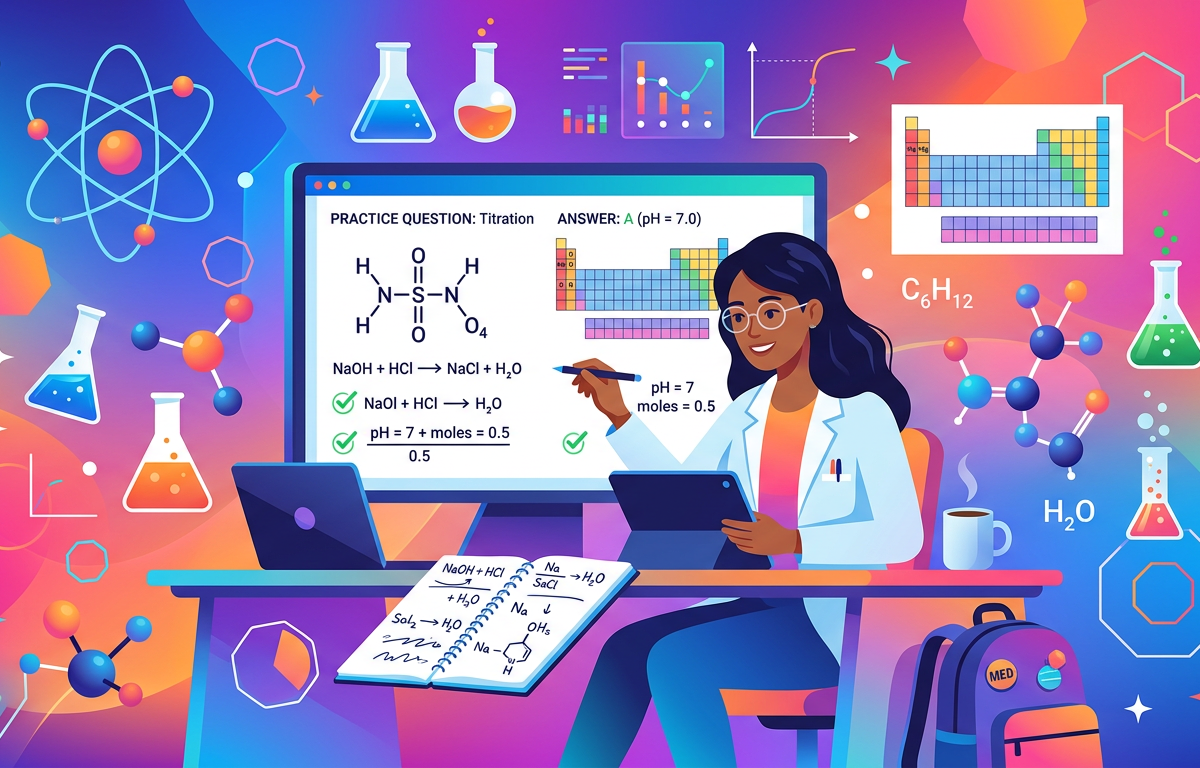
MCAT General Chemistry Practice Questions with Answers
Mastering MCAT General Chemistry requires a deep understanding of how physical laws govern chemical behavior, from the subatomic scale to macroscopic thermodynamic systems. This subject accounts for a significant portion of the Chemical and Physical Foundations of Biological Systems section, challenging students to apply concepts like stoichiometry, kinetics, and electrochemistry to biological contexts. To succeed, you must move beyond rote memorization and embrace active learning strategies. Using retrieval practice for medical students is one of the most effective ways to ensure these complex formulas and trends remain accessible during the high-pressure environment of the actual exam.
Concept Explanation
MCAT General Chemistry encompasses the study of matter, its properties, and the changes it undergoes, focusing specifically on the quantitative and qualitative laws that govern chemical reactions. At its core, the subject is divided into several high-yield areas: atomic structure, periodic trends, chemical bonding, stoichiometry, thermodynamics, kinetics, equilibrium, acids and bases, and electrochemistry. Understanding these concepts requires a grasp of how energy is exchanged during reactions and how the electronic structure of atoms dictates their reactivity. For instance, the periodic table serves as a roadmap for predicting atomic radius, ionization energy, and electronegativity. Furthermore, mastering the relationship between Gibbs Free Energy (), enthalpy (), and entropy () is essential for predicting reaction spontaneity, a recurring theme in both chemistry and biochemistry passages.
Solved Examples
Reviewing worked problems helps clarify the application of theoretical formulas to specific scenarios. Here are three examples demonstrating common MCAT-style calculations.
- Stoichiometry and Limiting Reagents: If 28 grams of Nitrogen gas () react with 9 grams of Hydrogen gas () to produce Ammonia (), which is the limiting reagent and how much ammonia is produced?
- Write the balanced equation:
- Calculate moles: Moles of . Moles of .
- Determine limiting reagent: 1 mole of requires 3 moles of . Since we have 4.5 moles of , is in excess and is the limiting reagent.
- Calculate product: 1 mole of produces 2 moles of . Mass of .
- Calculating pH of a Strong Base: What is the pH of a 0.01 M solution of ?
- Identify the species: is a strong base that dissociates completely into and .
- Find : .
- Calculate pOH: .
- Calculate pH: Since at 25°C, .
- Gibbs Free Energy: A reaction has an enthalpy change () of -100 kJ and an entropy change () of -200 J/K. Is the reaction spontaneous at 300 K?
- Convert units: .
- Use the Gibbs equation:
- Plug in values: .
- Solve: . Since , the reaction is spontaneous.
Practice Questions
Test your knowledge with these MCAT General Chemistry practice questions. Remember that using retrieval practice vs practice tests can help you identify which specific sub-topics require more review.
1. Which of the following elements has the highest first ionization energy?
A) Oxygen
B) Fluorine
C) Nitrogen
D) Carbon
2. A 2.0 L vessel contains 4.0 moles of an ideal gas at 300 K. What is the approximate pressure in atmospheres? (Use )
A) 25 atm
B) 49 atm
C) 74 atm
D) 98 atm
3. In the following redox reaction, which species is acting as the oxidizing agent?
A)
B)
C)
D)
Train like it’s test day.
Build confidence with timed MCAT practice sessions, performance analytics, and AI-powered study support.
Start Timed Practice4. For a first-order reaction, if the concentration of the reactant is doubled, what happens to the rate of the reaction?
A) It stays the same.
B) It doubles.
C) It quadruples.
D) It decreases by half.
5. Which of the following quantum numbers describes the shape of an orbital?
A) Principal quantum number (n)
B) Azimuthal quantum number (l)
C) Magnetic quantum number (ml)
D) Spin quantum number (ms)
6. Calculate the molarity of a solution prepared by dissolving 58.5 g of in enough water to make 500 mL of solution.
A) 0.5 M
B) 1.0 M
C) 2.0 M
D) 5.0 M
7. According to Le Chatelier’s Principle, what will happen to the equilibrium of the exothermic reaction if the temperature is increased?
A) Shift to the right (more product)
B) Shift to the left (more reactants)
C) No change in equilibrium position
D) The reaction will stop
8. What is the conjugate base of ?
A)
B)
C)
D)
Answers & Explanations
- Answer: B. Ionization energy increases across a period (left to right) and up a group. Fluorine is the furthest to the right and top among the choices, making it the most difficult to remove an electron from due to high effective nuclear charge.
- Answer: B. Use the ideal gas law . Rearranging for pressure: . Plugging in: . Simplifying: .
- Answer: B. An oxidizing agent is the species that gets reduced (gains electrons). goes from an oxidation state of +2 to 0, meaning it gained electrons.
- Answer: B. The rate law for a first-order reaction is . If is doubled, the rate becomes , so the rate doubles.
- Answer: B. The azimuthal (or angular momentum) quantum number (l) designates the subshell (s, p, d, f) and thus the shape of the orbital.
- Answer: C. Moles of . Volume = 0.5 L. Molarity = .
- Answer: B. In an exothermic reaction, heat is treated as a product. Increasing temperature is like adding product, which shifts the equilibrium toward the reactants (left) to consume the excess heat.
- Answer: B. A conjugate base is formed when an acid loses a proton (). Removing from leaves .
1. Which phase change is characterized by a decrease in entropy?
Frequently Asked Questions
What are the most high-yield topics in MCAT General Chemistry?
High-yield topics include stoichiometry, acid-base equilibrium (pH/pOH), thermodynamics (Gibbs Free Energy), and electrochemistry. Mastery of these areas is essential because they frequently appear in integrated passages alongside biology and physics concepts.
Do I need to memorize all the constants for the MCAT?
While you should know common constants like the Ideal Gas Constant () and Faraday’s Constant, the MCAT often provides specific values within the passage or question stem. It is more important to understand how to use them than to memorize every digit.
How is General Chemistry integrated into the MCAT?
General Chemistry is primarily found in the Chemical and Physical Foundations of Biological Systems section. It is often integrated with biochemistry, requiring students to apply chemical principles like kinetics or titration to biological molecules like enzymes and amino acids.
Can I use a calculator on the MCAT General Chemistry section?
No, calculators are not permitted on the MCAT. You must practice mental math, rounding, and scientific notation to quickly solve quantitative problems like molarity or equilibrium constant calculations.
What is the difference between a galvanic cell and an electrolytic cell?
A galvanic (voltaic) cell utilizes a spontaneous redox reaction to generate electrical energy, while an electrolytic cell uses electrical energy to drive a non-spontaneous reaction. This fundamental difference affects the signs of Gibbs Free Energy and cell potential.
How can I improve my speed in solving chemistry problems?
Improving speed requires consistent practice and the use of retrieval practice to solidify your understanding of formulas. Learning to quickly estimate calculations and identifying common distractors in multiple-choice options also saves valuable time.
Train like it’s test day.
Build confidence with timed MCAT practice sessions, performance analytics, and AI-powered study support.
Start Timed PracticeReviewed by
Michael Danquah, MS, PhD
Dr. Michael Danquah is a professor of pharmaceutical sciences and founder of several educational technology platforms focused on improving student learning and performance.
Enjoyed this article?
Share it with others who might find it helpful.
Related Articles

Medium MCAT General Chemistry Practice Questions
Medium MCAT General Chemistry Practice Questions
May 9, 2026

Easy MCAT General Chemistry Practice Questions
Easy MCAT General Chemistry Practice Questions
May 9, 2026
Hard MCAT Organic Chemistry Practice Questions
Hard MCAT Organic Chemistry Practice Questions
May 11, 2026
Medium MCAT Organic Chemistry Practice Questions
Medium MCAT Organic Chemistry Practice Questions
May 11, 2026
Easy MCAT Organic Chemistry Practice Questions
Easy MCAT Organic Chemistry Practice Questions
May 11, 2026

Easy MCAT Amino Acid Practice Questions
Easy MCAT Amino Acid Practice Questions
May 14, 2026
Easy MCAT Biochemistry Practice Questions
Easy MCAT Biochemistry Practice Questions
May 14, 2026
MCAT Citric Acid Practice Questions with Answers
MCAT Citric Acid Practice Questions with Answers
May 14, 2026