Easy MCAT Organic Chemistry Practice Questions
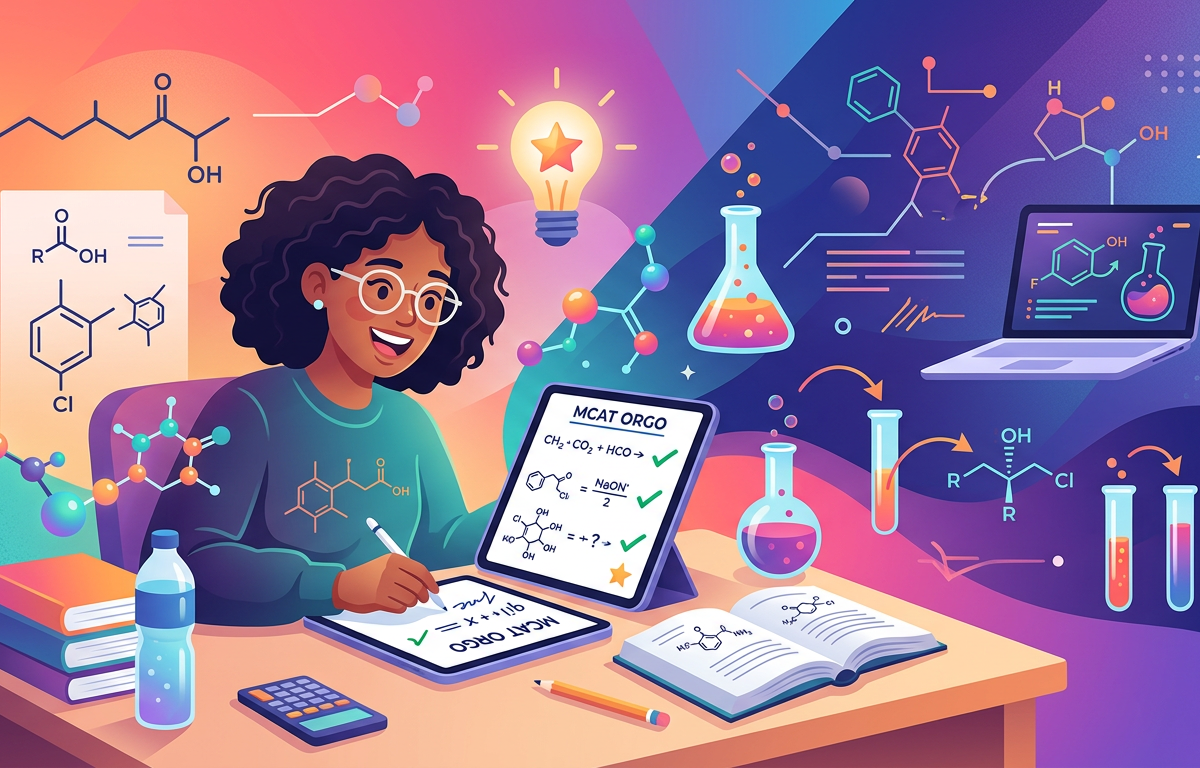
Easy MCAT Organic Chemistry Practice Questions
Mastering the basics of carbon-based molecules is essential for success on the Chemical and Physical Foundations of Biological Systems section of the MCAT. These Easy MCAT Organic Chemistry Practice Questions are designed to reinforce your understanding of foundational concepts like nomenclature, functional groups, and stereochemistry. By utilizing retrieval practice for medical students, you can move beyond passive reading and build the active recall necessary to tackle complex synthesis problems during the exam.
Concept Explanation
MCAT Organic Chemistry focuses on the structure, properties, and reactions of organic compounds, primarily emphasizing how these molecules behave in biological systems. Success in this subject requires a firm grasp of the periodic table, electronegativity, and molecular geometry. You must be able to identify functional groups such as alcohols, carboxylic acids, and amines, as these dictate a molecule's reactivity. According to the American Chemical Society, understanding the relationship between structure and function is the cornerstone of organic chemistry. To excel on the MCAT, you should focus on "high-yield" topics like nucleophilic substitution ( and ), carbonyl chemistry, and the physical properties of amino acids. Using evidence-based study methods like active testing can significantly improve your retention of these reaction mechanisms.
Solved Examples
Review these worked examples to understand the logic required for basic organic chemistry problems.
- Question: Identify the hybridization of the carbon atom in a molecule of methane ().
Solution:- Count the number of groups (atoms and lone pairs) attached to the central carbon.
- Carbon in methane is bonded to four hydrogen atoms and has zero lone pairs.
- Four electron domains correspond to hybridization.
- The geometry is tetrahedral with bond angles of .
- Question: Which functional group is characterized by a carbon-oxygen double bond () bonded to a hydroxyl group ()?
Solution:- The group is known as a carbonyl group.
- When a carbonyl is directly attached to an , the resulting group is .
- This functional group is a carboxylic acid.
- Question: Determine the R/S configuration of a chiral center where the priorities are: , , , and (pointing away).
Solution:- Trace a path from priority 1 to 2 to 3.
- The path moves in a clockwise direction.
- Since the lowest priority group () is in the back (dashed), the configuration is .
Practice Questions
Test your knowledge with these easy-level practice questions. If you find yourself struggling, consider reviewing our ultimate retrieval practice guide to improve your learning efficiency.
1. Which of the following functional groups contains a nitrogen atom bonded to two hydrogen atoms and a carbon scaffold?
2. In an reaction, how many steps are involved in the mechanism, and what happens to the stereochemistry of the chiral center?
3. Arrange the following in order of increasing boiling point: Ethane, Ethanol, Ethanoic acid.
Study smarter for the MCAT.
Turn practice into performance with AI-powered MCAT tools designed to help students retain more and score higher.
Start Learning Free4. What is the formal charge on the nitrogen atom in the ammonium ion ()?
5. Which type of isomerism describes molecules with the same molecular formula but different connectivity of atoms?
6. Identify the strongest intermolecular force present in a pure sample of acetone ().
7. A molecule has a specific rotation of . What is the specific rotation of its enantiomer?
8. Which of the following is a secondary alcohol: Methanol, Ethanol, 2-Propanol, or 2-Methyl-2-propanol?
Answers & Explanations
- Primary Amine: A primary amine () consists of a nitrogen atom bonded to one carbon group and two hydrogens.
- One step; Inversion: The mechanism is concerted, meaning bond-breaking and bond-making happen simultaneously. This leads to the "Walden Inversion" of stereochemistry.
- Ethane < Ethanol < Ethanoic acid: Ethane has only London dispersion forces. Ethanol has hydrogen bonding. Ethanoic acid (acetic acid) can form stable hydrogen-bonded dimers, giving it the highest boiling point.
- +1: Formal charge is calculated as . For Nitrogen: .
- Structural (Constitutional) Isomers: These isomers differ in the order in which atoms are attached to one another.
- Dipole-Dipole Interaction: Acetone is a polar molecule due to the carbonyl () group, but it lacks an bonded to , so it cannot hydrogen bond with itself.
- : Enantiomers rotate plane-polarized light by the same magnitude but in opposite directions.
- 2-Propanol: In 2-propanol (isopropanol), the hydroxyl group is attached to a carbon that is bonded to two other carbon atoms.
1. Which hybridization state corresponds to a trigonal planar molecular geometry?
Frequently Asked Questions
What is the most important functional group to know for the MCAT?
The carbonyl group is arguably the most important because it is central to the chemistry of aldehydes, ketones, carboxylic acids, and proteins. Understanding its electrophilic nature is key to predicting most organic reactions on the exam.
How do I distinguish between and reactions?
reactions occur in two steps via a carbocation intermediate and prefer tertiary substrates, while reactions are concerted one-step processes that prefer primary substrates. Solvent choice also matters, as polar protic solvents favor and polar aprotic solvents favor .
Do I need to memorize every organic chemistry reaction for the MCAT?
No, you should focus on understanding general reaction mechanisms and the behavior of nucleophiles and electrophiles. High-yield reactions include nucleophilic acyl substitution, esterification, and aldol condensations.
What are meso compounds?
Meso compounds are molecules that contain chiral centers but are achiral overall due to an internal plane of symmetry. They do not rotate plane-polarized light and are considered optically inactive.
Why is stereochemistry important in biological systems?
Biological receptors and enzymes are typically chiral, meaning they usually only interact with one specific enantiomer of a drug or substrate. This is why the 3D orientation of molecules is a major focus in Nature's chemical processes.
Study smarter for the MCAT.
Turn practice into performance with AI-powered MCAT tools designed to help students retain more and score higher.
Start Learning FreeReviewed by
Michael Danquah, MS, PhD
Dr. Michael Danquah is a professor of pharmaceutical sciences and founder of several educational technology platforms focused on improving student learning and performance.
Enjoyed this article?
Share it with others who might find it helpful.
Related Articles
Hard MCAT Organic Chemistry Practice Questions
Hard MCAT Organic Chemistry Practice Questions
May 11, 2026
Medium MCAT Organic Chemistry Practice Questions
Medium MCAT Organic Chemistry Practice Questions
May 11, 2026
Medium MCAT General Chemistry Practice Questions
Medium MCAT General Chemistry Practice Questions
May 9, 2026

Easy MCAT General Chemistry Practice Questions
Easy MCAT General Chemistry Practice Questions
May 9, 2026
MCAT General Chemistry Practice Questions with Answers
MCAT General Chemistry Practice Questions with Answers
May 9, 2026

Easy MCAT Amino Acid Practice Questions
Easy MCAT Amino Acid Practice Questions
May 14, 2026
Easy MCAT Biochemistry Practice Questions
Easy MCAT Biochemistry Practice Questions
May 14, 2026
MCAT Citric Acid Practice Questions with Answers
MCAT Citric Acid Practice Questions with Answers
May 14, 2026