The Ultimate Guide to Studying for Exams When Tired

The clock ticks past midnight. Your textbook is open, but your eyelids feel like they have weights attached. This frustrating, bleary-eyed state is a familiar battleground for students everywhere. The big question is not just how to stay awake, but how to study for exams when tired and actually make it productive. Pushing through exhaustion without a strategy is like trying to run a marathon with your shoes tied together; you’ll put in the effort, but won’t get far. The truth is, your brain operates under a specific set of biological rules. Understanding these rules is the first step to winning the war against fatigue. This guide breaks down the science of a tired mind and provides concrete, evidence-backed strategies to help you study smarter, not harder, even when you're running on fumes. We’ll cover everything from high-impact study techniques for a fatigued brain to building a fatigue-proof study plan for good.
First, Should You Even Study When You’re Exhausted?
Deciding whether to study or sleep when you're exhausted depends entirely on your level of fatigue; severe mental or physical exhaustion requires rest, while milder tiredness can be managed with strategic study sessions.
Forcing a completely depleted brain to absorb complex information is often a fruitless and frustrating exercise. The goal isn't just to keep your eyes open; it's to actually learn and retain information.
The Science of a Tired Brain: Why Learning Feels Impossible
When you're tired, you aren't just imagining the difficulty. Your brain's prefrontal cortex, the hub for executive functions like decision-making, critical thinking, and problem-solving, shows significantly reduced activity. This makes it harder to grasp new concepts or piece together complex arguments.
Worse yet, sleep deprivation wreaks havoc on your memory. During deep sleep, your brain consolidates memories, transferring information from short-term to long-term storage. According to the CDC, a lack of consistent, quality sleep impairs this process, which means that what you "learned" during a late-night cram session might vanish by morning. Sleep doesn't just rest your body; it actively reinforces learning and memory.
A Quick Test: When to Rest vs. When to Push Through
So how do you know when to call it a night? Use this simple self-assessment. If you are experiencing any of the following, shut the book and go to sleep:
You've read the same sentence or paragraph three or more times and still don't know what it says.
You find yourself physically unable to keep your eyes open or your head up.
You feel irritable, disoriented, or emotionally volatile.
These are signs of severe fatigue, and any "studying" you do will be counterproductive. However, if you simply feel a bit drained, unmotivated, or easily distracted, you're in a prime position to use strategic methods to make the next hour highly effective. Sometimes, the problem isn't total exhaustion but a simple struggle to get into the study zone.
How to Study for Exams When Tired: 5 High-Impact Strategies
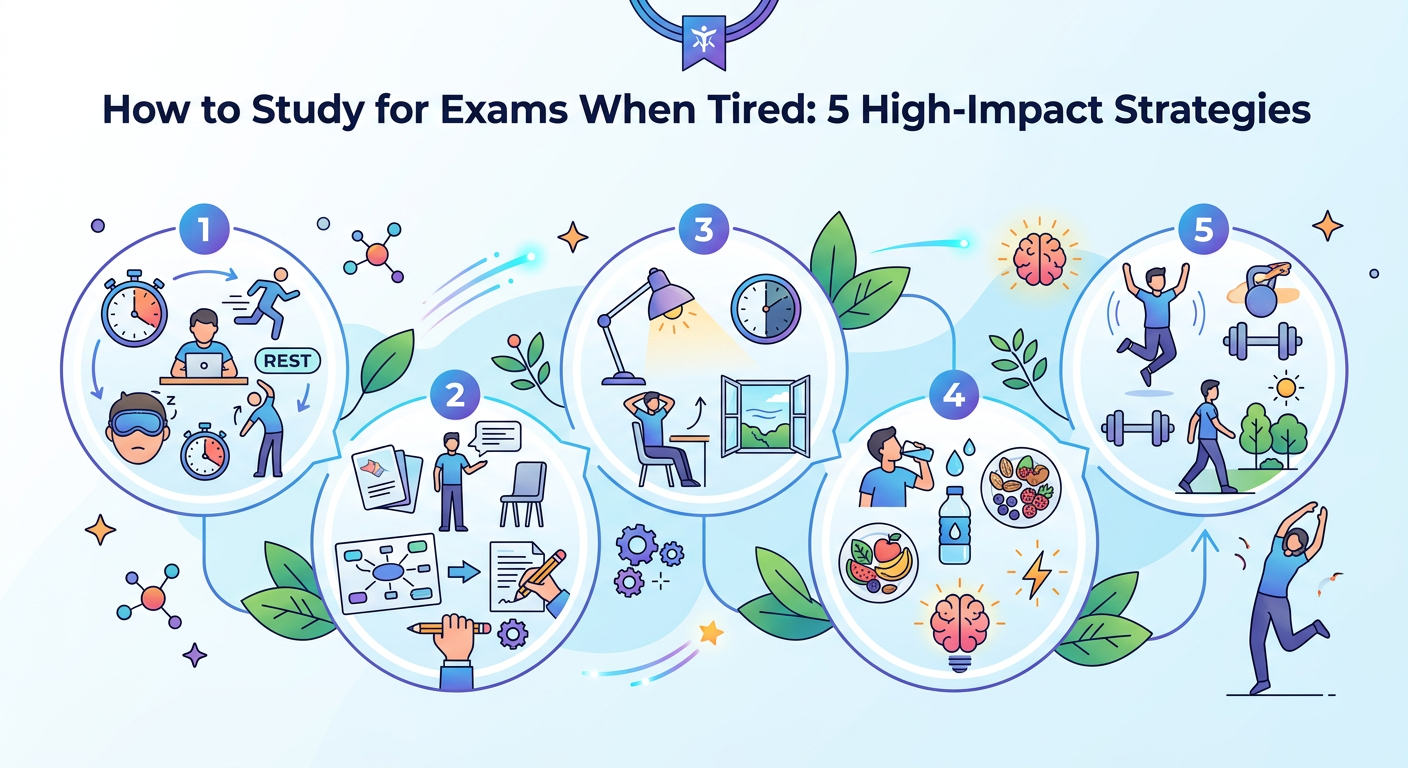
To study productively when you're tired, you must use methods that demand focus in short bursts and engage your brain actively rather than passively. Passive review won't work when your mind is already drifting. These five strategies are designed for maximum impact when energy is at a minimum.
The 25-Minute Power Sprint (Pomodoro Technique)
The Pomodoro Technique is your best friend when you lack energy. The concept is simple: set a timer for 25 minutes and dedicate that time to a single, focused task. When the timer goes off, you take a mandatory 5-minute break.
This method works because it breaks an overwhelming task ("study for the final") into a manageable micro-task ("work on this chapter for 25 minutes"). Anyone can do almost anything for just 25 minutes. During your 5-minute break, stand up, stretch, grab some water, and step away from your desk. After four "Pomodoros," take a longer break of 15-30 minutes.
Switch to Active Recall (Not Passive Review)
When you're tired, your brain defaults to the path of least resistance, which is often passively rereading your notes. This creates a dangerous "illusion of competence" where you mistake familiarity for mastery. The best way to study with no energy is to force your brain to work. That's the core of active recall.
Instead of reading, retrieve. Grab a blank sheet of paper and write down everything you remember about a topic. Use flashcards. Try to solve practice problems without looking at the solution first. If you're studying chemistry, for example, tackling some medium ICE table practice questions forces your brain to apply concepts, not just recognize them. These active recall techniques are far more effective for retaining information when tired.
Engage Multiple Senses to Stay Alert
Sitting still and staring at a page is a recipe for falling asleep. To combat this, get more of your body involved. Engaging multiple senses can help maintain alertness and improve memory encoding.
Try reading your notes aloud, which engages your auditory processing. Pace around your room while reciting key definitions. Rewrite your most important notes by hand. Watch a compelling YouTube video explaining the concept; the combination of visuals and audio can be more stimulating than text alone.
Struggling to Focus?
Our tools use science-backed methods to help you study smarter, even when you're tired.
Get Started FreeChange Your Environment to Trick Your Brain
Your brain forms powerful associations with your environment. If you consistently get drowsy at your desk, your brain starts to see that space as a place for sleep, not work. A simple change of scenery can act as a mental reset button.
If you're studying in your bedroom, move to the kitchen table. If you're at home, consider a short trip to a coffee shop or a quiet corner of the campus library. The novelty of the new environment, combined with the small physical effort of moving, can provide a surprising jolt of focus.
Prioritize Ruthlessly with the 80/20 Rule
The Pareto Principle, or the 80/20 rule, suggests that for many outcomes, roughly 80% of consequences come from 20% of the causes. Applied to studying, this means about 20% of the material will likely account for 80% of your exam grade. When you're tired, you don't have the energy to cover everything equally.
Identify that critical 20%. Look at past exams, listen for hints your professor dropped in lectures, or focus on the core concepts that everything else builds upon. By concentrating your limited energy on these high-yield topics, you ensure you're getting the most return on your investment of time and effort.
How to Boost Your Energy for a Quick Study Session
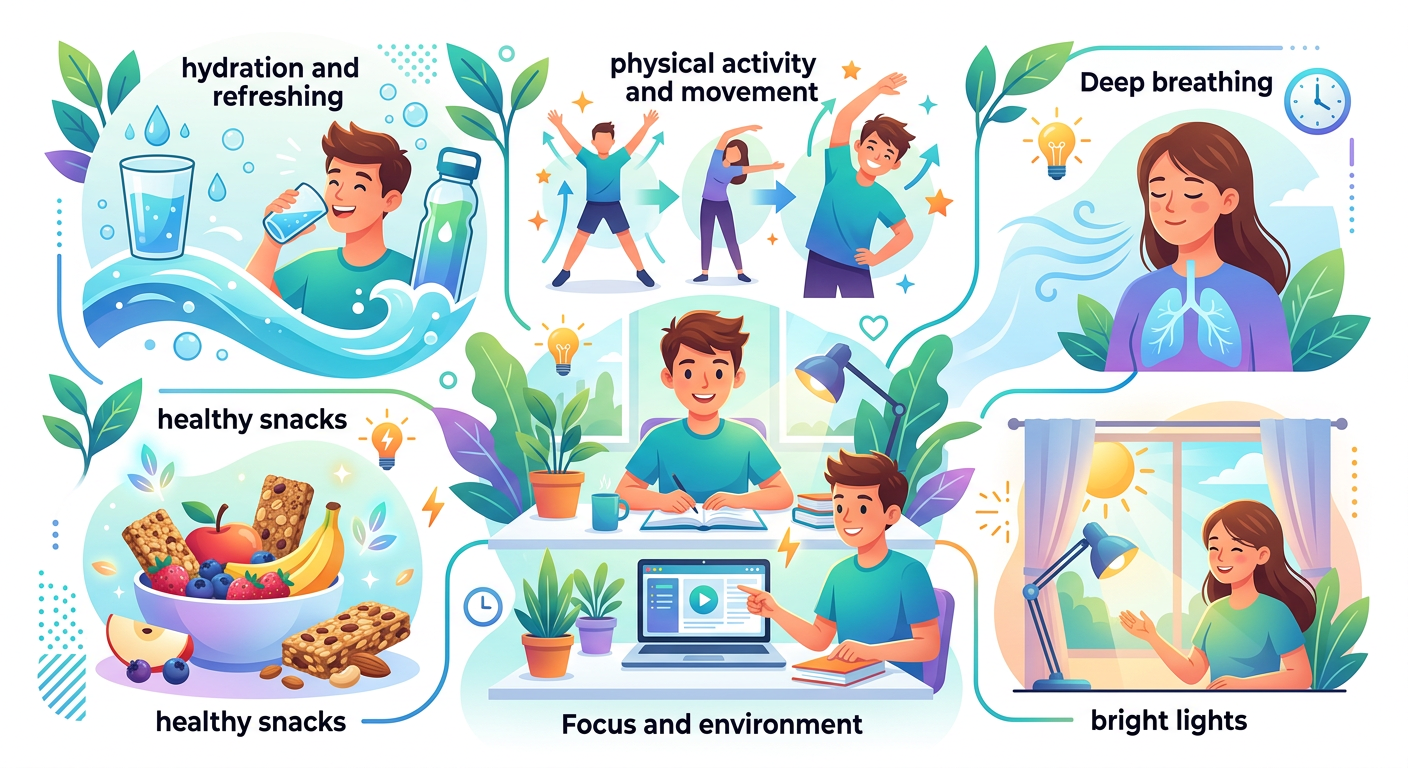
The most effective way to boost your energy for studying is with a strategic power nap, smart hydration and snacking choices, or a brief period of light physical activity. These methods provide a sustainable lift without the subsequent crash caused by sugar or excessive caffeine.
The Strategic Power Nap: 20 vs. 90 Minutes
If you have time, a nap can be one of the best study tips for tired students. But the length matters. The 20-minute power nap is ideal for a quick boost in alertness and concentration without causing grogginess. It stops you from entering the deeper stages of sleep, so you wake up refreshed.
A 90-minute nap, on the other hand, allows you to complete one full sleep cycle. This is incredibly beneficial for memory consolidation and can help you feel genuinely rested. Avoid naps between 30 and 60 minutes, as you're likely to wake up during deep sleep, which leads to sleep inertia—that groggy, disoriented feeling that's worse than being tired.
Hydration and Brain-Friendly Snacks
Dehydration is a major cause of fatigue and brain fog. Sometimes that feeling of exhaustion is simply your body crying out for water. Keep a water bottle on your desk and sip from it consistently.
When it comes to snacks, avoid the temptation of sugary candy or pastries. While they provide a quick spike in energy, the inevitable crash will leave you feeling worse. Instead, opt for snacks that offer sustained energy: a handful of almonds or walnuts, Greek yogurt, an apple with peanut butter, or some dark chocolate. These foods contain a mix of protein, healthy fats, and complex carbs that fuel your brain steadily.
The Surprising Benefit of a 10-Minute Walk or Stretch
When you feel your focus fading, вставай (get up). Even a 10-minute walk, whether it's around your home or outside, can work wonders. Light physical activity boosts blood flow to the brain, delivering a fresh supply of oxygen and nutrients.
This increased circulation enhances cognitive function and elevates your energy levels more sustainably than a cup of coffee. Simple stretches can also relieve muscle tension from sitting for too long, helping you feel more physically comfortable and mentally alert.
Common Traps to Avoid When Studying Tired
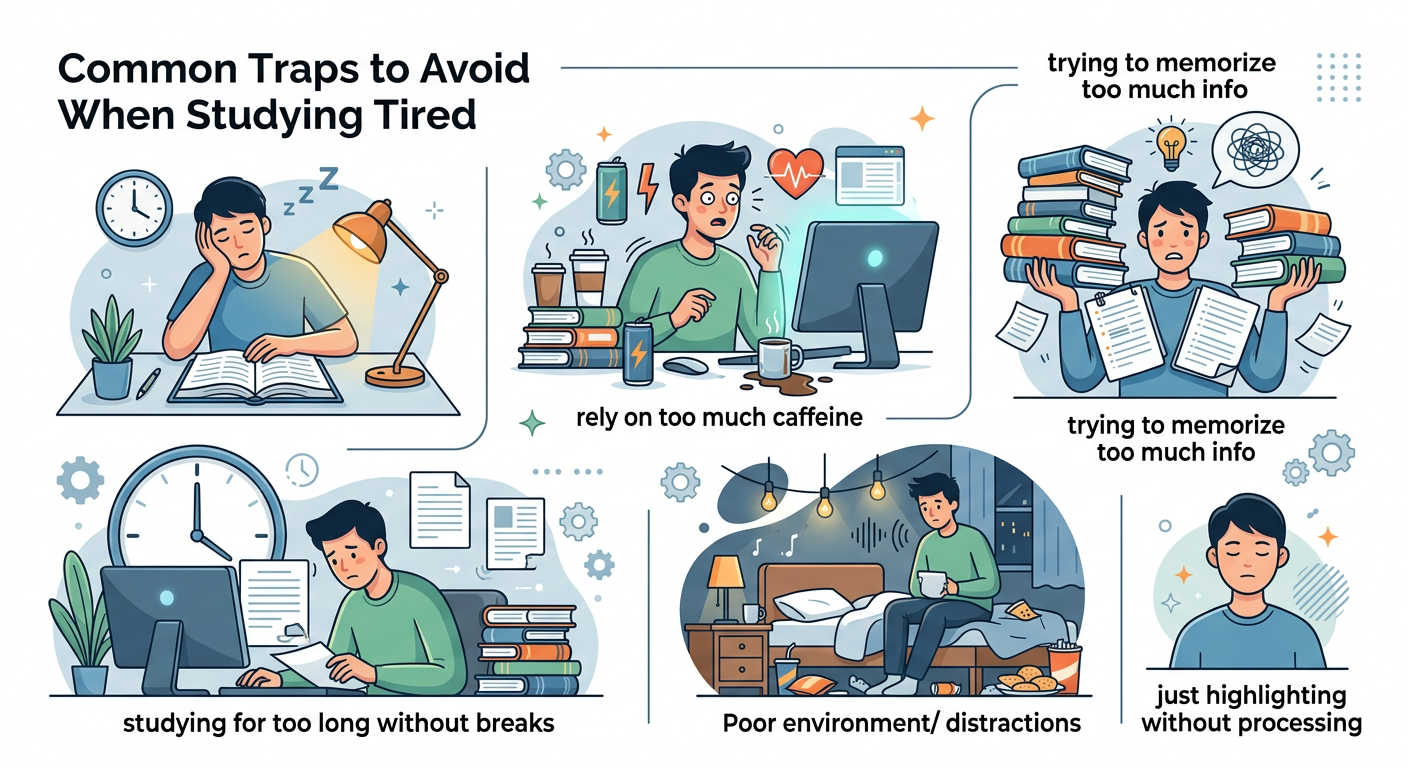
When studying while exhausted, you must avoid common traps like mindless rereading, pulling all-nighters, and relying on sugary snacks or energy drinks. These shortcuts feel productive in the moment but ultimately sabotage learning and well-being.
Why Mindlessly Rereading Your Notes Is Ineffective
As mentioned earlier, passively rereading notes is one of the least effective study habits, especially when tired. Your brain recognizes the material, and you mistake that feeling of familiarity for true understanding. This "illusion of competence" is a major pitfall because you only discover you don't know the material when you're sitting in the exam hall.
You can learn to master effective study techniques beyond rereading by focusing on methods that force you to test yourself. This is the only way to gauge what you've actually retained.
The All-Nighter: A Cost-Benefit Analysis
Is it productive to study when tired, especially all night long? The answer is an emphatic no. The romanticized idea of the all-nighter is a myth. While you might manage to cram some facts into your short-term memory, the lack of sleep severely impairs your ability to think critically and solve problems, the very skills needed on an exam.
Research consistently shows that after just one night of poor sleep, cognitive performance can decrease by as much as 40%. A few hours of sleep are infinitely more valuable than a few extra hours of low-quality, fatigue-ridden studying. You'll perform better on 6 hours of sleep and 4 hours of study than you will on 10 hours of study with no sleep.
The Downside of Sugary Snacks and Energy Drinks
Grabbing a can of an energy drink or a handful of candy seems like a quick fix for how to focus when tired and studying. The initial rush of sugar and caffeine can make you feel temporarily alert. However, this is always followed by a precipitous "crash."
Your blood sugar plummets, and your energy levels crater, leaving you more tired, irritable, and unfocused than you were before. This rollercoaster of highs and lows makes sustained concentration impossible. Stick to water and the brain-friendly snacks mentioned earlier for a stable and reliable source of energy.
Building a Fatigue-Proof Study Plan for the Future
The best way to handle studying while tired is to prevent extreme fatigue in the first place by adopting a sustainable study schedule, protecting your sleep, and managing stress proactively. This approach lets you work with your body's natural rhythms, not against them.
Creating a Sustainable Study Schedule (That You’ll Actually Follow)
Marathon cram sessions are a primary cause of student burnout and fatigue. The most effective learners use a strategy called distributed practice—studying in shorter, more frequent sessions spread out over several days or weeks. This method is far superior for long-term retention than cramming everything into one or two long nights.
Learning how to create a study plan is a skill that pays dividends. Break your studying down into manageable daily goals to avoid feeling overwhelmed and to ensure you're consistently making progress without sacrificing your well-being. Even if you only have a week, a 7-day study plan is better than no plan at all.
Prioritizing Sleep Hygiene During Exam Season
Treat sleep as an essential component of your study plan, not an obstacle to it. Good sleep hygiene is critical, especially during the high-stress period of exams. This means going to bed and waking up at roughly the same time every day, even on weekends.
Create a relaxing pre-sleep routine. Avoid screens (phones, laptops, TVs) for at least an hour before bed, as the blue light can interfere with melatonin production. Make sure your room is dark, quiet, and cool. Protecting your 7-9 hours of sleep is one of the most powerful academic performance enhancers available.
Techniques for Managing Exam Stress Proactively
Stress is a massive drain on your mental energy. When your body is in a constant state of "fight or flight," it burns through your energy reserves, leaving you feeling exhausted and unable to focus. Proactively managing this stress is key to preventing burnout.
Incorporate stress-reduction techniques into your daily routine. This could be 10 minutes of mindfulness meditation, regular exercise, or simply making time for a hobby you enjoy. If feelings of overwhelm are linked to a lack of drive, exploring strategies for how to study without motivation can help you build momentum and reduce anxiety.
Stop Studying Tired. Start Studying Smart.
Feeling overwhelmed? Bevinzey’s learning tools help you master topics faster with active recall, practice questions, and AI-powered feedback. Turn your fatigue into focus.
Get Started FreeFrequently Asked Questions
Is it better to sleep or study for an exam?
In almost all cases, it is better to sleep. Sleep is essential for memory consolidation and cognitive function. A well-rested brain will perform significantly better on an exam than a sleep-deprived brain that has crammed for a few extra hours.
How can I retain information when I am tired?
For retaining information when tired, use active learning techniques instead of passive ones. Instead of rereading notes, test yourself with flashcards, try to explain the concept out loud, or do practice problems. This forces your brain to engage and helps cement memories.
How many hours of sleep is best before an exam?
Aim for 7-9 hours of quality sleep, which is the standard recommendation for adults. This amount allows your brain to cycle through all sleep stages multiple times, which is crucial for memory, learning, and overall cognitive readiness.
Does pulling an all-nighter actually work?
No, pulling an all-nighter is highly counterproductive. The severe cognitive impairments from sleep deprivation—including poor reasoning, reduced problem-solving ability, and memory lapses—far outweigh any benefit from the extra hours of low-quality studying.
What should I eat when studying late at night to stay awake?
Opt for snacks that provide sustained energy, not a sugar rush. Good choices include nuts, seeds, Greek yogurt, fruit, or a small piece of dark chocolate. These foods combine protein, healthy fats, and complex carbs to fuel your brain without a subsequent crash.
How can I focus on studying when I have no energy?
When you have no energy, use the Pomodoro Technique: study in focused 25-minute intervals with 5-minute breaks. Also, changing your study environment, walking around, and engaging multiple senses (like reading aloud) can help reset your focus and provide a temporary energy boost.
Enjoyed this article?
Share it with others who might find it helpful.
Related Articles

How to Solve Molarity Problems: Step-by-Step Mastery
Learn how to solve molarity problems step-by-step with formulas, unit tips, and worked examples so you can calculate concentration with confidence.
Mar 26, 2026
Avoid These 7 Common Molarity Mistakes in Chemistry
Master chemistry calculations! Avoid common molarity mistakes with our expert guide on unit conversions, dilution errors, and proper lab techniques.
Mar 26, 2026

What Is Molarity? The Complete Guide to Molar Concentration
Master molarity with our complete guide. Learn the formula, step-by-step calculations, and the critical differences between molarity and molality.
Mar 26, 2026
Why Molarity Matters: Converting Mass to Moles for Lab Solutions
Master chemistry with our guide to the molarity formula. Learn how to calculate concentration with step-by-step examples, units, and practical lab tips.
Mar 26, 2026

Molarity vs Molality: The Essential Difference Explained
Master the difference between molarity vs molality. Learn the formulas, key differences, and when to use each in this comprehensive chemistry guide.
Mar 26, 2026