Why Exam Prep Paralyzes Your Brain and How to Regain Focus

When you stare at a pile of five different textbooks, your brain does not just see information; it sees a high-stakes choice that triggers decision fatigue. Most students believe they are lazy, but the reality is often analysis paralysis. If you spend twenty minutes debating whether to start with biology diagrams or history dates, you have already drained the limited cognitive energy required for actual encoding. This mental friction creates a physiological stress response that makes the act of sitting down feel physically repulsive.
This resistance is rarely about the difficulty of the material itself. Instead, it is a failure of emotional regulation. We avoid the desk because we are subconsciously avoiding the anxiety of potential failure or the boredom of rote memorization. By the time you finally open a book, your cortisol levels are high enough to impair your prefrontal cortex, the very part of the brain you need for logical thinking. Moving forward requires shifting from a mindset of total coverage to one of low-friction, specific entry points.
The Psychology Behind Why I Can’t Study for Exams
Your inability to study often stems from psychological barriers like decision fatigue, the anxiety-procrastination cycle, and a subconscious fear of failure. These mental hurdles are powerful because they operate just below the surface, making you feel lazy when you’re actually just overwhelmed.
Think about it: you have five different subjects, each with chapters of dense material. The sheer volume of work can trigger decision fatigue. When faced with too many choices, “Should I start with biology or history? Which chapter is most important?”, your brain defaults to the easiest option: doing nothing at all. This is classic analysis paralysis.
This inaction then fuels a vicious cycle. Procrastination isn't just "putting things off"; it's an emotional regulation problem. As Dr. Tim Pychyl, a leading researcher on the topic, explains, we procrastinate to avoid negative feelings associated with a task, like boredom or anxiety. This provides temporary relief but ultimately creates more stress and guilt, making the task even more daunting the next time you face it. This is how to stop procrastinating: by addressing the emotion, not just the behavior.
Finally, a deeply ingrained fear of failure can sabotage your efforts. If you believe you might not get the top grade, avoiding studying altogether provides a convenient excuse. “I would have done well if I had studied,” your brain rationalizes. It’s a self-preservation tactic that protects your ego but torpedoes your grades.
Is Your Environment Working Against You?
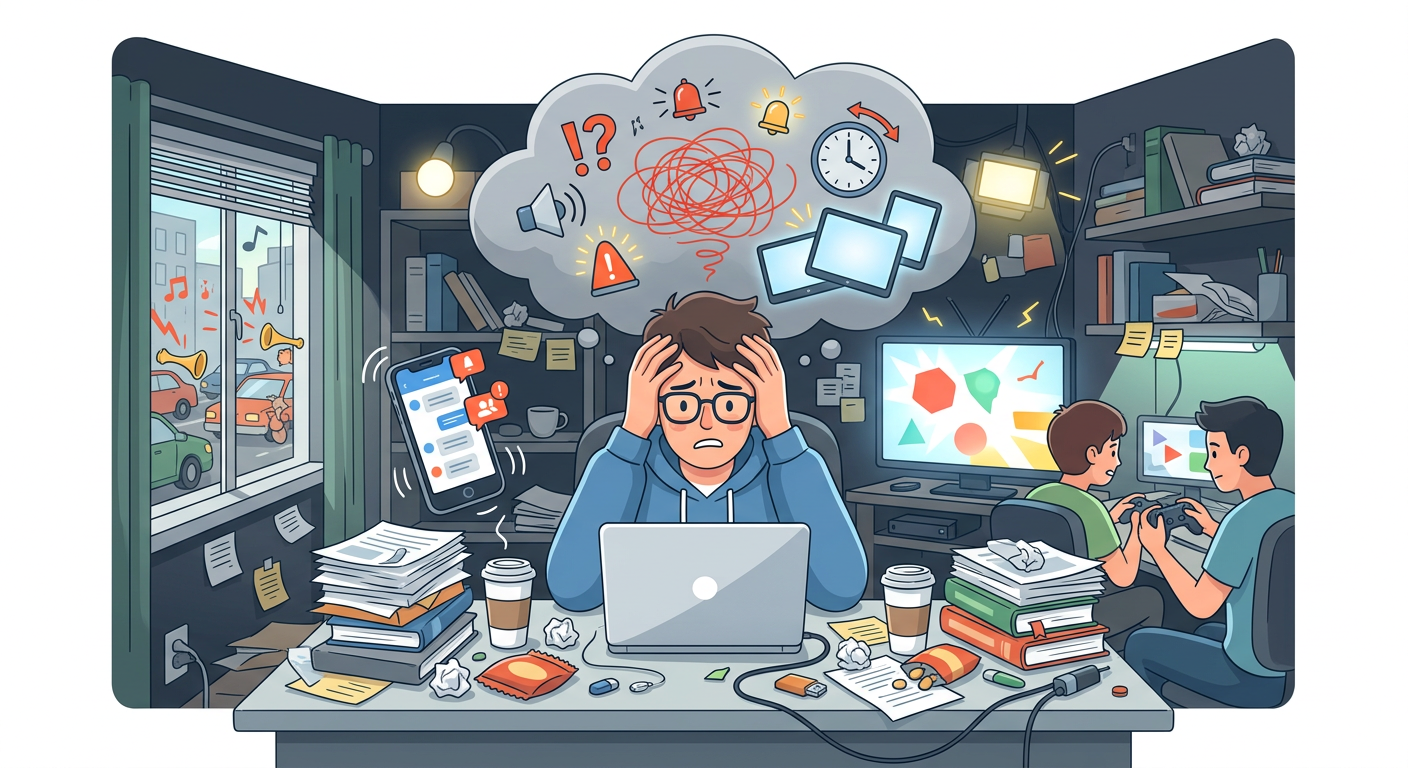
Your study environment can sabotage your efforts through digital distractions, a non-functional workspace, and social pressures that drain your mental energy. Even with the best intentions, a bad setup is like trying to swim upstream.
The most obvious culprit is the digital distraction black hole. Your smartphone, with its endless stream of notifications and social media updates, is designed to capture your attention. Every buzz or ping pulls you out of deep focus, and research shows it can take over 23 minutes to fully regain concentration after an interruption. Your brain isn't multitasking; it's rapidly switching contexts, which is exhausting and inefficient.
Then there’s the myth of the "perfect" study space. You don’t need a soundproof-chamber-level silent library. What you need is a functional space. This means having good lighting, a comfortable chair, and all your materials—pens, paper, textbooks—within arm's reach. The goal is to reduce friction so that starting is as easy as possible.
Don't forget the impact of social and family pressures. Constant interruptions from well-meaning family members or the feeling that you’re missing out on social events can deplete the willpower you need for studying. Setting clear boundaries, like telling your family, "I'm studying from 7 to 9 PM, please don't interrupt me unless it's an emergency," is not rude; it's essential for success.
When Your Mind and Body Refuse to Cooperate
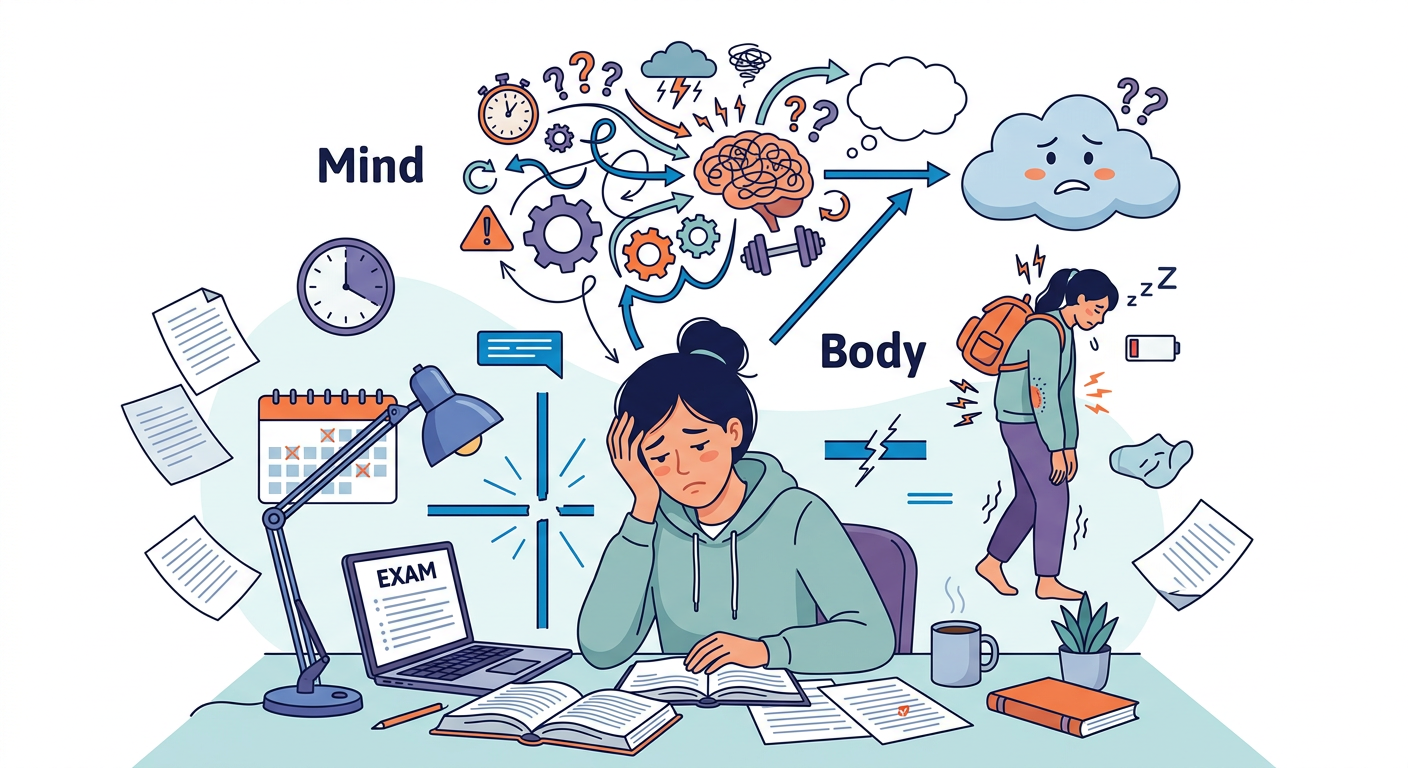
Your physical and mental state, including exam anxiety, study burnout, and poor self-care, directly impacts your brain's ability to focus and learn. You simply cannot force a tired brain and a stressed body to perform at their peak.
When you feel that intense exam anxiety, your body enters a "fight or flight" mode. It releases stress hormones like cortisol and adrenaline, which are great for escaping a predator but terrible for learning. The Mayo Clinic explains that this response can interfere with the brain's ability to retrieve long-term memories and encode new ones. You physically can’t think clearly when you're in a state of high alert.
Prolonged stress can lead to the next obstacle: academic burnout. This is more than just feeling tired; it’s a state of emotional, physical, and mental exhaustion. The key signs include deep cynicism about your schoolwork, feeling drained all the time, and a sense of ineffectiveness no matter how hard you work. If this sounds familiar, you might not just lack motivation; you might be completely out of fuel.
Underpinning all of this is your physical health. Sleep, diet, and movement are не-negotiable for cognitive performance. During sleep, your brain consolidates memories, transferring information from short-term to long-term storage. Without 7-9 hours of quality sleep, that process is severely impaired. Similarly, a diet high in processed foods and sugar leads to energy crashes that destroy focus, while even a 20-minute walk can boost brain function and mood.
Actionable Strategies to Start Studying Right Now
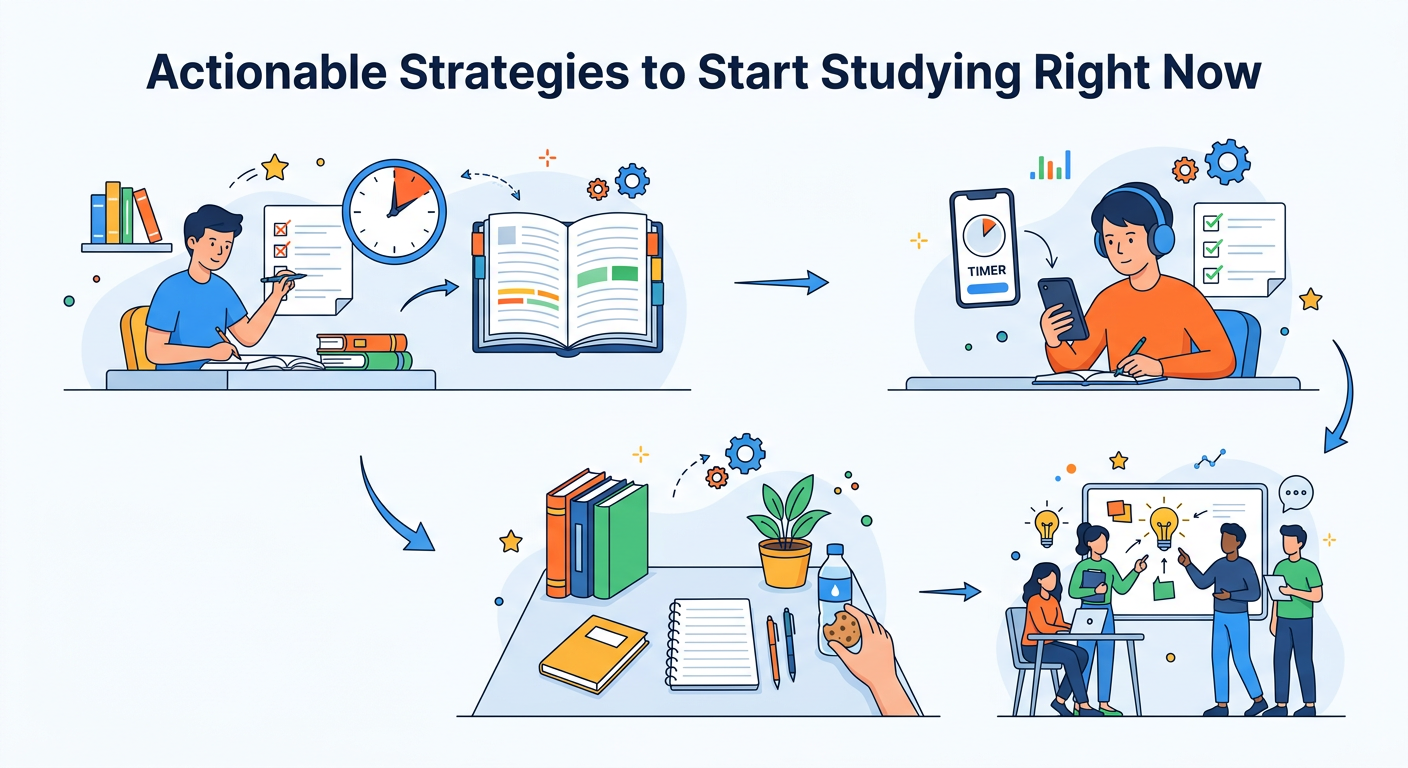
You can break through study paralysis immediately by using simple psychological tricks like the 2-Minute Rule, the Pomodoro Technique, and switching to active recall methods. The goal is to build momentum with a quick win.
First, try the 2-Minute Rule. The hardest part of any task is starting. So, make the task ridiculously small. Instead of "study for the history final," your goal becomes "open the textbook and read for two minutes." Anyone can do that. Often, once you start, you'll find it easy to keep going.
Next, use the Pomodoro Technique to build focus. Set a timer for 25 minutes and commit to working on a single task for that duration. When the timer goes off, take a 5-minute break. This method is effective because it makes a large, intimidating study session feel finite and manageable. It also gamifies the process, making it easier to maintain concentration.
Most importantly, change how you study. Many students default to passive review, like re-reading notes or textbooks. This is incredibly boring and ineffective. Instead, you need to learn how to study for exams using active recall. This means actively retrieving information from your brain. Methods include:
Making and using flashcards.
Answering practice questions (e.g., trying some hard ICE table practice questions if you're in a chemistry class).
Trying to explain a concept out loud to an imaginary person.
These evidence-based study methods are more engaging and far more effective at building strong memories, which helps combat the feeling of no motivation to study.
Building a System to Overcome Why I Can’t Study for Exams
To prevent future study paralysis, you need to build a sustainable system that includes a realistic schedule, clear goals, scheduled breaks, and a willingness to seek help. Short-term tricks are great for today, but a solid system is what ensures long-term success.
It starts with a plan. Don’t just write "study" in your calendar; get specific. Learning how to create a study plan for exams is essential. Break down each subject into small, concrete tasks and assign them to specific days. A good weekly study plan provides structure and eliminates the decision fatigue that leads to paralysis.
For each study session, set SMART goals: Specific, Measurable, Achievable, Relevant, and Time-bound. Instead of a vague goal like "get better at math," a SMART goal would be: "Complete 15 practice problems from Chapter 4 on quadratic equations with 80% accuracy in the next 60 minutes." This clarity gives you a defined finish line and a clear sense of accomplishment.
Finally, build breaks and rewards directly into your schedule. They are not a sign of weakness; they are a strategic defense against study burnout. After completing a tough chapter, allow yourself to watch an episode of your favorite show or go for a walk. This reinforces positive habits and gives your brain the downtime it needs to recharge.
If you've tried all of this and still feel stuck, it may be time to ask for help. Talk to your professor during office hours, form a study group with classmates, or consider seeing a tutor. If the core issue feels more like overwhelming anxiety or depression, reaching out to your school's counseling or mental health services is a sign of immense strength.
Turn 'Can't Study' into 'Can Ace This'
Feeling overwhelmed is the first sign you need a better system. Bevinzey's tools help you create smart study plans, generate practice questions, and use proven methods to conquer your exams.
Get Started FreeFrequently Asked Questions
Is it normal that I can't bring myself to study for an exam?
Yes, it's extremely common. Many students experience "study paralysis" due to factors like stress, anxiety, burnout, or feeling overwhelmed. It is not a reflection of your intelligence or work ethic but rather a signal that your current approach or circumstances aren't working.
How can I force myself to study when I have zero motivation?
Don't focus on "forcing" yourself. Instead, trick your brain into starting with the 2-Minute Rule: commit to studying for just two minutes. This lowers the mental barrier. Also, switch from passive re-reading to active study methods like flashcards or practice tests, which are more engaging and can create momentum.
Can anxiety really make it impossible to study?
Absolutely. High levels of anxiety trigger your body's "fight or flight" response, releasing cortisol and adrenaline. These hormones physically impair cognitive functions like memory recall and concentration, making it feel genuinely impossible to absorb information.
What should I do if I've procrastinated until the last minute?
First, forgive yourself for procrastinating to reduce anxiety. Then, triage the material: identify the most important topics that will likely appear on the exam. Focus your limited time on understanding those core concepts rather than trying to learn everything superficially. Use active study techniques like explaining concepts aloud to make them stick faster.
How do I get the motivation to study for a boring subject?
Find a way to make it active and relevant. Challenge yourself to create a one-page summary, turn the material into a game with a friend, or find a documentary about the subject to spark your interest. Connecting the material to a real-world application or a personal interest can also boost engagement.
Why do I lose focus so easily when I try to study?
Losing focus can be caused by digital distractions (like your phone), physical discomfort, an unclear plan, or mental fatigue. To improve focus, eliminate distractions by putting your phone away, use the Pomodoro Technique (25 minutes on, 5 off) to work in short bursts, and ensure you have a clear, specific goal for each study session.
Enjoyed this article?
Share it with others who might find it helpful.
Related Articles

How to Solve Molarity Problems: Step-by-Step Mastery
Learn how to solve molarity problems step-by-step with formulas, unit tips, and worked examples so you can calculate concentration with confidence.
Mar 26, 2026
Avoid These 7 Common Molarity Mistakes in Chemistry
Master chemistry calculations! Avoid common molarity mistakes with our expert guide on unit conversions, dilution errors, and proper lab techniques.
Mar 26, 2026

What Is Molarity? The Complete Guide to Molar Concentration
Master molarity with our complete guide. Learn the formula, step-by-step calculations, and the critical differences between molarity and molality.
Mar 26, 2026
Why Molarity Matters: Converting Mass to Moles for Lab Solutions
Master chemistry with our guide to the molarity formula. Learn how to calculate concentration with step-by-step examples, units, and practical lab tips.
Mar 26, 2026

Molarity vs Molality: The Essential Difference Explained
Master the difference between molarity vs molality. Learn the formulas, key differences, and when to use each in this comprehensive chemistry guide.
Mar 26, 2026