Medium ICE Table Practice Questions
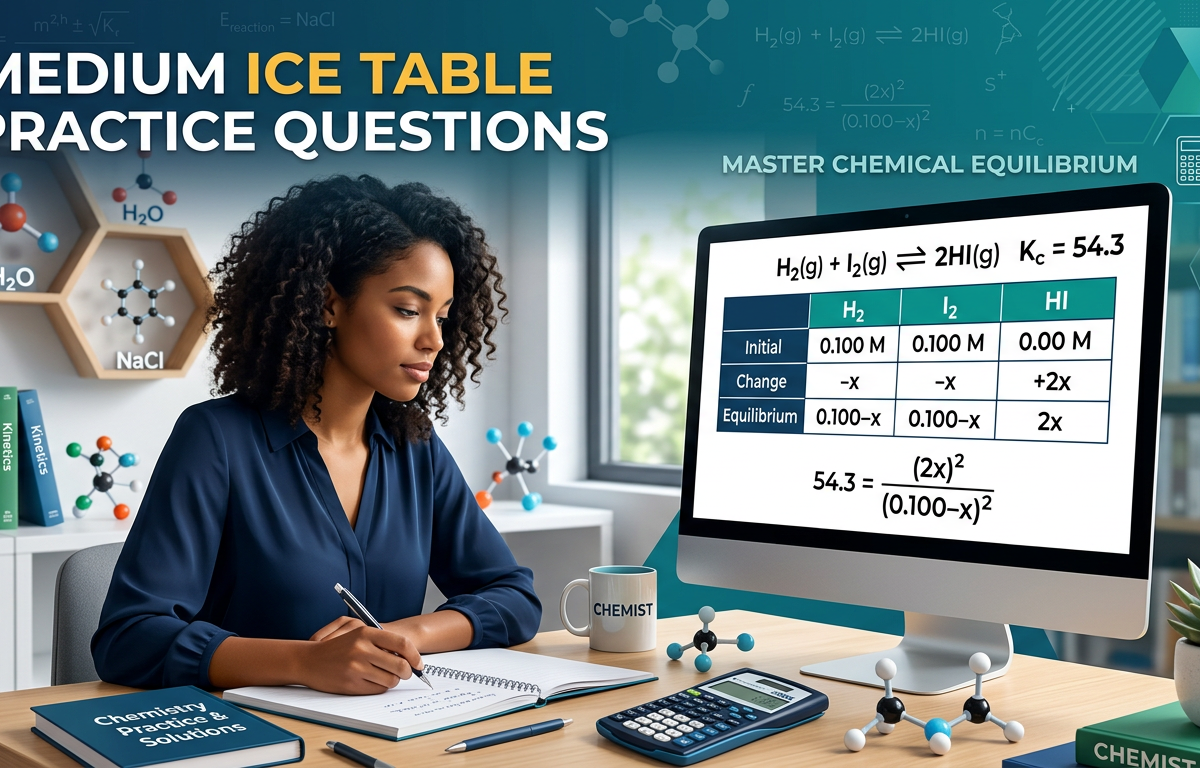
Concept Explanation
An ICE table is a systematic bookkeeping method used in chemistry to calculate the changing concentrations of reactants and products in a chemical reaction as it reaches equilibrium. The acronym ICE stands for Initial concentration, Change in concentration, and Equilibrium concentration. This tool is essential for solving problems involving the equilibrium constant ( or ) when the system is not yet at a steady state. By setting up an ICE table, you can relate the stoichiometry of the balanced equation to the unknown changes in molarity, typically represented by the variable '$x$'.
To master this concept, you must first ensure your chemical equation is balanced. The \"Change\" row is dictated by the stoichiometric coefficients; for example, if a reactant has a coefficient of 2, its change is $-2x$. This method is frequently used in Ka and Kb calculations to find the pH of weak acids and bases. According to Wikipedia's guide on equilibrium, the ICE table simplifies complex algebraic relationships into a manageable grid. It is particularly useful when the equilibrium constant is small enough to allow for approximations, or when a quadratic formula is required for more precise results.
Solved Examples
Below are three worked examples demonstrating how to apply the ICE method to gaseous and aqueous equilibria.
Example 1: Finding Equilibrium Concentrations
For the reaction , the is 54.3 at 430\u00b0C. If you start with 0.500 M of and 0.500 M of , what are the equilibrium concentrations?Set up the ICE table. Initial: .
Change: .
Equilibrium: .
Substitute into expression: $54.3 = (2x)^2 / (0.500 - x)^2$.
Take the square root of both sides: $7.37 = 2x / (0.500 - x)$.
Solve for $x$: $3.685 - 7.37x = 2x \u2192 9.37x = 3.685 \u2192 x = 0.393$ M.
Final concentrations: M, M, M.
Example 2: Calculating Kc from Equilibrium Molarity
A 1.00 L flask is filled with 2.00 mol of $NOCl$. At equilibrium, 0.66 mol of $NO$ is present. $2NOCl(g) \u21cc 2NO(g) + Cl_2(g)$. Find .Initial: .
Change: Since $[NO]$ at equilibrium is 0.66, the change for $NO$ is $+0.66$. Stoichiometry says $NOCl$ change is $-0.66$ and change is $+0.33$.
Equilibrium: ; ; .
.
Example 3: Weak Acid Dissociation
Calculate the concentration of in a 0.10 M solution of acetic acid ().Equation: .
Initial: . Change: $-x, +x, +x$.
(assuming $x$ is small).
M.
Practice Questions
Test your skills with these medium-level ICE table practice questions. You may need a calculator and knowledge of the quadratic formula for some problems.
The reaction has . If 1.0 mol of each reactant is placed in a 1.0 L container, calculate the equilibrium concentration of .
For the dissociation of phosphorus pentachloride, , . If the initial concentration of is 0.200 M, what is the equilibrium concentration of ?
In the reaction , at 2000 K. If the initial concentrations are M and M, find the concentration of $NO$ at equilibrium.
Start Learning Smarter Today
Join thousands of students using AI-powered study tools to achieve better results.
Get Started Free
Start Learning Smarter Today
Join thousands of students using AI-powered study tools to achieve better results.
Get Started FreeA solution of 0.20 M nitrous acid () has a . Use an ICE table to find the equilibrium concentration of .
For the reaction $2A(g) \u21cc B(g) + C(g)$, . If the initial concentration of $A$ is 0.60 M, what are the equilibrium concentrations of $B$ and $C$?
A 2.0 L flask contains 1.0 mol of and 2.0 mol of at a temperature where . Calculate the molarity of $HI$ at equilibrium.
Consider the reaction with . If the starting concentration of is 0.125 M, find the percent dissociation.
A mixture of 0.500 mol and 0.500 mol is placed in a 1.00 L flask. , . What is the equilibrium concentration of ?
Answers & Explanations
Answer: 0.67 M.
Setup: . Taking the square root: . Solving for $x$: . Since , the answer is 0.67 M.Answer: 0.073 M.
Setup: $0.042 = x^2 / (0.200 - x)$. This requires the quadratic formula: . Using , we find .Answer: 0.11 M.
Setup: $0.10 = (2x)^2 / (0.40 - x)^2$. Square root: $0.316 = 2x / (0.40 - x)$. $0.1264 - 0.316x = 2x \u2192 2.316x = 0.1264 \u2192 x = 0.0546$. Concentration of M.Answer: 0.0093 M.
Setup: . Using the approximation $0.20 - x \u2248 0.20$ gives . However, since $x$ is more than 5% of 0.20, use the quadratic formula to get $0.0093$ M. For more on this, see our pH calculation guide.Answer: M.
Setup: $25 = x \u00b7 x / (0.60 - 2x)^2$. Square root: $5 = x / (0.60 - 2x)$. $3.0 - 10x = x \u2192 11x = 3.0 \u2192 x = 0.273$.Answer: 0.932 M.
Initial concentrations: . $50.5 = (2x)^2 / (0.50-x)(1.0-x)$. This leads to a quadratic equation: $46.5x^2 - 75.75x + 25.25 = 0$. Solving for $x$ gives . M.Answer: 50.4%.
Setup: $0.078 = x^2 / (0.125 - x)$. Quadratic: . Percent dissociation = .Answer: $1.15 \u00d7 10^{-10}$ M.
Since is massive, the reaction goes almost to completion. Assume all $0.500$ M of and react to form $1.00$ M $HBr$. Then use a reverse ICE table or expression: $1.9 \u00d7 10^{19} = (1.00)^2 / x^2$. . Since (depending on setup) or simply $x$ if solving for remaining reactant, the value is extremely small.
1. What does the 'E' in ICE table stand for?
Frequently Asked Questions
What is the most common mistake when setting up an ICE table?
The most frequent error is forgetting to include stoichiometric coefficients in the \"Change\" row, which leads to incorrect algebraic expressions and wrong final values. Always multiply the variable $x$ by the coefficient from the balanced chemical equation.
Can I use moles instead of molarity in an ICE table?
You can use moles only if the total volume of the container is 1.0 L; otherwise, you must use molarity (mol/L) or partial pressures (). Using moles in a volume other than 1 L will result in an incorrect equilibrium constant calculation.
How do I know if I need the quadratic formula?
You need the quadratic formula when the equilibrium constant $K$ is relatively large compared to the initial concentration, making the \"$x$ is small\" approximation invalid. Generally, if $x$ is more than 5% of the initial concentration, the approximation is not acceptable.
Does an ICE table work for reactions that go to completion?
ICE tables are designed for reversible reactions that reach equilibrium, but they can be adapted for limiting reactant problems by assuming the change $x$ equals the entire initial concentration of the limiting species. For more practice on energy in reactions, check out enthalpy change practice questions.
What is the difference between $Q$ and $K$ in the context of ICE tables?
$Q$ is the reaction quotient calculated using initial or non-equilibrium concentrations, while $K$ is the constant at equilibrium. Comparing $Q$ to $K$ tells you which direction the reaction will shift (the sign of $x$ in the ICE table).
Where can I find more advanced equilibrium resources?
Higher-level chemistry students often refer to LibreTexts Chemistry or Khan Academy for in-depth tutorials on Le Chatelier's principle and complex equilibrium systems.
Start Learning Smarter Today
Join thousands of students using AI-powered study tools to achieve better results.
Get Started FreeEnjoyed this article?
Share it with others who might find it helpful.
Related Articles
Hard Le Chatelier’s Principle Practice Questions
Master Hard Le Chatelier’s Principle Practice Questions with our comprehensive guide featuring solved examples, practice problems, and detailed explanations.
Mar 30, 2026
Hard Reaction Quotient (Q) Practice Questions
Hard Reaction Quotient (Q) Practice Questions
Mar 30, 2026
Grams to Moles Practice Questions with Answers
Master grams to moles conversions with our comprehensive guide. Includes step-by-step examples, practice questions, and detailed answers for chemistry students.
Mar 26, 2026
Avogadro’s Number Practice Questions with Answers
Master the mole concept with our Avogadro’s Number practice questions. Includes step-by-step solved examples, a quick quiz, and detailed explanations.
Mar 26, 2026
Empirical Formulas: Solving Ratios from Mass and Percent Data
Master empirical formula calculations with 10 practice questions, worked answers, and a free step-by-step calculator for mass, percentage, and combustion problems.
Mar 26, 2026