How to Study Effectively for Exams: 16 Proven Strategies

Understanding the Science of Learning: How Your Brain Retains Information
Learning how to study effectively for exams requires shifting from an intuitive approach to a scientific one. Most students rely on "low-utility" methods like highlighting and re-reading, which create an illusion of competence without actually building long-term memory. According to American Psychological Association research, these passive methods fail because they don't challenge the brain to retrieve information.
The "Forgetting Curve," pioneered by Hermann Ebbinghaus, illustrates that we lose roughly 70% of new information within 24 hours if we don't actively review it. This is why cramming is fundamentally flawed; it relies on short-term "working memory" which has a limited capacity and evaporates under the stress of an exam hall. To counter this, you must engage in neuroplasticity, the process where the brain physically rewires itself through repeated, effortful retrieval.
Sleep plays the most underrated role in this biological process. During the rapid-eye-movement (REM) and slow-wave sleep cycles, your hippocampus "replays" the day's learning, moving data into the long-term storage of the neocortex. If you skip sleep to study more, you are essentially pouring water into a bucket full of holes. For those technical subjects where precision is everything, understanding the molarity formula explained requires this consolidated neural pathway to ensure you don't confuse volume with mass under pressure.
Core Evidence-Based Study Strategies for Maximum Retention
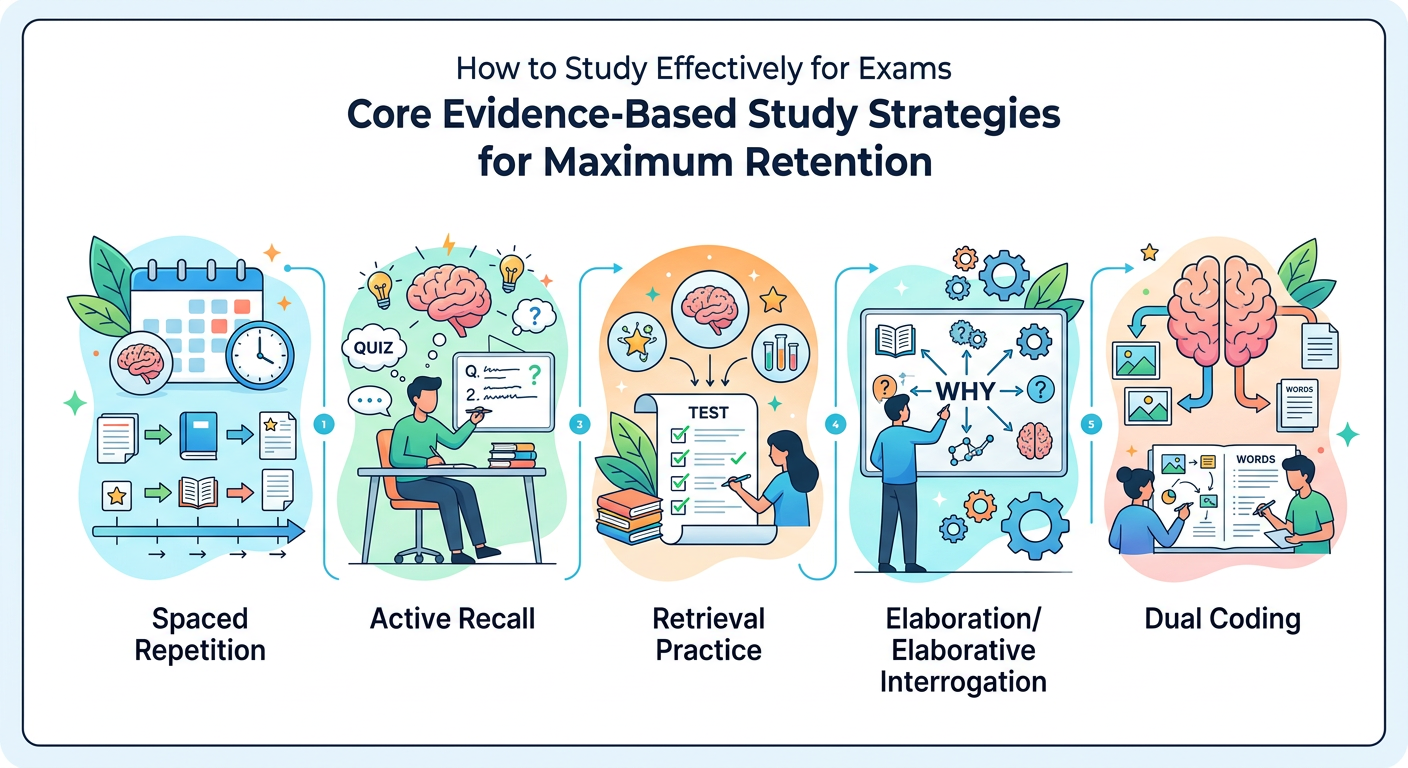
To master how to study effectively for exams, you must prioritize active recall and spaced repetition over passive review. These techniques force your brain to work harder, which signals to your neurons that the information is high priority. Think of your memory as a muscle; it only grows when it meets resistance.
Active Recall: Testing Yourself into Success
Active recall involves closing your book and forcing yourself to state a concept or solve a problem from scratch. It is the single most effective way to strengthen neural connections. Instead of reading a chapter on chemistry, try jumping straight into stoichiometry practice questions to see exactly where your knowledge breaks down. This "desirable difficulty" creates a mental map that is far more durable than simply looking at a solution key.
Spaced Repetition: Beating the Memory Decay
Spaced repetition involves reviewing material at increasing intervals (1 day, 3 days, 1 week, 1 month) to flatten the forgetting curve. Tools like Anki, AIflashcard.net or digital flashcards automate this, but you can also use a simple "Leitner System" with physical boxes. This method ensures you spend less time on what you already know and more on difficult concepts, such as tackling hard molarity practice questions that usually trip students up.
The Feynman Technique: Teaching to Learn
Named after physicist Richard Feynman, this technique requires you to explain a complex topic in simple terms, as if you were teaching a ten-year-old. If you cannot explain the difference between molarity and molality without using jargon, you don't truly understand it. If you find yourself stuck, check out this molarity vs molality difference guide to simplify the concept before trying to teach it back to yourself.
Interleaving: Mixing Subjects for Better Problem Solving
Interleaving is the practice of mixing different topics or types of problems within a single study session. While "blocked practice" (doing 50 identical problems) feels easier, it doesn't teach your brain how to choose the right strategy. By alternating between grams to moles practice questions and dilution practice questions, you train your mind to identify the specific nuances of each problem type, which is exactly what happens on a real exam.
Optimizing Your Study Environment and Focus
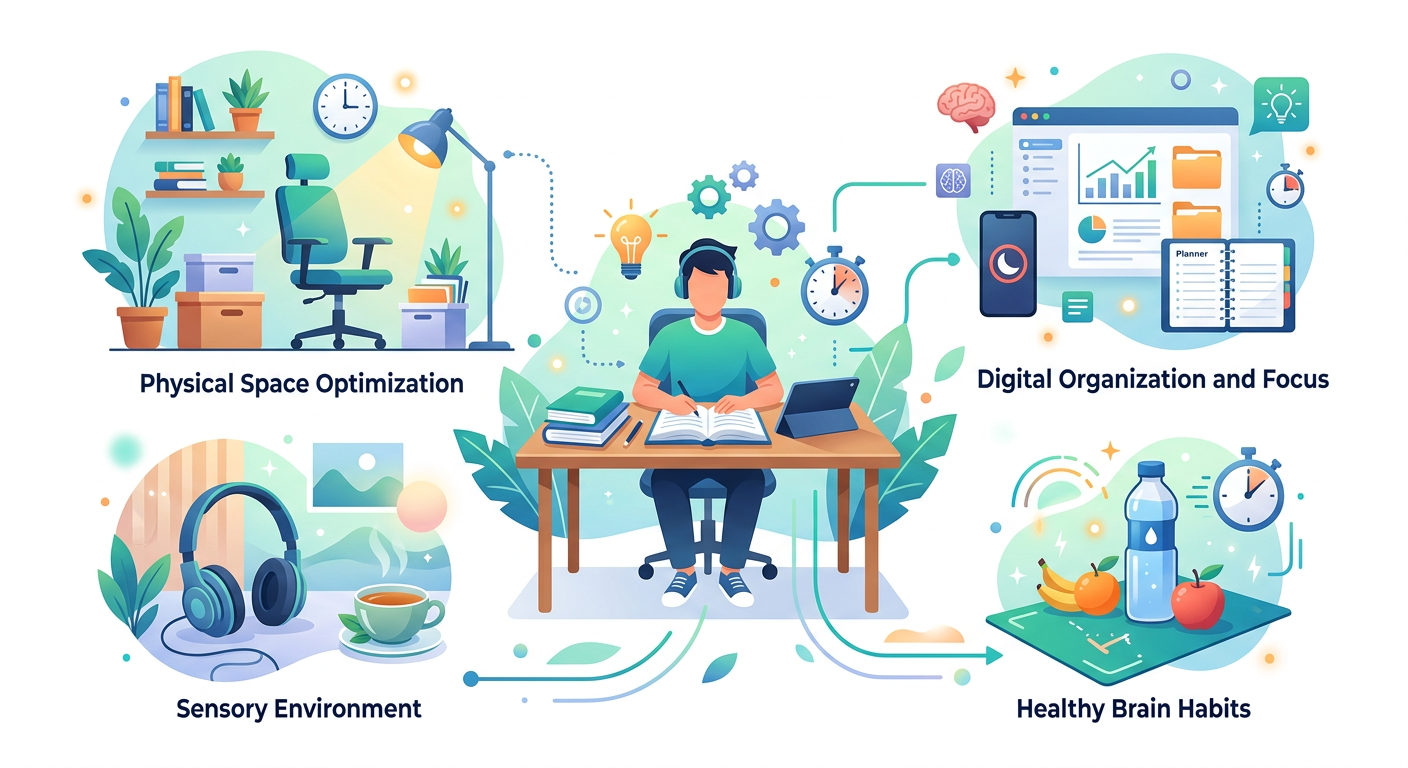
A distraction-free environment acts as a cognitive external hard drive, allowing your brain to focus all its resources on the task at hand. Your brain is highly sensitive to environmental cues. If you study in bed, your mind associates that space with relaxation, leading to "sleep hygiene" issues and poor concentration.
Create a dedicated "deep work" sanctuary where your phone is physically in another room. Research from Harvard Medical School suggests that even a visible smartphone reduces cognitive capacity. Use natural lighting to maintain circadian rhythms and consider "brown noise" or "lo-fi" beats if you need to mask erratic environmental sounds. Ergonomics also matter; a sore back is a massive cognitive tax you can't afford during a four-hour study block.
Time Management and Productivity Frameworks for Students
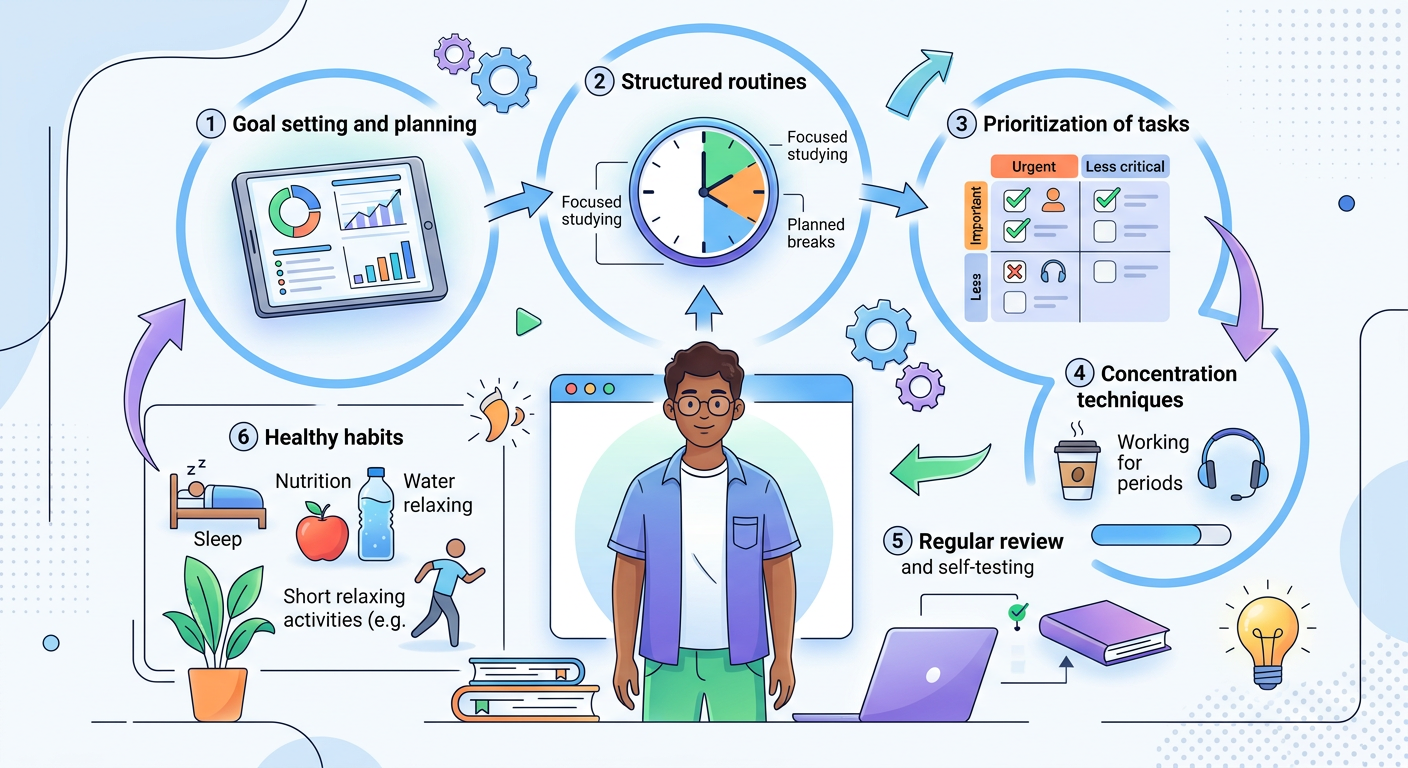
Time management is less about managing hours and more about managing energy and attention. Many students burn out because they try to sustain 100% focus for five hours straight, a feat that is biologically impossible for most humans. Instead, use structured frameworks to pace your cognitive load.
The Pomodoro Technique, 25 minutes of intense work followed by a 5-minute break, works because it provides a finish line for your focus. During those 25 minutes, you commit to one single task, like working through easy molarity practice questions to build momentum. After four cycles, take a longer 30-minute break to let your brain reset. This prevents the "decision fatigue" that leads to mindlessly scrolling social media.
Transition from a simple "to-do list" to "time blocking." A to-do list is just a wish list; a time block is a contract with yourself. By scheduling exactly when you will tackle percentage composition practice questions, you eliminate the mental friction of choosing what to do next. Use the "Eat the Frog" method—performing your hardest, most anxiety-inducing task first thing in the morning when your willpower is at its peak.
Master Your Exams with Bevinzey
Stop guessing and start growing. Get access to thousands of practice questions, active recall tools, and strategic guides tailored to help you ace your next science or math exam.
Get Started FreeAdvanced Notetaking Systems for Exam Readiness
Effective notetaking is a process of synthesis, not transcription. If you are simply writing down every word your professor says, you aren't learning; you're just acting as a human photocopier. You need a system that facilitates how to study effectively for exams by building review mechanisms into the notes themselves.
The Cornell Method is the gold standard for this. You divide your page into three sections: cues, notes, and summary. The "cues" column is particularly powerful; after the lecture, you write questions based on your notes. When it's time to study, you cover the notes and answer the questions. For visual learners, Mind Mapping helps bridge the gap between isolated facts. For instance, linking the mole concept to stoichiometry and gas laws through a central diagram can help you visualize how different chemical principles intersect.
The Holistic Approach: Health, Mindset, and Exam Anxiety
Your brain is a biological organ, not a computer, and its performance depends heavily on your physiological state. Chronic stress creates high levels of cortisol, which physically shrinks the hippocampus—the area of your brain responsible for forming new memories. Managing how to study effectively for exams includes managing your body.
Hydration is the lowest-hanging fruit in cognitive enhancement. Even 2% dehydration can impair your ability to perform complex tasks, such as solving hard solution preparation practice questions. Complement this with 'brain foods' like blueberries, walnuts, and fatty fish which are rich in omega-3s and antioxidants. Avoid the sugar-crash cycle of energy drinks; they provide a 20-minute spike followed by a massive drop in executive function.
On the day of the exam, use "box breathing", inhaling for 4 seconds, holding for 4, exhaling for 4, and holding for 4. This activates the parasympathetic nervous system, lowering your heart rate and calming the "fight or flight" response. If you've spent the weeks prior following a step-by-step study guide, your confidence will naturally suppress much of that anxiety. Remember, the goal isn't to be perfect; the goal is to be prepared.
Ready to Crush Your Next Test?
Join thousands of students who use Bevinzey to simplify complex subjects. From chemistry to physics, we provide the practice and precision you need to succeed.
Get Started FreeFrequently Asked Questions
What is the 2-3-5-7 study method?
The 2-3-5-7 method is a specific spaced repetition schedule. You review new material on day 2, day 3, day 5, and day 7 after the initial learning session to ensure the information moves into long-term memory.
Is it better to study at night or in the morning?
Morning is generally better for "heavy lifting" tasks like analytical problem solving because your willpower and cognitive focus are highest. Nighttime is suitable for lighter review or creative tasks, provided it doesn't interfere with your sleep schedule.
How many hours a day should I study for exams?
Quality matters more than quantity, but for major exams, 3 to 5 hours of deep, focused work (using Pomodoros) is more effective than 10 hours of distracted, "low-intensity" studying.
Can listening to music help you study?
Music without lyrics (like classical or lo-fi) can help some students maintain a flow state, but silence is generally superior for complex tasks that involve language or memorization.
How do I stop procrastinating when I have a big exam?
Break the task down into incredibly small pieces. Instead of "Study Chemistry," set a goal to "Complete three easy molarity questions." Reducing the barrier to entry makes it much easier to start.
Enjoyed this article?
Share it with others who might find it helpful.
Related Articles

How to Solve Molarity Problems: Step-by-Step Mastery
Learn how to solve molarity problems step-by-step with formulas, unit tips, and worked examples so you can calculate concentration with confidence.
Mar 26, 2026

Avoid These 7 Common Molarity Mistakes in Chemistry
Master chemistry calculations! Avoid common molarity mistakes with our expert guide on unit conversions, dilution errors, and proper lab techniques.
Mar 26, 2026

What Is Molarity? The Complete Guide to Molar Concentration
Master molarity with our complete guide. Learn the formula, step-by-step calculations, and the critical differences between molarity and molality.
Mar 26, 2026
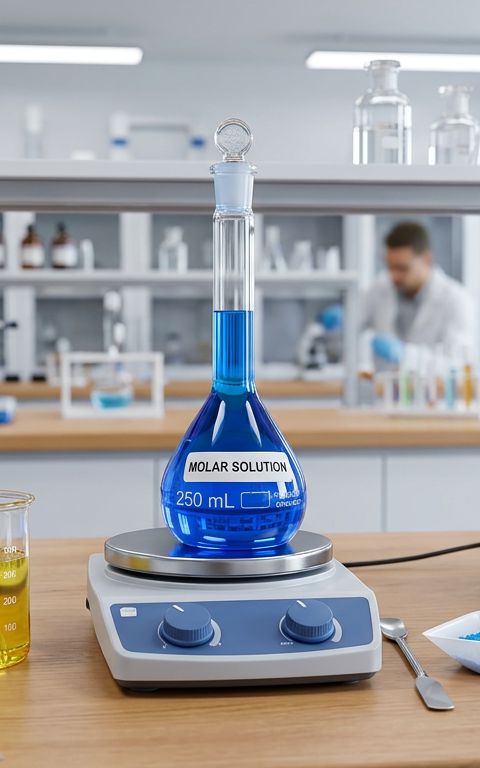
Why Molarity Matters: Converting Mass to Moles for Lab Solutions
Master chemistry with our guide to the molarity formula. Learn how to calculate concentration with step-by-step examples, units, and practical lab tips.
Mar 26, 2026
Molarity vs Molality: The Essential Difference Explained
Master the difference between molarity vs molality. Learn the formulas, key differences, and when to use each in this comprehensive chemistry guide.
Mar 26, 2026