Solving Multistep Concentration Problems: Density and Dilutions
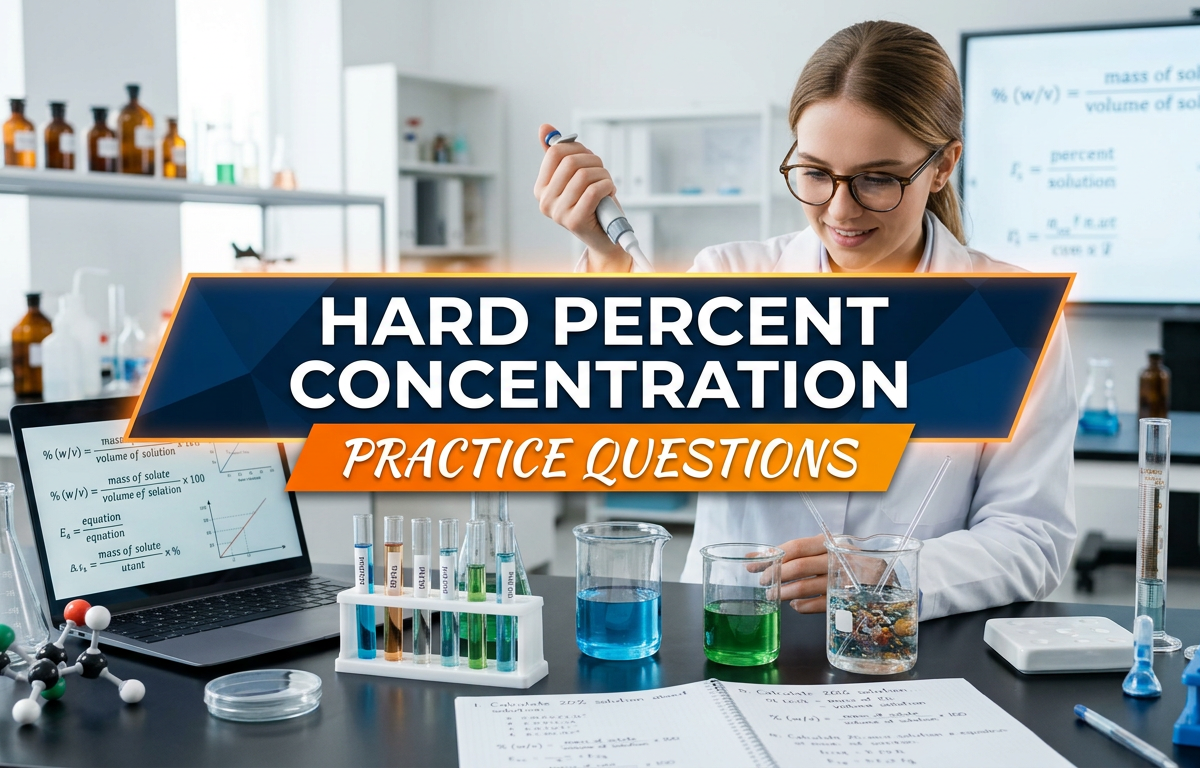
When a chemist mixes 50 mL of ethanol with 150 mL of water, the resulting volume is not 200 mL. Due to molecular contraction, the final solution measures closer to 198 mL. If you calculate the volume percent using the sum of parts rather than the actual total volume, your analytical results will be systematically flawed. This distinction between additive volumes and real-world measurements is what separates basic chemistry exercises from high-level laboratory practice.
Advanced concentration problems rarely give you the total mass or volume directly. Instead, they force you to bridge the gap between mass and volume using density as a conversion factor. A common trap is forgetting that the denominator in a mass percent (m/m) calculation must include the mass of both the solute and the solvent. If you are dissolving 12.5g of glucose into 100g of water, dividing by 100 instead of 112.5 will lead to an incorrect percentage every time. These practice questions focus on these specific technical hurdles, requiring you to manipulate density, handle non-additive volumes, and convert between (m/m) and (m/v) units across multiple steps.
Quantifying Solute Ratios in Complex Solutions
Percent concentration is a measure of the amount of solute present in a given quantity of solution, expressed as a percentage of the total mass or volume. In chemical analysis and laboratory preparation, understanding these values is critical for ensuring reaction accuracy and safety. There are three primary ways to express this: mass percent (m/m), volume percent (v/v), and mass-volume percent (m/v). Unlike molarity, which depends on moles and liters, percent concentration is often used in industrial and consumer applications, such as the labeling of household cleaners or medical saline solutions.
Calculating Hard Percent Concentration Practice Questions often requires multiple steps, such as accounting for the density of the solution, performing unit conversions, or handling dilution series. The general formulas are as follows:
Mass Percent (% m/m): (Mass of Solute / Total Mass of Solution) × 100
Volume Percent (% v/v): (Volume of Solute / Total Volume of Solution) × 100
Mass-Volume Percent (% m/v): (Mass of Solute in grams / Volume of Solution in mL) × 100
To master advanced problems, you must remember that the "total mass of solution" is the sum of the solute and the solvent. According to the International Union of Pure and Applied Chemistry (IUPAC), precision in these measurements is vital for experimental reproducibility. When working with complex mixtures, you may also need to apply concepts from percentage composition to determine the purity of the reagents involved.
Solved Examples
Below are three high-level examples that demonstrate how to navigate complex concentration problems involving density and multi-step dilutions.
Example 1: Density and Mass Percent
A 250 mL aqueous solution of sulfuric acid (H₂SO₄) has a density of 1.25 g/mL and contains 45 grams of acid. Calculate the mass percent concentration of the solution.
Calculate the total mass of the solution: Mass = Density × Volume = 1.25 g/mL × 250 mL = 312.5 g.
Apply the mass percent formula: (45 g / 312.5 g) × 100.
Result: 14.4% (m/m).
Example 2: Volume Percent in Multi-Component Mixtures
A chemist mixes 50 mL of pure ethanol with 150 mL of water. If the final volume of the solution is 198 mL (due to molecular contraction), what is the volume percent of ethanol?
Identify the solute volume: 50 mL.
Identify the final solution volume: 198 mL (Note: Do not simply add 50 + 150 as real-world volumes are not always additive).
Calculate: (50 mL / 198 mL) × 100 = 25.25%.
Result: 25.25% (v/v).
Example 3: Converting Percent to Molarity
A concentrated HCl solution is 37% (m/m) and has a density of 1.19 g/mL. What is its molarity? (Molar mass of HCl = 36.46 g/mol).
Assume 1 Liter (1000 mL) of solution.
Find mass of 1 L: 1000 mL × 1.19 g/mL = 1190 g.
Find mass of HCl: 0.37 × 1190 g = 440.3 g.
Convert mass to moles: 440.3 g / 36.46 g/mol = 12.08 moles.
Since this is in 1 L, the concentration is 12.08 M. This demonstrates how hard molarity problems often overlap with percent concentration.
Practice Questions
1. A solution is prepared by dissolving 12.5 g of glucose in 100.0 g of water. Calculate the mass percent of glucose in the solution.
2. How many grams of a 15.0% (m/m) NaCl solution contain exactly 4.50 g of NaCl?
3. A 500 mL bottle of rubbing alcohol contains 350 mL of isopropyl alcohol. What is the volume percent concentration?
Want unlimited practice questions like these?
Generate AI-powered questions with step-by-step solutions on any topic.
Try Question Generator Free →4. Calculate the mass of sodium nitrate needed to prepare 2.50 kg of a 12.0% (m/m) solution.
5. A 15.0% (m/v) NaOH solution has a density of 1.16 g/mL. Convert this concentration to mass percent (m/m).
6. You need to create 500 mL of a 5.0% (v/v) acetic acid solution using a 20.0% (v/v) stock solution. How much stock solution and water are required?
7. A 2.00 L aqueous solution contains 180 g of ethanol. If the density of the solution is 0.985 g/mL, what is the mass percent of ethanol?
8. Silver nitrate is used in many analytical chemistry procedures. If you have 250 g of a 4.0% (m/m) AgNO₃ solution and you evaporate 50 g of water, what is the new mass percent?
9. A sample of seawater is 3.5% (m/m) salt. If the density of seawater is 1.025 g/mL, how many grams of salt are in 1.5 liters of seawater?
10. A chemist mixes 40.0 g of a 10.0% (m/m) NaCl solution with 60.0 g of a 20.0% (m/m) NaCl solution. What is the final percent concentration by mass?
Answers & Explanations
11.1% (m/m): Total mass = 12.5 g (solute) + 100.0 g (solvent) = 112.5 g. (12.5 / 112.5) × 100 = 11.11%.
30.0 g: Use the formula: Mass of solution = Mass of solute / (percent / 100). 4.50 / 0.15 = 30.0 g.
70.0% (v/v): (350 mL / 500 mL) × 100 = 70%.
300 g: Mass of solute = Total mass × percent. 2500 g × 0.12 = 300 g.
12.9% (m/m): 15.0% (m/v) means 15 g solute in 100 mL solution. Mass of 100 mL solution = 100 mL × 1.16 g/mL = 116 g. Mass percent = (15 / 116) × 100 = 12.93%.
125 mL stock / 375 mL water: Use C₁V₁ = C₂V₂. (20%)(V₁) = (5%)(500). V₁ = 125 mL of stock. Water = 500 - 125 = 375 mL.
9.14% (m/m): Total mass = 2000 mL × 0.985 g/mL = 1970 g. Mass percent = (180 / 1970) × 100 = 9.14%.
5.0% (m/m): Initial solute = 250 × 0.04 = 10 g. New total mass = 250 - 50 = 200 g. New percent = (10 / 200) × 100 = 5.0%.
53.8 g: Total mass = 1500 mL × 1.025 g/mL = 1537.5 g. Salt mass = 1537.5 × 0.035 = 53.81 g.
16.0% (m/m): Solute in first = 40 × 0.10 = 4 g. Solute in second = 60 × 0.20 = 12 g. Total solute = 16 g. Total mass = 40 + 60 = 100 g. (16 / 100) × 100 = 16%.
1. Which factor is required to convert a mass-volume percent (% m/v) into a mass percent (% m/m)?
Frequently Asked Questions
What is the difference between mass percent and molarity?
Mass percent measures the ratio of solute mass to total solution mass, while molarity measures the moles of solute per liter of solution. Mass percent is temperature-independent, whereas molarity can change as liquid volume expands or contracts with heat.
Can percent concentration exceed 100%?
No, percent concentration cannot exceed 100% because the solute is a component of the total solution. A 100% concentration would imply the substance is pure and contains no solvent.
How does density affect percent concentration calculations?
Density acts as the conversion factor between the mass of a solution and its volume. It is essential when you need to switch between mass-based units (like % m/m) and volume-based units (like % m/v or molarity).
Why is mass percent used more in industry than in research labs?
Industry prefers mass percent because mass can be measured more accurately than volume on a large scale using industrial scales. It also ensures consistent dosing regardless of environmental temperature fluctuations during shipping.
Is mass percent the same as parts per million (ppm)?
They are related but differ in scale. While mass percent is parts per hundred, ppm represents parts per million; therefore, 1% concentration is equivalent to 10,000 ppm.
Want unlimited practice questions like these?
Generate AI-powered questions with step-by-step solutions on any topic.
Try Question Generator Free →
Want unlimited practice questions like these?
Generate AI-powered questions with step-by-step solutions on any topic.
Try Question Generator Free →Enjoyed this article?
Share it with others who might find it helpful.
Related Articles

Solving Time-Shift Algebra: How to Model Age Ratios and Sums
Master age problems with our comprehensive guide featuring solved examples, practice questions, and detailed algebraic explanations for all levels.
Apr 6, 2026
Predicting Voltage: Solving Nernst Equation Problems at Non-Standard State
Master the Nernst equation with our comprehensive practice guide. Includes solved examples, step-by-step calculations, and a quick quiz to test your knowledge.
Apr 3, 2026

Solving Arrhenius Problems Involving Two-Point Data and Ln Plots
Master advanced kinetics with these hard Arrhenius equation practice questions. Includes step-by-step solutions, theory explanations, and a quick quiz.
Apr 2, 2026
Calculating Gas Mixes: Solving Dalton’s Law Without Math Errors
Master Dalton’s Law of Partial Pressures with these easy practice questions and step-by-step solutions. Perfect for chemistry students and exam prep.
Apr 2, 2026
![Converting [OH-] to pOH: Solving Logarithmic Base Scales](https://dsssdaeklwicrvdzxzza.supabase.co/storage/v1/render/image/public/blog-media/ai-generated/1774738420110-92953793-8536-46e8-aa53-f182141cd497.png?width=480&quality=65&resize=cover)
Converting [OH-] to pOH: Solving Logarithmic Base Scales
This guide provides a comprehensive overview of pOH calculation, including its definition, formulas, solved examples, and practice questions with detailed explanations.
Mar 28, 2026

Decimal Conversion Practice Questions with Answers
Master decimal conversion with our comprehensive guide featuring solved examples, practice questions, and a quick quiz to sharpen your math skills.
Apr 6, 2026

Fraction Practice Questions with Answers
Fraction Practice Questions with Answers
Apr 6, 2026

Logarithm Practice Questions with Answers
Master logarithms with our guide featuring core concepts, solved examples, and 10 practice questions with detailed answers to help you ace your math exams.
Apr 6, 2026