Hard MCAT Genetics Practice Questions

Hard MCAT Genetics Practice Questions
Mastering complex genetic patterns and molecular inheritance is essential for achieving a top score on the Biological and Biochemical Foundations of Living Systems section. These Hard MCAT Genetics Practice Questions are designed to push your understanding of non-Mendelian inheritance, linkage, and population genetics to the limit. By engaging in retrieval practice, you can identify gaps in your knowledge and solidify your grasp of high-yield concepts like the Hardy-Weinberg equilibrium and recombination frequencies.
Concept Explanation
MCAT genetics encompasses the study of heredity, gene expression, and the molecular mechanisms that govern the transmission of traits from one generation to the next. At this advanced level, students must move beyond simple Punnett squares to understand complex interactions such as epistasis, where one gene masks the effect of another, and penetrance, which describes the proportion of individuals with a specific genotype who actually express the associated phenotype. Furthermore, the concept of genetic linkage challenges the Law of Independent Assortment; genes located close together on the same chromosome are likely to be inherited together unless a crossover event occurs during meiosis. Understanding these nuances is critical for interpreting data in MCAT Biology exam practice questions. According to Nature Scitable, the distance between genes is measured in centimorgans (cM), where 1 cM represents a 1% chance of recombination.
Solved Examples
- Example 1: Hardy-Weinberg Equilibrium
In a population of 10,000 individuals, a recessive disease has a prevalence of 1 in 400. Assuming the population is in Hardy-Weinberg equilibrium, how many individuals are carriers (heterozygotes)?- Identify the given value: The prevalence of the recessive phenotype is .
- Calculate : .
- Calculate : Since , then .
- Calculate the frequency of heterozygotes (): .
- Find the number of individuals: .
- Example 2: Recombination Frequency
Three genes (A, B, and C) are located on the same chromosome. The recombination frequency between A and B is 12%, between B and C is 7%, and between A and C is 5%. What is the linear order of these genes?- Identify the largest distance: A and B are 12 cM apart.
- Check the intermediate gene: If the order is A-C-B, the distance A-C (5) + C-B (7) should equal A-B (12).
- Verify: . Therefore, the gene order is A-C-B (or B-C-A).
- Example 3: X-Linked Recessive Inheritance
A woman is a carrier for Hemophilia A (X-linked recessive). She marries a man who does not have the disease. What is the probability that their first child will be an affected male?- Determine parental genotypes: Mother is ; Father is .
- Set up the cross: Offspring possibilities are (healthy female), (carrier female), (healthy male), and (affected male).
- Calculate probability: There are 4 possible outcomes. Only 1 outcome is an affected male (). Probability = or 25%.
Practice Questions
1. In a specific breed of flowers, color is determined by two genes. Gene R produces red pigment, but gene I is an epistatic inhibitor that prevents any pigment from being deposited, resulting in white flowers. If two dihybrids () are crossed, what is the expected phenotypic ratio of white to red flowers?
2. A researcher is studying a rare autosomal dominant disorder with 70% penetrance. If a heterozygous affected man mates with a homozygous recessive unaffected woman, what is the probability that their first child will exhibit the disease phenotype?
3. In a population of rabbits, the frequency of a dominant allele for brown fur is 0.8. If the population is in Hardy-Weinberg equilibrium, what is the frequency of the homozygous recessive (white fur) genotype?
Need more MCAT practice questions?
Generate unlimited MCAT-style questions with instant explanations and adaptive practice powered by Bevinzey AI.
Generate Questions Free4. Genes X, Y, and Z are linked. The distance between X and Y is 15 cM, and the distance between Y and Z is 10 cM. If the distance between X and Z is 5 cM, which gene is located in the middle?
5. A man with Type AB blood marries a woman with Type B blood whose father had Type O blood. What is the probability that they will have a child with Type A blood?
6. Nondisjunction during Meiosis II in the father results in a sperm cell with two Y chromosomes. If this sperm fertilizes a normal egg, what is the resulting chromosomal abnormality in the zygote?
7. A specific trait is only ever passed from fathers to all of their sons, but never to their daughters. What is the most likely mode of inheritance for this trait?
8. If the recombination frequency between two genes is 50%, what does this indicate about their physical location on the chromosome?
Answers & Explanations
- 13:3 (White:Red). In dominant epistasis, the presence of the inhibitor allele () makes the flower white regardless of the allele. The genotypes (12/16) are white. The genotype (3/16) is red. The genotype (1/16) is white (no pigment). Total white: . Total red: 3.
- 35%. The cross is . The probability of the child inheriting the dominant allele () is 50% (0.5). Since the penetrance is 70%, the probability of expressing the phenotype is or 35%.
- 0.04. If , then . The frequency of the homozygous recessive genotype is . .
- Z. The largest distance is between X and Y (15 cM). The sum of X-Z (5 cM) and Z-Y (10 cM) equals the total distance (15 cM). Therefore, Z must be in the middle.
- 25%. The man is . The woman is (because her father was ). The possible offspring are (AB), (A), (B), and (B). The probability of Type A is 1 out of 4.
- 47, XYY (Jacob's Syndrome). Meiosis II nondisjunction of the Y chromosome produces a sperm. Fertilization with an egg results in . This is a classic example of chromosomal variation often discussed in MCAT reproduction practice questions.
- Y-linked. Only males have Y chromosomes. If a trait is passed from father to all sons and no daughters, it must be located on the Y chromosome (holandric inheritance).
- They are unlinked. A recombination frequency of 50% is the maximum possible and suggests the genes are either on different chromosomes or so far apart on the same chromosome that they assort independently. For more on how these traits change over time, see MCAT evolution practice questions.
1. Which of the following is a requirement for a population to be in Hardy-Weinberg equilibrium?
Frequently Asked Questions
What is the difference between penetrance and expressivity?
Penetrance is a binary measure of whether or not an individual with a specific genotype expresses the corresponding phenotype at all. Expressivity, on the other hand, measures the severity or range of the phenotype among those who do express it.
How do you calculate the number of possible gametes for a genotype?
The number of unique gametes can be calculated using the formula , where is the number of heterozygous gene pairs. For example, a genotype of would produce different gametes.
What does a recombination frequency of less than 50% imply?
A recombination frequency of less than 50% indicates that two genes are linked, meaning they are located on the same chromosome and do not assort independently. The smaller the frequency, the closer the genes are physically located to one another.
What is the purpose of a backcross?
A backcross is a breeding technique where an offspring is crossed with one of its parents or an individual genetically similar to its parent. It is often used in genetics research and agriculture to isolate specific traits or achieve a desired genetic background.
Why is the mitochondrial genome inherited maternally?
Mitochondrial DNA is inherited maternally because the sperm's mitochondria are typically destroyed by the egg after fertilization or are located in the tail, which does not enter the egg. Consequently, all mitochondria in the zygote originate from the cytoplasm of the ovum.
Need more MCAT practice questions?
Generate unlimited MCAT-style questions with instant explanations and adaptive practice powered by Bevinzey AI.
Generate Questions FreeReviewed by
Michael Danquah, MS, PhD
Dr. Michael Danquah is a professor of pharmaceutical sciences and founder of several educational technology platforms focused on improving student learning and performance.
Enjoyed this article?
Share it with others who might find it helpful.
Related Articles

Applying Coulomb’s Law and Potential to MCAT Biological Systems
MCAT Electrostatics Practice Questions with Answers
May 14, 2026
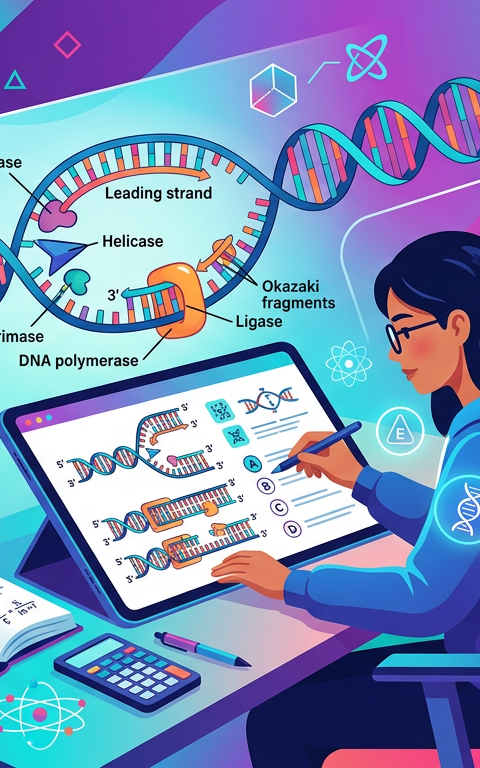
Hard MCAT DNA Replication Practice Questions
Master high-level DNA replication concepts with these hard MCAT practice questions covering enzymes, directionality, and telomeres.
May 14, 2026
Hard MCAT Enzyme Practice Questions
Hard MCAT Enzyme Practice Questions
May 14, 2026

Medium MCAT DNA Replication Practice Questions
Medium MCAT DNA Replication Practice Questions
May 14, 2026

Medium MCAT Enzyme Practice Questions
Medium MCAT Enzyme Practice Questions
May 14, 2026

Easy MCAT DNA Replication Practice Questions
Master DNA replication with these easy MCAT practice questions. Learn about helicase, polymerase, and semi-conservative replication with detailed explanations.
May 14, 2026

MCAT Enzyme Kinetics: Solving KM and Vmax Without a Calculator
Easy MCAT Enzyme Practice Questions
May 14, 2026

MCAT DNA Replication Practice Questions with Answers
MCAT DNA Replication Practice Questions with Answers
May 14, 2026