MCAT Biology Exam Practice Questions with Answers

Preparing for the MCAT Biology Exam Practice Questions with Answers requires a deep understanding of biological systems, from molecular genetics to complex organ physiology. The MCAT (Medical College Admission Test) is a standardized exam that assesses your problem-solving abilities and knowledge of natural sciences. Mastering the biology section is not just about memorization; it involves applying conceptual knowledge to novel experimental scenarios. This guide provides a comprehensive overview of essential topics, detailed walkthroughs of complex problems, and high-yield practice questions designed to mimic the actual exam experience.
Concept Explanation
The biology section of the MCAT evaluates your mastery of living systems through the lens of foundational concepts like cell biology, genetics, and organ systems. To succeed, students must integrate their knowledge of biochemistry with physiological processes. The exam focuses heavily on the "Central Dogma" of molecular biology (DNA to RNA to protein), Mendelian and non-Mendelian genetics, and the intricate feedback loops of the endocrine and nervous systems. Using retrieval practice in medical education is one of the most effective ways to ensure these concepts are stored in long-term memory. Unlike undergraduate exams that may ask for simple definitions, the MCAT requires you to interpret data from graphs, predict the outcome of genetic mutations, and understand how a drug might interfere with a specific metabolic pathway.
Key Biological Pillars
- Molecular Biology: Focus on DNA replication, transcription, and translation. Understand the roles of enzymes like DNA polymerase and helicase.
- Genetics: Master Punnett squares, pedigrees, and the law of independent assortment. Be prepared for questions on linked genes and recombination frequency.
- Human Physiology: The MCAT emphasizes the renal, circulatory, and respiratory systems. Know how the body maintains homeostasis through hormonal signaling.
- Cellular Metabolism: Deeply understand glycolysis, the Krebs cycle, and oxidative phosphorylation, including the net yield of ATP and NADH.
Solved Examples
Working through solved examples helps bridge the gap between theory and application by demonstrating the logic required for high-level questions.
- Example 1: Genetics and Probability
A researcher crosses two pea plants that are heterozygous for seed color (Yy, where Y is yellow and y is green). What is the probability that the offspring will be green?
- Identify the genotypes of the parents: Both are .
- Set up a Punnett square: The possible combinations are and .
- Determine the phenotypic ratio: 3 yellow (dominant) to 1 green (recessive).
- Calculate the probability: The green phenotype corresponds to the genotype, which occurs in 1 out of 4 cases.
- Final Answer: The probability is 25% or .
- Example 2: Enzyme Kinetics
An enzyme-catalyzed reaction follows Michaelis-Menten kinetics. If the substrate concentration is equal to the , what is the reaction velocity ?
- Recall the Michaelis-Menten equation:
- Substitute for :
- Simplify the denominator:
- Cancel out the terms:
- Final Answer: The velocity is half of the maximum velocity.
- Example 3: Osmotic Pressure
Calculate the osmotic pressure () of a 0.5 M solution of at 310 K (body temperature), assuming .
- Identify the formula:
- Determine the van't Hoff factor (): Since dissociates into and , .
- Plug in the values:
- Perform the calculation: ; then .
- Final Answer: The osmotic pressure is approximately 25.45 atm.
Practice Questions
Test your knowledge with these MCAT Biology Exam Practice Questions with Answers. To maximize your learning, try to answer these without looking at your notes, a technique known as retrieval practice.
- A mutation occurs in the promoter region of a gene. Which process is most likely to be directly affected?
- During the action potential of a neuron, which ion movement is primarily responsible for depolarization?
- In a population in Hardy-Weinberg equilibrium, the frequency of a recessive allele (q) is 0.4. What is the frequency of the heterozygous genotype?
Ready to boost your MCAT score?
Practice smarter with Bevinzey’s AI-powered MCAT quizzes, explanations, and personalized study tools.
Start MCAT Prep Free- Which organelle is responsible for the post-translational modification and packaging of proteins intended for secretion?
- If a segment of DNA has the sequence 5'-ATGCGT-3', what is the sequence of the complementary RNA strand produced during transcription?
- What is the primary function of the hormone aldosterone, and where is it produced?
- A scientist observes a cell undergoing meiosis. During which phase do homologous chromosomes separate?
- Which of the following would cause a rightward shift in the hemoglobin-oxygen dissociation curve?
- Describe the path of blood through the heart starting from the superior vena cava and ending at the aorta.
- How do competitive inhibitors affect the and of an enzyme?
Answers & Explanations
- Transcription: The promoter is the DNA sequence where RNA polymerase binds to initiate transcription. A mutation here would prevent or alter the efficiency of mRNA synthesis.
- Sodium (Na+) influx: Depolarization is caused by the opening of voltage-gated sodium channels, allowing to rush into the cell, making the interior more positive.
- 0.48: Using the Hardy-Weinberg equation , if , then . The frequency of heterozygotes is . Calculation: .
- Golgi Apparatus: The Golgi apparatus acts as the "shipping center" of the cell, modifying proteins from the ER and sorting them into vesicles.
- 3'-UACGCA-5' (or 5'-ACGCAU-3'): RNA is synthesized antiparallel to the template. If the DNA coding strand is 5'-ATGCGT-3', the mRNA will be nearly identical but with Uracil (U) instead of Thymine (T).
- Sodium reabsorption in the kidneys; Adrenal Cortex: Aldosterone increases reabsorption and secretion in the distal tubule and collecting duct to increase blood pressure.
- Anaphase I: In Meiosis I, homologous pairs separate. In Meiosis II (specifically Anaphase II), sister chromatids separate.
- Increased , decreased pH, or increased temperature: These factors decrease hemoglobin's affinity for oxygen, facilitating oxygen unloading in tissues (the Bohr effect).
- Path of Blood: Superior Vena Cava → Right Atrium → Tricuspid Valve → Right Ventricle → Pulmonary Valve → Pulmonary Artery → Lungs → Pulmonary Vein → Left Atrium → Mitral Valve → Left Ventricle → Aortic Valve → Aorta.
- stays the same, increases: Competitive inhibitors bind to the active site. They can be overcome by adding more substrate, so the maximum velocity doesn't change, but it takes more substrate to reach half .
1. Which of the following is the primary site of water reabsorption in the human digestive system?
Frequently Asked Questions
What is the best way to study for the MCAT Biology section?
The most effective strategy involves active learning techniques like retrieval practice vs passive studying. Focus on understanding the "why" behind physiological processes and practice interpreting data from scientific journals to build your analytical skills.
How much biochemistry is on the MCAT biology section?
Biochemistry makes up a significant portion of the Biological and Biochemical Foundations of Living Systems section, often overlapping with general biology. You should be comfortable with amino acid structures, enzyme kinetics, and metabolic pathways as they are frequently integrated.
Do I need to memorize every single step of the Krebs cycle?
While you don't need to know every single atom's position, you must know the substrates, products, and rate-limiting enzymes. Understanding the net energy yield (NADH, , and GTP) is more critical than memorizing every intermediate's molecular structure.
What are the most high-yield biology topics for the MCAT?
High-yield topics include amino acids, genetics (Mendelian and molecular), the endocrine system, and the nervous system. The AAMC official guide highlights these as core competencies for medical students.
How is the MCAT biology section scored?
The biology section is scored on a scale from 118 to 132. Your raw score (number of correct answers) is converted to this scaled score to account for small variations in difficulty between different versions of the exam.
Ready to boost your MCAT score?
Practice smarter with Bevinzey’s AI-powered MCAT quizzes, explanations, and personalized study tools.
Start MCAT Prep FreeReviewed by
Michael Danquah, MS, PhD
Dr. Michael Danquah is a professor of pharmaceutical sciences and founder of several educational technology platforms focused on improving student learning and performance.
Enjoyed this article?
Share it with others who might find it helpful.
Related Articles

Hard MCAT Biology Exam Practice Questions
Hard MCAT Biology Exam Practice Questions
May 9, 2026

Applying Coulomb’s Law and Potential to MCAT Biological Systems
MCAT Electrostatics Practice Questions with Answers
May 14, 2026
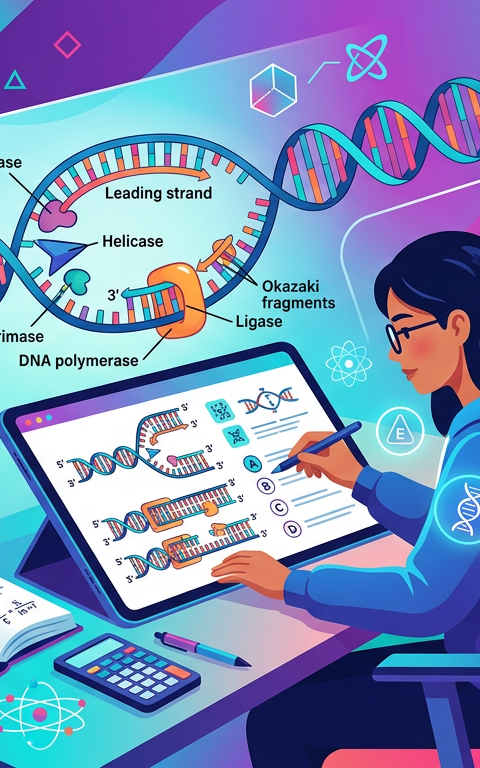
Hard MCAT DNA Replication Practice Questions
Master high-level DNA replication concepts with these hard MCAT practice questions covering enzymes, directionality, and telomeres.
May 14, 2026
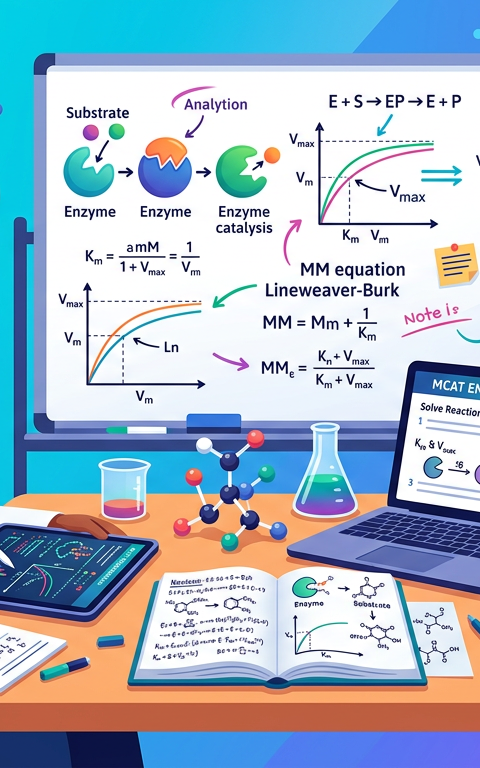
Hard MCAT Enzyme Practice Questions
Hard MCAT Enzyme Practice Questions
May 14, 2026

Medium MCAT DNA Replication Practice Questions
Medium MCAT DNA Replication Practice Questions
May 14, 2026

Medium MCAT Enzyme Practice Questions
Medium MCAT Enzyme Practice Questions
May 14, 2026

Easy MCAT DNA Replication Practice Questions
Master DNA replication with these easy MCAT practice questions. Learn about helicase, polymerase, and semi-conservative replication with detailed explanations.
May 14, 2026

MCAT Enzyme Kinetics: Solving KM and Vmax Without a Calculator
Easy MCAT Enzyme Practice Questions
May 14, 2026