Gas Stoichiometry Practice Questions with Answers
Concept Explanation
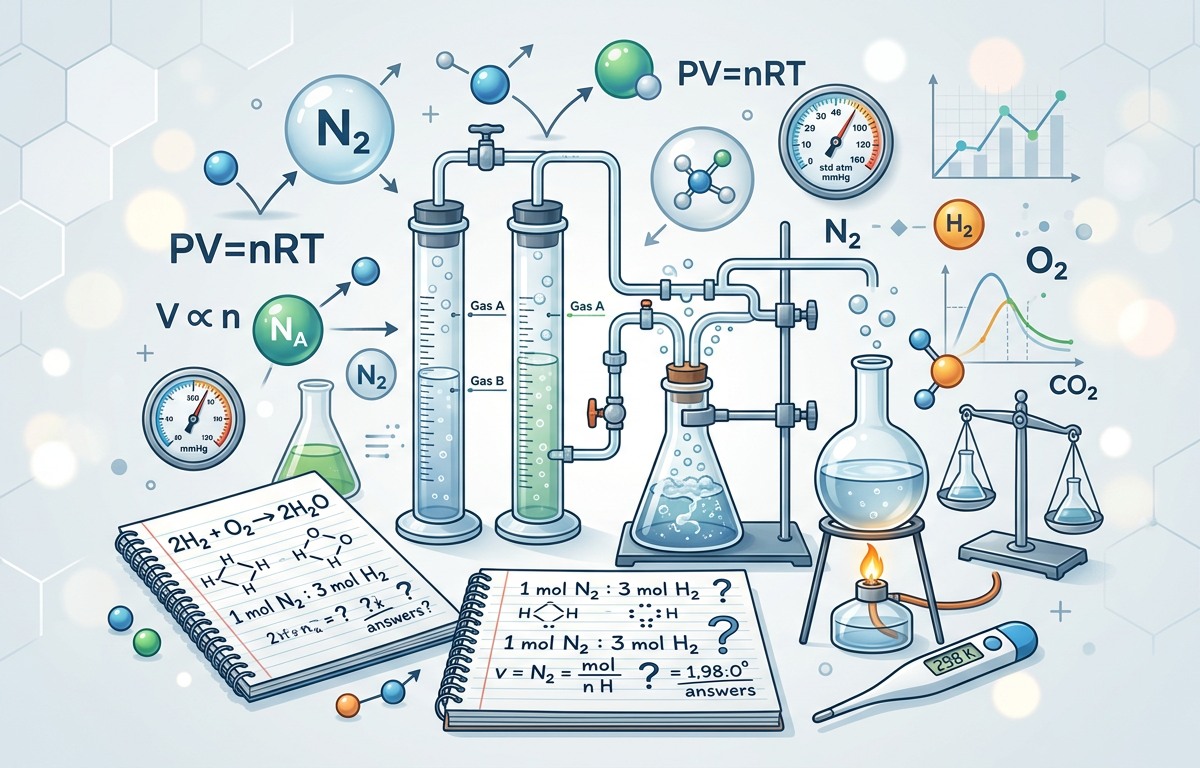
Gas stoichiometry is the quantitative study of the relationships between the amounts of gaseous reactants and products in a chemical reaction, typically utilizing the Ideal Gas Law (PV = nRT) to relate volume, pressure, and temperature to molar quantities. While standard stoichiometry practice questions focus on mass and moles, gas stoichiometry requires an understanding of how gases behave under different conditions. According to Avogadro's Law, equal volumes of gases at the same temperature and pressure contain the same number of molecules, which simplifies calculations when reactants and products are all gases at the same conditions.
To master gas stoichiometry, you must be comfortable with two primary scenarios. First, if a reaction occurs at Standard Temperature and Pressure (STP), which is 0°C (273.15 K) and 1 atm, you can use the molar volume of an ideal gas: 22.4 L/mol. Second, if the reaction occurs at non-standard conditions, you must use the Ideal Gas Law, PV = nRT, where P is pressure, V is volume, n is moles, R is the gas constant (0.0821 L·atm/mol·K), and T is temperature in Kelvin. Often, these problems involve a transition from mass to moles (using mass-to-mass stoichiometry techniques) before applying gas laws.
Variable Common Units Notes Pressure (P) atm, kPa, mmHg 1 atm = 101.325 kPa = 760 mmHg Volume (V) Liters (L) Must be in Liters for PV=nRT Temperature (T) Kelvin (K) K = °C + 273.15
Solved Examples
Example 1: Volume-to-Volume at STP
How many liters of oxygen gas are required to react completely with 45.0 L of hydrogen gas to form water vapor at STP? (2H₂ + O₂ → 2H₂O)
Identify the mole ratio from the balanced equation: 2 moles H₂ : 1 mole O₂.
Since both gases are at the same temperature and pressure, the volume ratio is the same as the mole ratio (Avogadro's Law).
Calculate: 45.0 L H₂ × (1 L O₂ / 2 L H₂) = 22.5 L O₂.
Example 2: Mass-to-Volume at STP
What volume of CO₂ gas is produced at STP when 5.00 g of CaCO₃ decomposes? (CaCO₃ → CaO + CO₂)
Find the molar mass of CaCO₃: 40.08 + 12.01 + (3 × 16.00) = 100.09 g/mol.
Convert mass to moles: 5.00 g / 100.09 g/mol = 0.04996 moles CaCO₃.
Use the mole ratio (1:1) to find moles of CO₂: 0.04996 moles CO₂.
Multiply by molar volume at STP: 0.04996 mol × 22.4 L/mol = 1.12 L CO₂.
Example 3: Non-Standard Conditions
Find the volume of Nitrogen gas (N₂) produced by the decomposition of 65.0 g of Sodium Azide (NaN₃) at 300 K and 1.15 atm. (2NaN₃ → 2Na + 3N₂)
Calculate moles of NaN₃: 65.0 g / 65.01 g/mol = 1.00 mole NaN₃.
Use mole ratio to find moles of N₂: 1.00 mol NaN₃ × (3 mol N₂ / 2 mol NaN₃) = 1.50 moles N₂.
Apply PV = nRT: V = nRT / P.
V = (1.50 mol × 0.0821 L·atm/mol·K × 300 K) / 1.15 atm = 32.1 L N₂.
Practice Questions
(Easy) How many liters of Chlorine gas (Cl₂) are needed to react with 10.0 L of Hydrogen gas (H₂) to produce HCl at constant temperature and pressure? (H₂ + Cl₂ → 2HCl)
(Easy) What is the volume occupied by 2.50 moles of an ideal gas at STP?
(Medium) 15.0 grams of Magnesium reacts with excess HCl to produce Hydrogen gas. What volume of H₂ is collected at STP? (Mg + 2HCl → MgCl₂ + H₂)
Start Learning Smarter Today
Join thousands of students using AI-powered study tools to achieve better results.
Get Started Free(Medium) If 20.0 L of Propane (C₃H₈) is burned in excess oxygen, what volume of CO₂ is produced, assuming all gases are measured at the same temperature and pressure? (C₃H₈ + 5O₂ → 3CO₂ + 4H₂O)
(Medium) Ammonia is produced by the reaction: N₂ + 3H₂ → 2NH₃. If 5.0 L of N₂ reacts with 12.0 L of H₂, which is the limiting reagent and what volume of NH₃ is produced?
(Hard) A 10.0 g sample of Potassium Chlorate (KClO₃) decomposes to form Oxygen gas and Potassium Chloride. If the Oxygen is collected at 25°C and 0.950 atm, what is the volume? (2KClO₃ → 2KCl + 3O₂)
(Hard) What mass of Zinc is required to produce 500 mL of H₂ gas at 1.2 atm and 310 K? (Zn + H₂SO₄ → ZnSO₄ + H₂)
(Hard) Ammonia (NH₃) reacts with Oxygen to form Nitrogen Monoxide and Water. If 3.00 L of NH₃ reacts with 4.00 L of O₂ at STP, what is the total volume of gas remaining after the reaction? (4NH₃ + 5O₂ → 4NO + 6H₂O)
Answers & Explanations
10.0 L. According to Avogadro’s Law, the volume ratio is equal to the mole ratio. The ratio of H₂ to Cl₂ is 1:1, so 10.0 L of H₂ requires 10.0 L of Cl₂.
56.0 L. At STP, 1 mole = 22.4 L. Therefore, 2.50 mol × 22.4 L/mol = 56.0 L.
13.8 L. First, find moles of Mg: 15.0 g / 24.31 g/mol = 0.617 mol. The mole ratio Mg:H₂ is 1:1, so 0.617 mol of H₂ is produced. At STP: 0.617 mol × 22.4 L/mol = 13.8 L.
60.0 L. Using the volume-volume ratio (1 C₃H₈ : 3 CO₂), 20.0 L C₃H₈ × 3 = 60.0 L CO₂.
Limiting: H₂; Volume: 8.0 L. Ratio is 1 N₂ : 3 H₂. 5.0 L N₂ would need 15.0 L H₂ (we only have 12.0 L, so H₂ is limiting). 12.0 L H₂ × (2 NH₃ / 3 H₂) = 8.0 L NH₃.
3.15 L. Moles KClO₃: 10.0 g / 122.55 g/mol = 0.0816 mol. Moles O₂: 0.0816 × (3/2) = 0.1224 mol. Use PV=nRT: V = (0.1224 × 0.0821 × 298.15) / 0.950 = 3.15 L.
1.54 g. First, find moles of H₂: n = PV/RT = (1.2 × 0.500) / (0.0821 × 310) = 0.02357 mol. Mass of Zn = 0.02357 mol × 65.38 g/mol = 1.54 g.
4.30 L. Check limiting reagent: 3.00 L NH₃ requires 3.75 L O₂ (3.00 × 5/4). Since we have 4.00 L, NH₃ is limiting. O₂ remaining = 4.00 - 3.75 = 0.25 L. NO produced = 3.00 L (1:1 ratio with NH₃). Water is liquid at STP (usually ignored in gas volume unless specified as vapor), so total gas = 0.25 L O₂ + 3.00 L NO = 3.25 L. (Note: If water is vapor, add 4.5 L for a total of 7.75 L).
Frequently Asked Questions
What is the difference between stoichiometry and gas stoichiometry?
While standard stoichiometry focuses on mass-to-mole conversions, gas stoichiometry incorporates gas laws to relate the volume of gaseous reactants and products to their molar amounts. It specifically uses the Ideal Gas Law or molar volume at STP to bridge the gap between volume and chemical quantity.
When can I use the 22.4 L/mol shortcut?
You can only use the 22.4 L/mol conversion factor when the gas is at Standard Temperature and Pressure (STP), defined as 273.15 K and 1 atm. For any other conditions, you must use the Ideal Gas Law (PV=nRT) to calculate the specific volume or moles.
Does the identity of the gas matter in gas stoichiometry?
For calculations involving the Ideal Gas Law, the identity of the gas does not matter because all ideal gases are assumed to behave the same way regardless of their chemical composition. However, the molar mass is still required if you are converting between mass and volume.
How do you handle water vapor in gas stoichiometry problems?
If a gas is collected over water, you must subtract the vapor pressure of water at that specific temperature from the total pressure to find the partial pressure of the dry gas. This application of Dalton's Law of Partial Pressures ensures the stoichiometry reflects only the gas produced in the reaction.
Why is it necessary to convert temperature to Kelvin?
Kelvin is an absolute temperature scale, meaning 0 K represents zero thermal energy, which is required for the mathematical ratios in gas laws to remain valid. Using Celsius would result in incorrect or impossible (negative) volumes and pressures in the PV=nRT equation.
Enjoyed this article?
Share it with others who might find it helpful.
Related Articles
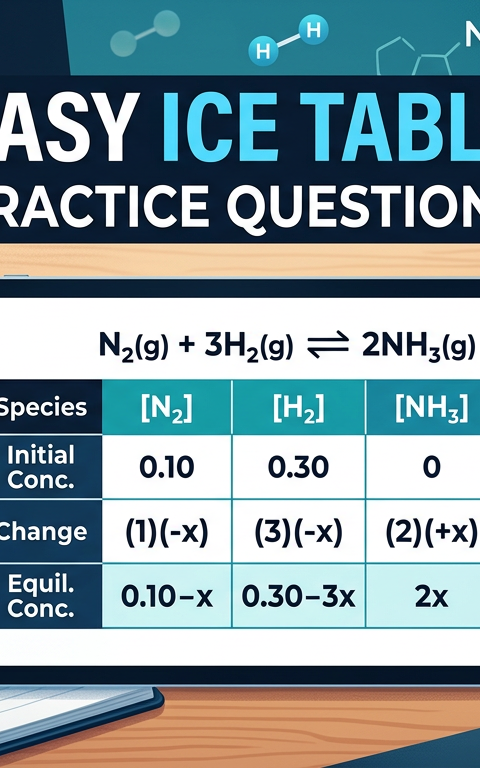
Solving Equilibrium Problems Without Losing Your Stoichiometry
Master chemical equilibrium with these easy ICE table practice questions. Learn to calculate concentrations and K values with step-by-step solved examples.
Mar 30, 2026
Solving Titration Math: From M1V1 to Polyprotic Stoichiometry
Master the basics of neutralization with our easy acid-base titration practice questions. Includes step-by-step solved examples and a quick quiz.
Mar 29, 2026
Stoichiometry of the Flask: Calculating Solute Mass and Dilutions
Master solution preparation with these easy practice questions. Learn to calculate molarity, mass, and dilutions with step-by-step examples and a quick quiz.
Mar 27, 2026
Stoichiometry Word Practice Questions with Answers
Master stoichiometry word problems with our comprehensive guide. Includes step-by-step solved examples, practice questions, and detailed answer explanations.
Mar 24, 2026

Mole-to-Mole Stoichiometry Practice Questions with Answers
Master mole-to-mole stoichiometry with our comprehensive guide featuring solved examples, practice questions, and detailed explanations for chemistry students.
Mar 23, 2026
Predicting Reaction Yields: Grams-to-Grams Stoichiometry Guide
Master mass-to-mass stoichiometry with our comprehensive guide. Includes step-by-step solved examples, practice questions, and a quick quiz to test your knowledge.
Mar 21, 2026

Stoichiometry vs. Reality: Calculating Percent Yield in Chemistry
Master percent yield calculations with our guide. Includes step-by-step solved examples, practice questions, and a quiz to test your chemistry skills.
Mar 21, 2026

Calculating High-Stakes Meds: BSA Mosteller Formula Practice
Master hard body surface area-based dosage calculations with our comprehensive guide, solved examples, and practice questions for healthcare students.
May 17, 2026