Easy MCAT Redox Practice Questions
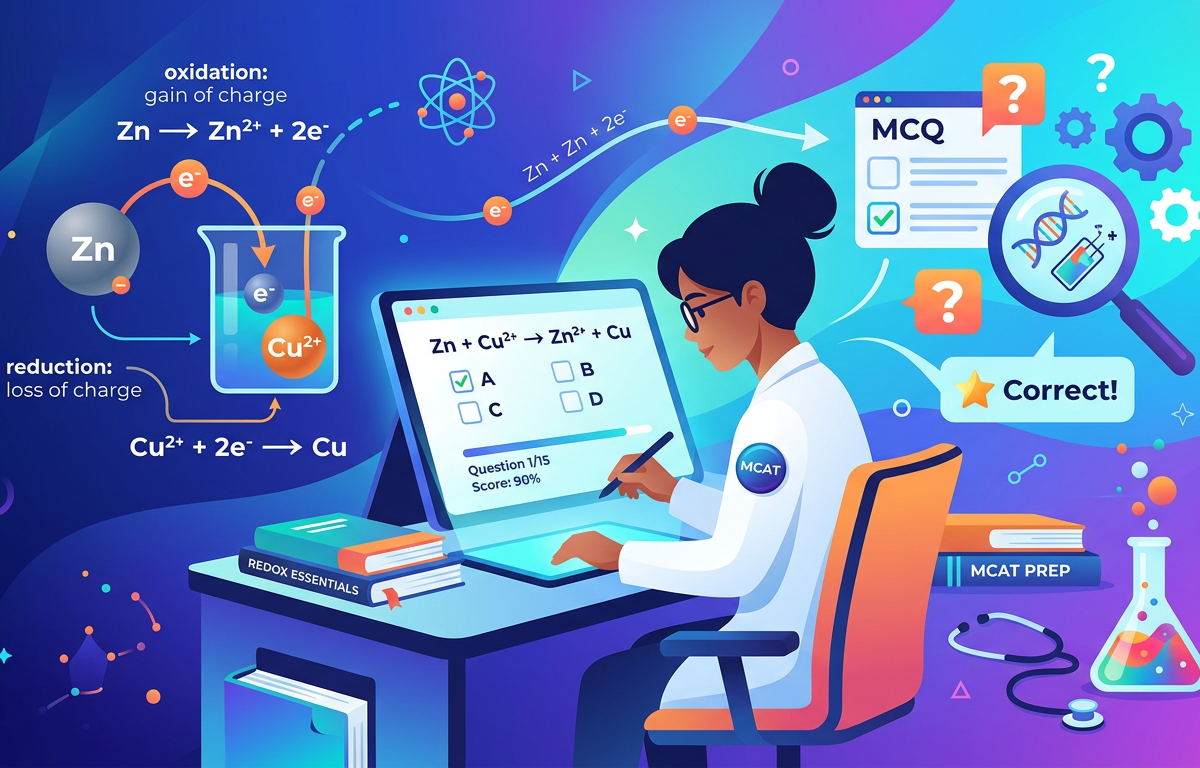
Easy MCAT Redox Practice Questions
Mastering oxidation-reduction (redox) reactions is a fundamental requirement for success on the Chemical and Physical Foundations of Biological Systems section of the MCAT. These reactions, which involve the transfer of electrons between species, underpin everything from basic inorganic chemistry to complex metabolic pathways like the electron transport chain. By working through Easy MCAT Redox Practice Questions, you can build the foundational speed and accuracy needed for more complex passage-based problems. Understanding the flow of electrons is not just a chemistry skill; it is essential for biological applications such as cellular respiration and photosynthesis.
Concept Explanation
Redox reactions are chemical processes characterized by the transfer of electrons from one reactant to another, resulting in changes in oxidation states. To remember the movement of electrons, most students use the mnemonic "OIL RIG" (Oxidation Is Loss, Reduction Is Gain) or "LEO says GER" (Lose Electrons Oxidation, Gain Electrons Reduction). In any redox reaction, oxidation and reduction must occur simultaneously; one species cannot lose electrons unless another is present to accept them.
To identify these transfers, we assign oxidation numbers to every atom in a molecule using a specific set of hierarchy rules:
- Atoms in their elemental form (e.g., , , ) have an oxidation state of 0.
- Monatomic ions have an oxidation state equal to their charge (e.g., is +1, is -1).
- Fluorine is always -1 in compounds.
- Hydrogen is usually +1 when bonded to nonmetals and -1 when bonded to metals.
- Oxygen is usually -2, except in peroxides () or when bonded to fluorine.
- The sum of oxidation states must equal the net charge of the molecule or ion.
When a species is oxidized, it acts as the reducing agent because it provides electrons to reduce another species. Conversely, the species being reduced acts as the oxidizing agent. In the context of medical education, these concepts are vital for understanding how antioxidants protect cells from oxidative stress by acting as reducing agents. According to Wikipedia's overview of redox, these reactions are central to both industrial applications and biological energy conversion.
Solved Examples
Here are three worked examples to illustrate how to assign oxidation states and identify redox components.
- Identify the oxidation states of all atoms in .
- Potassium () is a Group 1 metal, so it has an oxidation state of +1.
- Oxygen () is typically -2. Since there are four oxygens, the total contribution is .
- The molecule is neutral, so the sum must be 0: .
- Solving for Manganese (): , so .
- Determine which species is oxidized and which is reduced in the reaction: .
- Assign oxidation states: goes from 0 to +2. goes from +2 to 0.
- Analyze the change: lost electrons (Oxidation).
- Analyze the change: gained electrons (Reduction).
- Identify agents: is the reducing agent; is the oxidizing agent.
- Find the oxidation state of Sulfur in the sulfate ion ().
- Oxygen is -2. Total for four oxygens is -8.
- The net charge of the ion is -2.
- Set up the equation: .
- Solving for : .
Practice Questions
Test your knowledge with these Easy MCAT Redox Practice Questions. Utilizing retrieval practice while solving these will help solidify your memory of the rules.
1. What is the oxidation state of Chromium in the dichromate ion, ?
2. In the following reaction, which atom is being reduced?
3. Identify the oxidizing agent in the reaction: .
Create your MCAT study system.
Get a personalized MCAT study experience with quizzes, active recall tools, and intelligent study guidance.
Build My Study Plan4. What is the oxidation state of Nitrogen in ?
5. True or False: In a galvanic cell, oxidation always occurs at the cathode.
6. Which of the following represents a disproportionation reaction?
A)
B)
7. What is the oxidation state of Iron in ?
8. In the reaction , which species is the reducing agent?
9. Assign oxidation states to Phosphorus in .
10. How many electrons are transferred in the balanced half-reaction: ?
Answers & Explanations
- Answer: +6.
Explanation: Oxygen is -2. Seven oxygens total -14. The total charge is -2. . , so . - Answer: Oxygen.
Explanation: Elemental oxygen () has an oxidation state of 0. In both and , it is -2. Since the oxidation state decreased, oxygen was reduced. - Answer: .
Explanation: goes from 0 to +2 (oxidized). goes from 0 to -1 (reduced). The species that is reduced is the oxidizing agent. - Answer: -3.
Explanation: Hydrogen bonded to a nonmetal is +1. Four hydrogens total +4. The net charge is +1. , so . - Answer: False.
Explanation: Oxidation always occurs at the anode (An Ox), and reduction always occurs at the cathode (Red Cat). This is a standard rule for all electrochemical cells, which you can review in the Khan Academy chemistry modules. - Answer: B.
Explanation: In reaction B, Oxygen in (oxidation state -1) is both oxidized to (state 0) and reduced to (state -2). This is the definition of disproportionation. - Answer: +3.
Explanation: Three oxygens total -6. To balance this to zero, two irons must total +6, meaning each iron is +3. - Answer: .
Explanation: Tin () goes from +2 to +4. Since it lost electrons (was oxidized), it is the reducing agent. - Answer: +5.
Explanation: . , so . - Answer: 5 electrons.
Explanation: The half-reaction explicitly shows being added to the reactant side to balance the change in oxidation state of Manganese from +7 to +2.
1. Which mnemonic correctly identifies the behavior of electrons in redox?
Frequently Asked Questions
What is the difference between an oxidizing agent and a reducing agent?
An oxidizing agent facilitates the oxidation of another species by accepting electrons and becoming reduced itself. A reducing agent facilitates the reduction of another species by donating electrons and becoming oxidized.
How do I find the oxidation state of a transition metal?
Transition metals often have multiple oxidation states, so you must determine their state by calculating the known oxidation states of the other atoms in the molecule and ensuring the sum equals the total charge. Always prioritize rules for Group 1, Group 2, and Oxygen/Halogens first.
Why is the oxidation state of Oxygen sometimes not -2?
Oxygen deviates from its -2 state in peroxides (where it is -1), in superoxides (where it is -1/2), and when bonded to Fluorine, which is more electronegative and forces Oxygen into a positive oxidation state.
Can a reaction be a redox reaction if there is no oxygen involved?
Yes, many redox reactions do not involve oxygen; the term "oxidation" historically referred to reactions with oxygen, but now broadly describes any loss of electrons regardless of the elements involved. For more on this, check out our guide on retrieval practice for STEM subjects.
What is a disproportionation reaction?
A disproportionation reaction is a specific type of redox reaction where a single reactant is simultaneously oxidized and reduced to form two different products with different oxidation states. This is common in biological systems and enzyme-catalyzed reactions.
Create your MCAT study system.
Get a personalized MCAT study experience with quizzes, active recall tools, and intelligent study guidance.
Build My Study PlanReviewed by
Michael Danquah, MS, PhD
Dr. Michael Danquah is a professor of pharmaceutical sciences and founder of several educational technology platforms focused on improving student learning and performance.
Enjoyed this article?
Share it with others who might find it helpful.
Related Articles
Hard MCAT Redox Practice Questions
Hard MCAT Redox Practice Questions
May 9, 2026
Medium MCAT Redox Practice Questions
Medium MCAT Redox Practice Questions
May 9, 2026

Easy MCAT Amino Acid Practice Questions
Easy MCAT Amino Acid Practice Questions
May 14, 2026
Easy MCAT Biochemistry Practice Questions
Easy MCAT Biochemistry Practice Questions
May 14, 2026
MCAT Citric Acid Practice Questions with Answers
MCAT Citric Acid Practice Questions with Answers
May 14, 2026

MCAT Biochemistry Practice Questions with Answers
MCAT Biochemistry Practice Questions with Answers
May 14, 2026

Solving High-Yield MCAT Stereochemistry: Beyond R and S Basics
Hard MCAT Stereochemistry Practice Questions
May 11, 2026
Hard MCAT Organic Chemistry Practice Questions
Hard MCAT Organic Chemistry Practice Questions
May 11, 2026