Medium MCAT Redox Practice Questions

Mastering redox chemistry is essential for success on the MCAT, as these reactions underpin metabolic pathways, electrochemical cells, and basic physiological functions. By working through Medium MCAT Redox Practice Questions, you can bridge the gap between basic oxidation state rules and the complex application of these principles in biological and chemical systems.
Concept Explanation
Reduction-oxidation (redox) reactions are chemical processes involving the transfer of electrons between species, where one species is oxidized (loses electrons) and another is reduced (gains electrons). To keep track of these movements, we use oxidation states, which are formal charges assigned to atoms based on electronegativity rules. A helpful mnemonic used by many students is "OIL RIG" (Oxidation Is Loss, Reduction Is Gain) or "LEO says GER" (Loss of Electrons is Oxidation, Gain of Electrons is Reduction). Beyond simple electron transfer, the MCAT frequently tests your ability to identify oxidizing agents (which get reduced and cause oxidation) and reducing agents (which get oxidized and cause reduction). These reactions are the physical basis for galvanic and electrolytic cells, where the standard reduction potential determines the spontaneity of the process. In biological contexts, redox reactions often involve the transfer of hydride ions or hydrogen atoms, frequently mediated by cofactors like NAD+ and FAD. Mastering these concepts through retrieval practice for medical students ensures that you can quickly identify which molecule is being energized or depleted during metabolic cycles.
Solved Examples
The following examples demonstrate how to apply oxidation state rules and half-reaction methods to solve common MCAT-style problems.
- Determine the oxidation state of Phosphorus in the phosphate ion .
- Recall the rule that Oxygen usually has an oxidation state of -2.
- Set up an algebraic equation where the sum of oxidation states equals the net charge of the ion: .
- Solve for : , which simplifies to .
- The oxidation state of Phosphorus in phosphate is +5.
- Identify the oxidizing agent in the following reaction:
- Assign oxidation states: goes from 0 to +2. Since it loses electrons, it is oxidized.
- goes from +2 to 0. Since it gains electrons, it is reduced.
- The molecule that is reduced is the oxidizing agent because it facilitates the oxidation of the other species.
- Therefore, is the oxidizing agent.
- Calculate the standard cell potential for a cell with the following half-reactions:
- In a galvanic cell, the half-reaction with the higher reduction potential occurs at the cathode (reduction). Here, Silver is reduced.
- The other half-reaction must be reversed to represent oxidation at the anode: .
- Use the formula .
- . Note: Do not multiply the potential by stoichiometric coefficients.
Practice Questions
Test your knowledge with these Medium MCAT Redox Practice Questions. Ensure you are using active retrieval by attempting the questions before looking at the answers.
1. What is the oxidation state of Chromium in the dichromate ion ?
2. In the metabolic conversion of pyruvate to lactate by lactate dehydrogenase, NADH is converted to NAD+. In this specific reaction, is pyruvate being oxidized or reduced?
3. Balance the following half-reaction in an acidic solution:
Create your MCAT study system.
Get a personalized MCAT study experience with quizzes, active recall tools, and intelligent study guidance.
Build My Study Plan4. Which of the following species is the strongest reducing agent based on these standard reduction potentials?
5. During the operation of a concentration cell, in which direction do electrons flow?
6. Calculate the change in Gibbs free energy for a reaction where moles of electrons are transferred and . (Use Faraday’s constant ).
7. In the reaction , which element undergoes disproportionation, if any?
8. A student observes that a reaction has a negative standard reduction potential. Under standard conditions, is the equilibrium constant for this reaction greater than, less than, or equal to 1?
Answers & Explanations
- Answer: +6.
Using the rule for Oxygen (-2), the equation for the ion is . This simplifies to , then , resulting in . This is a common oxidation state for Chromium in strong oxidizing agents used in organic chemistry, such as Jones reagent.
- Answer: Reduced.
Since NADH is being converted to NAD+, NADH is losing electrons (being oxidized). In a redox pair, if one species is oxidized, the other must be reduced. Pyruvate accepts the electrons (and a hydride) to become lactate, meaning pyruvate is reduced. This is consistent with the reduction of a carbonyl group to an alcohol.
- Answer: .
Steps: 1) Balance atoms other than O and H (Mn is balanced). 2) Balance O by adding (add to the right). 3) Balance H by adding (add to the left). 4) Balance charge by adding electrons (left side is +7, right side is +2, so add to the left).
- Answer: .
The strongest reducing agent is the species that is most easily oxidized. This corresponds to the species with the most negative reduction potential (or most positive oxidation potential). Since has the most negative reduction potential, the reverse reaction (oxidation of ) is highly favorable.
- Answer: From the electrode in the less concentrated solution to the electrode in the more concentrated solution.
Concentration cells drive toward equilibrium. Electrons flow to the side where reduction (consumption of ions) occurs to decrease the concentration gradient, which is the cathode (higher concentration half-cell).
- Answer: (or ).
Use the formula . A positive cell potential always results in a negative (spontaneous) Gibbs free energy change.
- Answer: None.
Disproportionation occurs when the same element is both oxidized and reduced in a single reaction. In this reaction, Mn is reduced (+4 to 0) and Al is oxidized (0 to +3). Since these are two different elements, it is a standard redox reaction, not disproportionation.
- Answer: Less than 1.
A negative indicates a non-spontaneous reaction under standard conditions . The relationship implies that if is positive, must be negative, meaning .
1. Which of the following best describes the function of a salt bridge in a galvanic cell?
Frequently Asked Questions
What is the difference between an oxidizing agent and a reducing agent?
An oxidizing agent is a substance that gains electrons and is reduced, thereby causing another substance to be oxidized. Conversely, a reducing agent loses electrons and is oxidized, facilitating the reduction of another species.
How do I identify a redox reaction on the MCAT?
Look for changes in oxidation states of atoms from the reactant side to the product side. If any atom increases its oxidation state and another decreases, the reaction is a redox process.
Why is the standard reduction potential of the SHE defined as 0V?
The Standard Hydrogen Electrode (SHE) serves as a universal reference point for measuring the relative potentials of other half-cells. By defining it as 0V, scientists can create a consistent scale to compare the electron affinity of different species under standard conditions, as detailed by IUPAC standards.
Does stoichiometry affect the standard reduction potential ?
No, standard reduction potential is an intensive property, meaning it does not depend on the amount of substance present. When balancing a full redox equation, you do not multiply the value by the coefficients used to balance the electrons.
What is disproportionation in chemistry?
Disproportionation is a specific type of redox reaction where a single element in one oxidation state is simultaneously oxidized and reduced to form two different products. An example is the decomposition of hydrogen peroxide into water and oxygen gas.
Create your MCAT study system.
Get a personalized MCAT study experience with quizzes, active recall tools, and intelligent study guidance.
Build My Study PlanReviewed by
Michael Danquah, MS, PhD
Dr. Michael Danquah is a professor of pharmaceutical sciences and founder of several educational technology platforms focused on improving student learning and performance.
Enjoyed this article?
Share it with others who might find it helpful.
Related Articles
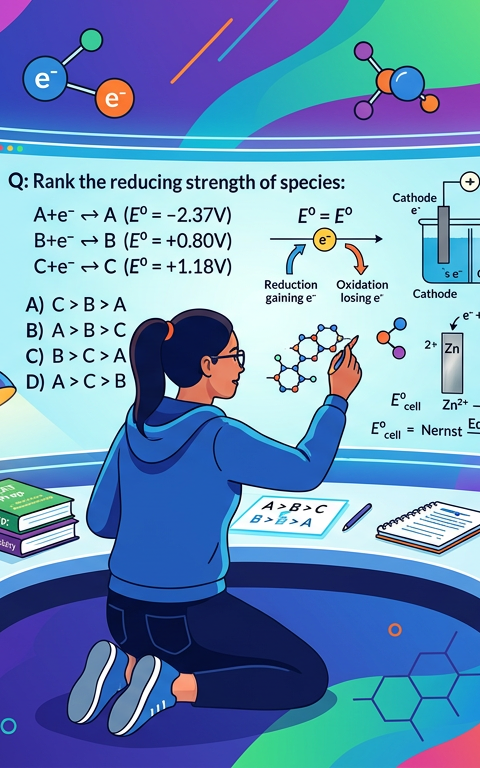
Hard MCAT Redox Practice Questions
Hard MCAT Redox Practice Questions
May 9, 2026

Easy MCAT Redox Practice Questions
Easy MCAT Redox Practice Questions
May 9, 2026

Easy MCAT Amino Acid Practice Questions
Easy MCAT Amino Acid Practice Questions
May 14, 2026
Easy MCAT Biochemistry Practice Questions
Easy MCAT Biochemistry Practice Questions
May 14, 2026
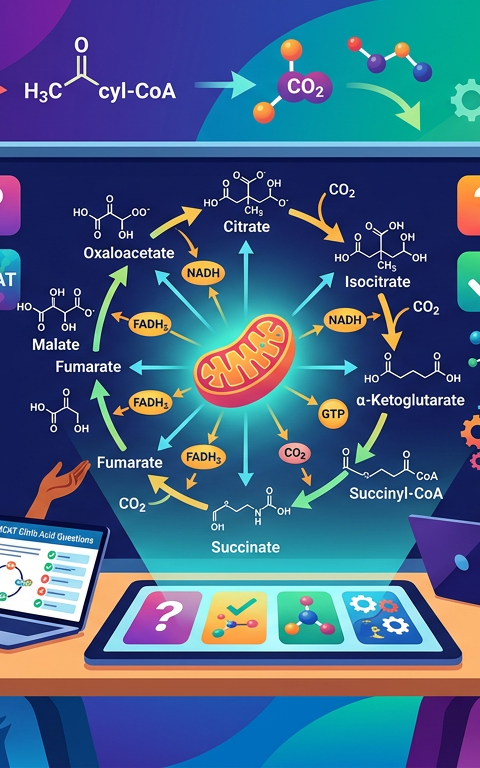
MCAT Citric Acid Practice Questions with Answers
MCAT Citric Acid Practice Questions with Answers
May 14, 2026

MCAT Biochemistry Practice Questions with Answers
MCAT Biochemistry Practice Questions with Answers
May 14, 2026

Solving High-Yield MCAT Stereochemistry: Beyond R and S Basics
Hard MCAT Stereochemistry Practice Questions
May 11, 2026

Hard MCAT Organic Chemistry Practice Questions
Hard MCAT Organic Chemistry Practice Questions
May 11, 2026