Easy MCAT Evolution Practice Questions

Easy MCAT Evolution Practice Questions
Mastering the fundamentals of biological change over time is essential for success on the MCAT Biological and Biochemical Foundations of Living Systems section. These easy MCAT evolution practice questions focus on core principles like natural selection, genetic drift, and Hardy-Weinberg equilibrium to help you build a solid foundation. By using retrieval practice, you can strengthen your memory of these evolutionary mechanisms and improve your performance on test day.
Concept Explanation
Evolution is the change in the heritable characteristics of biological populations over successive generations, driven by mechanisms such as natural selection, mutation, gene flow, and genetic drift. At its core, evolution explains how life diversifies from common ancestors through the differential survival and reproduction of individuals with advantageous traits. On the MCAT, you must distinguish between microevolution (changes in allele frequencies within a population) and macroevolution (large-scale patterns such as speciation). Key concepts include Natural Selection, where individuals with higher fitness contribute more to the next generation's gene pool, and Hardy-Weinberg Equilibrium, a mathematical model describing a non-evolving population where allele frequencies remain constant. Understanding these basics is as crucial as mastering MCAT genetics practice questions, as the two fields are deeply interconnected.
Solved Examples
- Hardy-Weinberg Calculation: In a population of 100 individuals, 16 exhibit a recessive phenotype. Assuming the population is in Hardy-Weinberg equilibrium, what is the frequency of the dominant allele ()?
- Step 1: Identify the given value. The recessive phenotype frequency is .
- Step 2: Solve for by taking the square root: .
- Step 3: Use the equation to find .
- Step 4: . The frequency of the dominant allele is 0.6.
- Types of Selection: A population of birds has a wide range of beak sizes. After a drought, only birds with very large beaks can crack the remaining hard seeds, while birds with small or medium beaks perish. What type of selection is this?
- Step 1: Analyze the shift in the population. The environment is favoring one extreme phenotype (large beaks).
- Step 2: Recall the definitions of selection. Stabilizing favors the middle, disruptive favors both extremes, and directional favors one extreme.
- Step 3: Since the average shifts toward one end of the spectrum, this is directional selection.
- Convergent Evolution: Dolphins (mammals) and sharks (fish) both possess streamlined bodies and fins despite belonging to different classes. Is this an example of homologous or analogous structures?
- Step 1: Define the terms. Homologous structures share a common ancestor; analogous structures share a common function but different ancestry.
- Step 2: Dolphins and sharks evolved these traits independently to survive in aquatic environments.
- Step 3: Because the traits arose due to similar selective pressures rather than a recent common ancestor, they are analogous structures resulting from convergent evolution.
Practice Questions
- Which of the following is a necessary condition for a population to remain in Hardy-Weinberg equilibrium?
- A) Small population size
- B) Non-random mating
- C) Absence of migration (gene flow)
- D) High mutation rate
- The "founder effect" is a specific example of which evolutionary mechanism?
- A) Natural selection
- B) Genetic drift
- C) Artificial selection
- D) Sexual selection
- Two species of frogs live in the same pond but mate at different times of the year. This is an example of which type of reproductive isolation?
- A) Gametic isolation
- B) Behavioral isolation
- C) Temporal isolation
- D) Post-zygotic isolation
- A structure that is present in an organism but no longer serves its original purpose, such as the human appendix or the pelvic bone in whales, is known as a:
- A) Homologous structure
- B) Analogous structure
- C) Vestigial structure
- D) Divergent structure
- In a population of flowers, individuals with medium-length stems are more likely to survive and reproduce than those with very short or very long stems. This is an example of:
- A) Disruptive selection
- B) Stabilizing selection
- C) Directional selection
- D) Genetic bottleneck
- Which theory suggests that evolutionary change occurs in rapid bursts separated by long periods of stability?
- A) Gradualism
- B) Punctuated equilibrium
- C) Adaptive radiation
- D) Parallel evolution
- If the frequency of the recessive allele in a population is 0.3, what is the frequency of the heterozygous genotype () assuming Hardy-Weinberg equilibrium?
- A) 0.09
- B) 0.49
- C) 0.42
- D) 0.21
- Which of the following describes the biological species concept?
- A) Species are defined by their physical appearance.
- B) Species are defined by their ability to interbreed and produce fertile offspring.
- C) Species are defined by their ecological niche.
- D) Species are defined by their DNA sequence similarity only.
Need more MCAT practice questions?
Generate unlimited MCAT-style questions with instant explanations and adaptive practice powered by Bevinzey AI.
Generate Questions FreeAnswers & Explanations
- 1. Answer: C. For a population to be in Hardy-Weinberg equilibrium (not evolving), it must meet five criteria: large population size, no mutations, random mating, no natural selection, and no gene flow (migration). According to the Hardy-Weinberg principle, absence of migration ensures no new alleles enter or leave the gene pool.
- 2. Answer: B. Genetic drift refers to random changes in allele frequencies, which have a more significant impact on small populations. The founder effect occurs when a small group breaks off from a larger population to establish a new colony, representing a random subset of the original genetic diversity.
- 3. Answer: C. Temporal isolation is a pre-zygotic barrier where species are prevented from mating because they breed at different times of day, seasons, or years. This is a common mechanism in evolutionary biology.
- 4. Answer: C. Vestigial structures are remnants of organs or structures that had a function in an early ancestor but are no longer useful to the modern species. They provide evidence of common ancestry and evolutionary change.
- 5. Answer: B. Stabilizing selection reduces variation by favoring the intermediate phenotype and selecting against extreme phenotypes. This is the opposite of disruptive selection, which favors both extremes.
- 6. Answer: B. Punctuated equilibrium, proposed by Eldredge and Gould, contrasts with gradualism by suggesting that species remain relatively unchanged for long periods (stasis), interrupted by brief periods of rapid change.
- 7. Answer: C. If , then . The frequency of heterozygotes is calculated as .
- 8. Answer: B. The biological species concept, widely used in biology, defines a species as a group of populations whose members have the potential to interbreed in nature and produce viable, fertile offspring.
1. Which mechanism of evolution is most likely to decrease genetic variation within a small, isolated population?
Frequently Asked Questions
What is the difference between microevolution and macroevolution?
Microevolution refers to small-scale changes in allele frequencies within a single population over a few generations. Macroevolution refers to larger evolutionary patterns that occur above the species level, such as the origin of new groups of organisms through multiple speciation events.
How does natural selection differ from genetic drift?
Natural selection is a non-random process where traits that improve survival and reproduction become more common. Genetic drift is a random process where allele frequencies fluctuate due to chance events, which typically has a stronger effect in smaller populations.
What are homologous structures?
Homologous structures are physical features in different species that are similar because they were inherited from a common ancestor, even if they serve different functions today. An example is the bone structure in a human arm and a bat's wing, which you can learn more about via Khan Academy's evolution resources.
What is an adaptive radiation?
Adaptive radiation is a process in which organisms diversify rapidly from an ancestral species into a multitude of new forms, particularly when a change in the environment makes new resources available or creates new challenges. This is often seen after mass extinctions or the colonization of new islands.
Why is the Hardy-Weinberg equilibrium considered a "null model"?
It acts as a baseline to compare real-world populations; if the observed allele frequencies differ from the Hardy-Weinberg predictions, it indicates that evolutionary forces like selection or drift are actively occurring. Just as you might use practice tests to gauge your baseline knowledge, scientists use this model to detect evolutionary change.
Need more MCAT practice questions?
Generate unlimited MCAT-style questions with instant explanations and adaptive practice powered by Bevinzey AI.
Generate Questions FreeReviewed by
Michael Danquah, MS, PhD
Dr. Michael Danquah is a professor of pharmaceutical sciences and founder of several educational technology platforms focused on improving student learning and performance.
Enjoyed this article?
Share it with others who might find it helpful.
Related Articles

Applying Coulomb’s Law and Potential to MCAT Biological Systems
MCAT Electrostatics Practice Questions with Answers
May 14, 2026
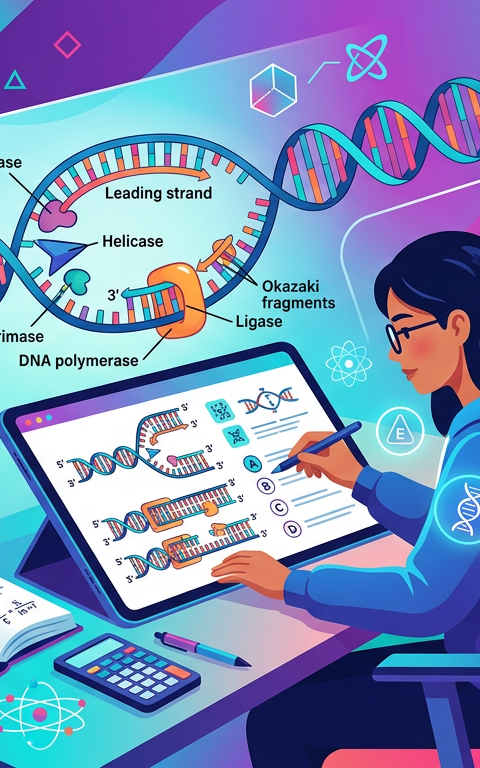
Hard MCAT DNA Replication Practice Questions
Master high-level DNA replication concepts with these hard MCAT practice questions covering enzymes, directionality, and telomeres.
May 14, 2026

Hard MCAT Enzyme Practice Questions
Hard MCAT Enzyme Practice Questions
May 14, 2026

Medium MCAT DNA Replication Practice Questions
Medium MCAT DNA Replication Practice Questions
May 14, 2026

Medium MCAT Enzyme Practice Questions
Medium MCAT Enzyme Practice Questions
May 14, 2026

Easy MCAT DNA Replication Practice Questions
Master DNA replication with these easy MCAT practice questions. Learn about helicase, polymerase, and semi-conservative replication with detailed explanations.
May 14, 2026

MCAT Enzyme Kinetics: Solving KM and Vmax Without a Calculator
Easy MCAT Enzyme Practice Questions
May 14, 2026

MCAT DNA Replication Practice Questions with Answers
MCAT DNA Replication Practice Questions with Answers
May 14, 2026