Calculate Trace Concentrations: ppm and ppb Chemistry Problems
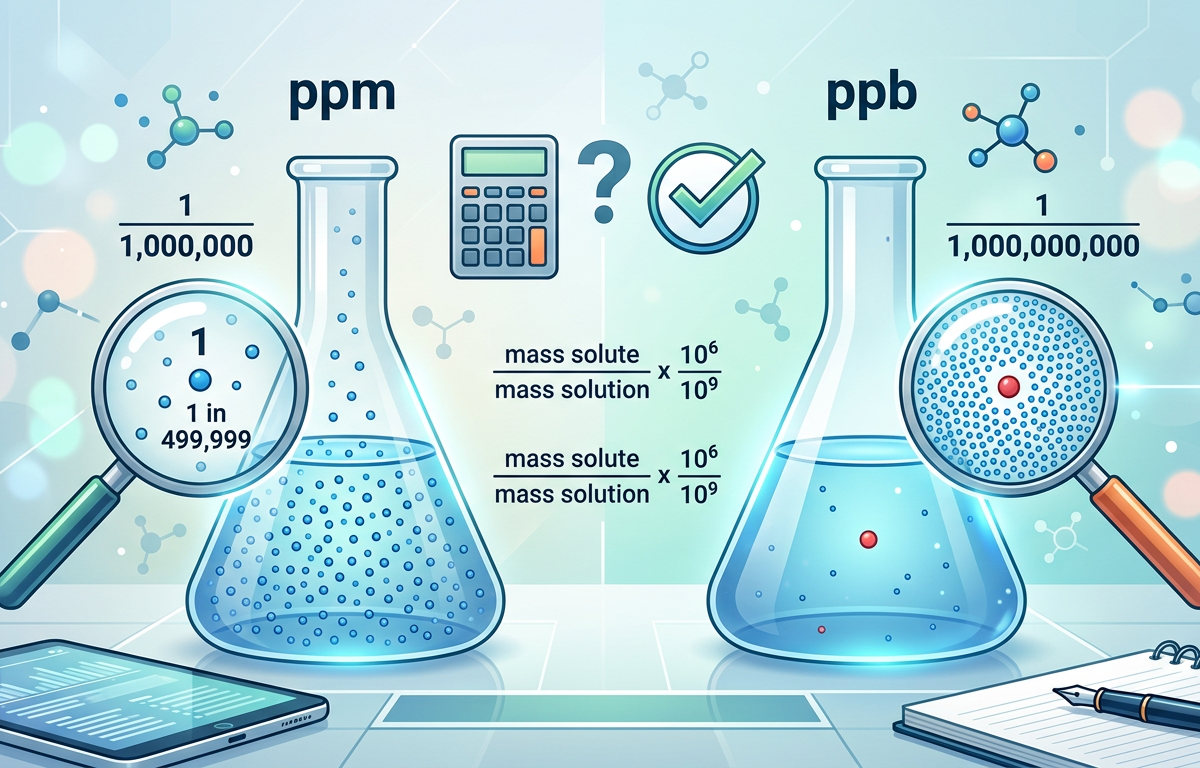
Imagine trying to find a single drop of ink in a 13-gallon fuel tank. That is roughly the scale of 1 part per million (ppm). When you move to parts per billion (ppb), you are looking for that same drop in an Olympic-sized swimming pool. In these concentrations, standard molarity becomes cumbersome because the numbers are so small they disappear into a sea of leading zeros. The most common error students make is not in the division itself, but in failing to normalize units before applying the multiplier. You cannot divide milligrams by kilograms and expect a correct ratio without first converting both values to a shared unit like grams.
This guide focuses on the specific arithmetic needed to navigate these ratios, particularly the leap between 10^6 and 10^9. We will work through the mental shift required to see 1 mg/L as 1 ppm and 1 µg/L as 1 ppb in aqueous solutions. By mastering these conversions, you ensure that trace contaminants in environmental reports or analytical data are interpreted with precision rather than guesswork. The following problems will challenge your ability to handle these massive denominators without losing track of your decimal points.
Mastering Ratios for Trace Analysis
Parts per million (ppm) and parts per billion (ppb) are units of measurement used to express very low concentrations of a substance within a mixture, typically representing the mass of a solute relative to one million or one billion units of the total solution mass. These units are essential in environmental science, toxicology, and analytical chemistry where substances like pollutants or trace minerals are present in minute quantities. While molarity is the standard for laboratory-scale reactions, ppm and ppb provide a more intuitive scale for describing contaminants in air or water.
To calculate these values, you compare the mass of the solute to the total mass of the solution and multiply by a factor of 106 for ppm or 109 for ppb. Because 1 liter of water has a mass of approximately 1 kilogram (1,000,000 milligrams), 1 ppm is often equivalent to 1 mg/L in aqueous solutions. Similarly, 1 ppb is equivalent to 1 µg/L. These units are dimensionless ratios, much like percentage composition, but scaled to much larger denominators to handle trace amounts.
Unit Ratio Typical Aqueous Equivalent Percent (%) 1 / 100 10 g / L ppm 1 / 1,000,000 1 mg / L ppb 1 / 1,000,000,000 1 µg / L
Solved Examples
Review these step-by-step examples to understand how to apply the formulas for ppm and ppb in various scenarios.
Example 1: Calculating ppm from Mass
A 2,500 gram sample of ground water is found to contain 5.0 mg of arsenic. What is the concentration of arsenic in ppm?
Convert all units to the same mass unit. 5.0 mg = 0.005 g.
Identify the total mass of the solution: 2,500 g.
Apply the ppm formula: (Mass of Solute / Total Mass) × 106.
(0.005 / 2,500) × 1,000,000 = 2 ppm.
Example 2: Converting ppm to ppb
The EPA limit for lead in drinking water is 0.015 ppm. What is this concentration in ppb?
Recognize the relationship: 1 ppm = 1,000 ppb.
Multiply the ppm value by 1,000.
0.015 × 1,000 = 15 ppb.
Example 3: Finding Solute Mass from ppb
How many milligrams of mercury are in 5.0 kg of soil if the concentration is 20 ppb?
Convert the total mass to grams: 5.0 kg = 5,000 g.
Set up the ppb equation: 20 = (Mass of Solute / 5,000) × 109.
Solve for Mass of Solute: Mass = (20 × 5,000) / 109 = 0.0001 g.
Convert grams to milligrams: 0.0001 g × 1,000 = 0.1 mg.
Practice Questions
Test your understanding of ppm and ppb with these practice questions. Remember to check your units carefully before calculating.
A chemical analysis shows that a 500 g sample of pond water contains 1.5 mg of fluoride ions. What is the fluoride concentration in ppm?
If a solution has a concentration of 0.00045% by mass, what is this concentration expressed in ppm?
An air quality sensor detects 0.8 mg of carbon monoxide in a 2.0 kg air sample. Calculate the concentration in ppb.
Want unlimited practice questions like these?
Generate AI-powered questions with step-by-step solutions on any topic.
Try Question Generator Free →A 1.2 liter bottle of mineral water (assume density = 1.0 g/mL) contains 0.036 mg of cadmium. Is this within a safety limit of 5 ppb?
Convert a concentration of 12.5 ppm to ppb.
A technician needs to prepare 2.0 kg of a 50 ppm nitrate solution. How many grams of nitrate should be added?
The World Health Organization guideline for arsenic in water is 10 ppb. Express this as a percentage by mass.
A pool contains 150,000 kg of water. If the chlorine level is 3.0 ppm, how many grams of chlorine are in the pool?
A sample of ocean water contains 0.000002 g of gold per 1,000 g of water. Calculate the concentration in ppb.
If you dissolve 5.0 mg of sugar into 5.0 kg of water, what is the concentration in ppm?
Answers & Explanations
3 ppm: First, convert 1.5 mg to 0.0015 g. Calculation: (0.0015 g / 500 g) × 106 = 3 ppm.
4.5 ppm: Percent means parts per hundred. To go from percent to ppm, multiply by 10,000 (since 106 / 102 = 10,000). 0.00045 × 10,000 = 4.5 ppm.
400 ppb: Convert 0.8 mg to 0.0008 g. Calculation: (0.0008 g / 2,000 g) × 109 = 400 ppb.
No (30 ppb): Mass of water = 1,200 g. Cadmium mass = 0.000036 g. (0.000036 / 1,200) × 109 = 30 ppb, which exceeds the 5 ppb limit.
12,500 ppb: Simply multiply the ppm value by 1,000. 12.5 × 1,000 = 12,500.
0.1 g: Use the formula: 50 = (mass / 2,000 g) × 106. Rearranging gives mass = (50 × 2,000) / 1,000,000 = 0.1 g.
0.000001%: To convert ppb to percent, divide by 10,000,000 (109 / 102). 10 / 10,000,000 = 10-6%.
450 g: 3.0 ppm = (mass / 150,000,000 mg) × 106. Alternatively, 3 mg/kg × 150,000 kg = 450,000 mg = 450 g.
2 ppb: Calculation: (0.000002 g / 1,000 g) × 109 = 0.000000002 × 109 = 2 ppb.
1 ppm: Convert 5.0 mg to 0.005 g and 5.0 kg to 5,000 g. (0.005 / 5,000) × 1,000,000 = 1 ppm.
1. Which of the following is equivalent to 1 ppm in an aqueous solution?
Frequently Asked Questions
What is the difference between ppm and ppb?
The difference lies in the scale of the denominator: ppm represents one part in a million (106), while ppb represents one part in a billion (109). Consequently, 1 ppm is 1,000 times larger than 1 ppb.
How do you convert ppm to mg/L?
For dilute aqueous solutions, 1 ppm is numerically equal to 1 mg/L because the density of water is approximately 1 g/mL. This allows scientists to use mass/volume and mass/mass units interchangeably in most environmental water testing.
Why are ppm and ppb used instead of molarity?
They are used because they provide readable, whole numbers for extremely dilute concentrations that would otherwise be expressed in very small scientific notation in molarity. This makes data more accessible for public health reporting and environmental regulations.
Is ppm a measure of weight or volume?
It can be either, but in chemistry, it most commonly refers to a mass-to-mass ratio (w/w). However, in gas phase chemistry, it often refers to a volume-to-volume ratio (v/v), so it is important to check the context of the measurement.
How do you convert percentage to ppm?
To convert a percentage to ppm, multiply the percentage value by 10,000. For example, a 0.02% concentration is equivalent to 200 ppm because 1% is 1/100 and 1 ppm is 1/1,000,000.
Want unlimited practice questions like these?
Generate AI-powered questions with step-by-step solutions on any topic.
Try Question Generator Free →
Want unlimited practice questions like these?
Generate AI-powered questions with step-by-step solutions on any topic.
Try Question Generator Free →Enjoyed this article?
Share it with others who might find it helpful.
Related Articles
Solve Boyle's Law Problems Without Flipping the Pressure Ratio
Master Boyle’s Law with these easy practice questions and step-by-step solutions. Learn how pressure and volume interact at constant temperatures.
Apr 2, 2026
Solving Equilibrium Problems Without Losing Your Stoichiometry
Master chemical equilibrium with these easy ICE table practice questions. Learn to calculate concentrations and K values with step-by-step solved examples.
Mar 30, 2026
Mastering the Log Ratio: Henderson-Hasselbalch Buffer Problems
Master the Henderson-Hasselbalch equation with our detailed guide, solved examples, and practice problems to ace your chemistry exams.
Mar 28, 2026

Calculating Mass Ratios: Percent Composition Mastery and Problems
Master percentage composition with our comprehensive guide featuring step-by-step solved examples, practice questions, and a quick quiz to test your knowledge.
Mar 26, 2026
Closing the Efficiency Gap: Calculating Percent Yield in Chemistry
Learn the difference between theoretical and actual yield with our comprehensive guide. Includes formulas, solved examples, and 10 practice questions with answers.
Mar 21, 2026
Stoichiometry vs. Reality: Calculating Percent Yield in Chemistry
Master percent yield calculations with our guide. Includes step-by-step solved examples, practice questions, and a quiz to test your chemistry skills.
Mar 21, 2026
Avoid These 7 Common Molarity Mistakes in Chemistry
Master chemistry calculations! Avoid common molarity mistakes with our expert guide on unit conversions, dilution errors, and proper lab techniques.
Mar 26, 2026

Calculating High-Stakes Meds: BSA Mosteller Formula Practice
Master hard body surface area-based dosage calculations with our comprehensive guide, solved examples, and practice questions for healthcare students.
May 17, 2026