NAPLEX Sterile Compounding Practice Questions with Answers

NAPLEX Sterile Compounding Practice Questions with Answers
Mastering NAPLEX sterile compounding is essential for ensuring patient safety and regulatory compliance when preparing injectable medications. This guide provides a deep dive into the standards set by USP Chapter 797, covering everything from air quality requirements to beyond-use dating. Whether you are calculating osmolarity or determining the correct ISO class for a buffer room, these practice questions will help solidify your knowledge for the board exam.
Concept Explanation
Sterile compounding is the process of combining, mixing, or altering ingredients to create a sterile medication for administration via routes such as intravenous, intramuscular, or ophthalmic. The primary regulatory standard governing these practices is USP Chapter 797, which aims to prevent patient harm from microbial contamination, excessive bacterial endotoxins, and ingredient errors. Key components include the maintenance of a controlled environment, such as an ISO Class 5 Primary Engineering Control (PEC) located within an ISO Class 7 buffer room. Pharmacists must understand the differences between Category 1, Category 2, and Category 3 compounded sterile preparations (CSPs), as these designations dictate the allowable beyond-use dates (BUDs) based on storage conditions and sterility testing results. For comprehensive preparation across all clinical areas, refer to our NAPLEX Prep hub.
Safety in the cleanroom also involves rigorous personnel training, including media-fill testing and gloved fingertip sampling. Understanding the "first air" principle—ensuring that the cleanest air from the HEPA filter reaches the critical sites of the compounding materials without obstruction—is a fundamental skill tested on the exam. Additionally, calculations involving tonicity, renal adjustments, and flow rates are frequently integrated into sterile compounding scenarios.
Solved Examples
Example 1: Determining ISO Class Requirements
A pharmacy is designing a new cleanroom suite. What is the minimum ISO air quality requirement for the buffer room and the ante-room (opening into a negative pressure room)?
- Identify the buffer room requirement: According to USP 797, the buffer room must maintain ISO Class 7.
- Identify the ante-room requirement for negative pressure: When the ante-room opens into a negative pressure room (used for hazardous drugs), it must be ISO Class 7. (If it opened into a positive pressure room, ISO Class 8 would be acceptable).
- Solution: Buffer Room = ISO 7; Ante-room = ISO 7.
Example 2: Beyond-Use Date (BUD) Calculation
A pharmacist prepares a Category 2 CSP using only sterile starting ingredients. The preparation is not sterility tested and will be stored in a refrigerator. What is the maximum BUD?
- Classify the preparation: It is a Category 2 CSP made with sterile components.
- Determine storage limits: For Category 2 CSPs prepared from sterile components without sterility testing, the BUD is 4 days at room temperature or 10 days in a refrigerator.
- Solution: The BUD is 10 days.
Example 3: Osmolarity Calculation
Calculate the osmolarity (mOsm/L) of a 0.9% Sodium Chloride solution (MW = 58.5). The dissociation factor is 1.8.
- Convert percentage to g/L: 0.9% means 0.9g per 100mL, which is 9g per 1,000mL (1L).
- Use the formula:
- Substitute the values: (Note: While is 1.8 for osmotic pressure, for theoretical osmolarity calculations, NaCl dissociates into 2 particles).
- Calculation:
- Solution: Approximately 308 mOsm/L.
Practice Questions
1. Which of the following is the correct order for donning Personal Protective Equipment (PPE) before entering the buffer area?
2. A pharmacist is preparing a parenteral nutrition bag. During the process, they must ensure the "first air" is not blocked. In a horizontal laminar airflow workbench (LAFW), where does the HEPA-filtered air originate from?
3. How often must a laminar airflow workbench be certified to ensure it meets ISO Class 5 standards?
Train like it’s exam day.
Build confidence with timed NAPLEX practice questions, mock exams, and performance analytics.
Start Timed Practice4. A Category 1 CSP is prepared in a Segregated Compounding Area (SCA). What is the maximum beyond-use date (BUD) if stored at room temperature?
5. Which specific test is used to verify that a compounder can perform aseptic manipulation without introducing contamination?
6. In the event of a power failure, how long must a laminar airflow workbench run before compounding can resume?
7. A pharmacist needs to sterilize a solution that is heat-labile. Which pore size filter is required for sterilization by filtration?
8. What is the minimum pressure differential required between a high-traffic ante-room and a positive-pressure buffer room?
9. A multi-dose vial (MDV) of insulin is opened on June 1st. What is the default USP 797 expiration date for this vial after opening, provided the manufacturer’s date is not sooner?
10. Which of the following cleaning agents is primarily used for its sporicidal properties in a cleanroom environment?
Answers & Explanations
1. Answer: Shoe covers, head/facial hair covers, face mask, hand hygiene, gown, sterile gloves.
According to USP 797, garbing proceeds from "dirtiest" to "cleanest." You start with shoe covers and hair covers, followed by the mask, then perform hand washing before donning the non-shedding gown. Sterile gloves are always the final step and are donned inside the buffer room or after applying alcohol-based surgical hand scrub.
2. Answer: The back of the hood.
In a horizontal LAFW, the HEPA filter is located at the back, and the air flows forward toward the operator. It is critical not to place any items between the HEPA filter and the sterile object (the "critical site") to avoid blocking "first air." For more on complex medication management, see oncology therapeutics.
3. Answer: Every 6 months.
Primary engineering controls (PECs) like LAFWs and secondary engineering controls (SECs) must be certified at least every 6 months and whenever the device or room is moved or structurally modified.
4. Answer: 12 hours.
Category 1 CSPs are typically prepared in an SCA (which does not meet ISO 7 requirements). Their BUD is limited to 12 hours at room temperature or 24 hours if refrigerated.
5. Answer: Media-fill test.
The media-fill test uses a growth medium (like soybean-casein digest medium) in place of actual drug products to ensure the compounder’s technique does not result in microbial growth. This is similar in rigor to tests found in infectious disease protocols.
6. Answer: 30 minutes.
If a hood is turned off, it must run for at least 30 minutes to clear the air of particles and re-establish laminar flow before it can be used for sterile compounding.
7. Answer: 0.22 micron.
A 0.22-micron filter is the standard for removing most bacteria and fungi from a solution. It is used for heat-labile medications that cannot undergo terminal sterilization in an autoclave.
8. Answer: 0.02 inches of water column.
USP 797 requires a minimum differential positive pressure of 0.02 inches of water column between the buffer room and the ante-room to prevent contaminated air from entering the sterile area.
9. Answer: 28 days.
Unless otherwise specified by the manufacturer, the BUD for an opened or entered multi-dose container is 28 days.
10. Answer: Sodium hypochlorite (Bleach) or Hydrogen Peroxide.
While 70% Isopropyl Alcohol (IPA) is used for disinfecting surfaces and gloves, it is not sporicidal. Sporicidal agents like bleach are required periodically (e.g., weekly or monthly) to eliminate bacterial spores. You can further challenge your knowledge using an AI Exam Simulator.
1. What is the maximum ISO class allowed for an ante-room that opens into a positive-pressure buffer room?
Frequently Asked Questions
What is the difference between Category 1 and Category 2 CSPs?
Category 1 CSPs are prepared in an unclassified segregated compounding area (SCA) and have shorter beyond-use dates (BUDs), typically 12 hours at room temperature. Category 2 CSPs are prepared in an ISO Class 7 cleanroom suite and have longer BUDs based on their components and storage conditions.
How often should the floors be cleaned in a sterile compounding area?
According to USP 797, floors in the buffer room and ante-room must be cleaned at least daily. This helps minimize the particle load that could potentially compromise the ISO Class 5 air quality in the primary engineering control.
What is the requirement for hand hygiene in sterile compounding?
Personnel must wash hands and forearms up to the elbows with soap and water for at least 30 seconds. This must be done in the ante-room before donning a non-shedding gown and entering the buffer area.
When is a 1.2-micron filter used instead of a 0.22-micron filter?
A 1.2-micron filter is typically used for lipids or total nutrient admixtures (TNA) that contain fat emulsions. These particles are too large to pass through a standard 0.22-micron sterilizing filter without clogging it or breaking the emulsion.
What is the purpose of a bubble-point test?
The bubble-point test is used to verify the integrity of a sterilizing filter after use. It ensures that the filter was not damaged during the filtration process and successfully maintained its pore size to ensure sterility.
Train like it’s exam day.
Build confidence with timed NAPLEX practice questions, mock exams, and performance analytics.
Start Timed PracticeTags
Enjoyed this article?
Share it with others who might find it helpful.
Related Articles
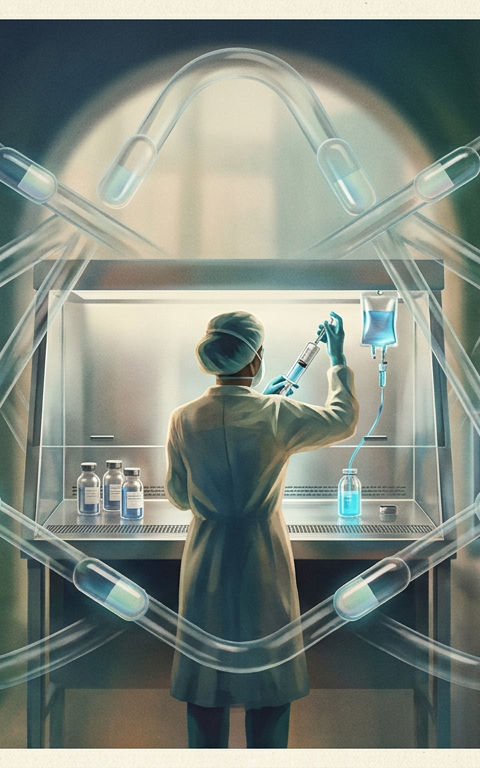
Medium NAPLEX Sterile Compounding Practice Questions
Medium NAPLEX Sterile Compounding Practice Questions
May 31, 2026

Hard NAPLEX Sterile Compounding Practice Questions
Hard NAPLEX Sterile Compounding Practice Questions
May 31, 2026

Hard NAPLEX Compounding Calculations Practice Questions
Hard NAPLEX Compounding Calculations Practice Questions
May 31, 2026

Hard NAPLEX Nonsterile Compounding Practice Questions
Hard NAPLEX Nonsterile Compounding Practice Questions
May 31, 2026
Medium NAPLEX Compounding Calculations Practice Questions
Master medium-level NAPLEX compounding calculations with this guide featuring alligation, mEq formulas, isotonicity problems, and 10 detailed practice questions.
May 31, 2026

Medium NAPLEX Nonsterile Compounding Practice Questions
Medium NAPLEX Nonsterile Compounding Practice Questions
May 31, 2026

Easy NAPLEX Compounding Calculations Practice Questions
Easy NAPLEX Compounding Calculations Practice Questions
May 31, 2026

Applying USP 797 Standards: Solving Sterile Compounding Scenarios
Easy NAPLEX Sterile Compounding Practice Questions
May 31, 2026