Medium NAPLEX Nonsterile Compounding Practice Questions

Concept Explanation
Nonsterile compounding is the process of combining, admixing, diluting, pooling, or otherwise altering a drug or bulk drug substance to create a medication tailored to the needs of an individual patient based on a practitioner’s prescription.
According to the USP General Chapter <795>, nonsterile compounding must adhere to strict standards to ensure the preparation's quality, strength, and purity. This involves selecting appropriate equipment, calculating precise ingredient amounts, and determining the correct Beyond-Use Date (BUD). Key components of nonsterile compounding include the Master Formulation Record (the "recipe") and the Compounding Record (the log of the specific batch made). Mastery of these concepts is essential for success in NAPLEX Prep, as it ensures patient safety and therapeutic efficacy.
Pharmacists must differentiate between simple, moderate, and complex compounding. Simple compounding involves following a USP monograph or reconstituting commercial products. Moderate compounding requires special calculations or making preparations with unknown stability data. Complex compounding involves specialized equipment or procedures, such as transdermal patches or extended-release tablets. Proper technique, such as geometric dilution, ensures that small amounts of potent drugs are uniformly distributed throughout a base.
Solved Examples
The following examples demonstrate common calculations and decision-making processes found in medium-level nonsterile compounding scenarios.
- Geometric Dilution Calculation: A pharmacist needs to mix 500 mg of a potent active pharmaceutical ingredient (API) with 19.5 g of an ointment base. Describe the steps for geometric dilution.
- Place the 500 mg of API on the ointment slab.
- Add an approximately equal amount (500 mg) of the ointment base to the API and mix thoroughly.
- The mixture now weighs 1,000 mg. Add another 1,000 mg of the base and mix.
- Continue doubling the size of the mixture by adding an equal amount of base until all 19.5 g of base are incorporated.
- Determining Beyond-Use Date (BUD): A pharmacist prepares a topical oil-based suspension using manufactured crushed tablets and mineral oil. The preparation is made on May 1st. What is the maximum BUD?
- Identify the preparation type: Nonaqueous formulation.
- Apply USP <795> standards: For nonaqueous formulations, the BUD is not later than the time remaining until the earliest expiration date of any API or 6 months, whichever is earlier.
- If the tablets expire in 1 year, the BUD is November 1st (6 months from May 1st).
- Percentage Strength Calculation: How many grams of hydrocortisone powder are needed to prepare 120 g of a 2.5% hydrocortisone ointment?
- Identify the formula: .
- Convert percentage to decimal: .
- Calculate: .
- Answer: 3 grams of hydrocortisone powder are required.
Practice Questions
Test your knowledge with these Medium NAPLEX Nonsterile Compounding Practice Questions. For additional help with calculations, you might find the AI Question Generator useful for creating custom drills.
- A pharmacist is preparing a 10% salicylic acid ointment using 30 g of a 5% salicylic acid ointment and an appropriate amount of 15% salicylic acid ointment. How many grams of the 15% ointment are required?
- Which USP chapter provides the standards for the hazardous drug handling that may overlap with nonsterile compounding?
- Calculate the Beyond-Use Date for a water-containing oral formulation stored in a refrigerator, prepared today using USP-grade ingredients.
Train like it’s exam day.
Build confidence with timed NAPLEX practice questions, mock exams, and performance analytics.
Start Timed Practice- A prescription calls for 60 mL of a 2% lidocaine solution. The pharmacy only has 5% lidocaine solution and distilled water. How many milliliters of each are needed?
- What is the minimum weighable quantity for a Class A prescription balance with a sensitivity requirement of 6 mg and an acceptable error rate of 5%?
- A pharmacist is compounding a topical cream containing 15% water. According to USP <795>, what is the default BUD for this preserved aqueous dosage form if stored at room temperature?
- When using a mortar and pestle to reduce the particle size of a crystalline powder before incorporating it into a cream, what is the term for this process?
- A pharmacist is preparing a compound that requires 0.5 mL of a potent liquid. If using a 10 mL graduated cylinder with 0.2 mL markings, is this the appropriate equipment?
- Which document must the pharmacist create to provide step-by-step instructions so that another compounder can replicate the preparation exactly?
- If a compounding ingredient does not have an expiration date from the manufacturer, what is the maximum expiration date that should be assigned to the ingredient container by the pharmacy?
Answers & Explanations
- Answer: 30 g. Using the alligation method: Higher strength (15%) - Desired (10%) = 5 parts of the 15%. Desired (10%) - Lower strength (5%) = 5 parts of the 5%. Since the parts are equal (5:5 or 1:1), you need an equal amount of the 15% ointment as the 5% ointment. Thus, 30 g of the 15% ointment is required.
- Answer: USP <800>. While USP <795> covers nonsterile compounding, USP General Chapter <800> provides the safety standards for handling hazardous drugs (HDs) to protect personnel and the environment.
- Answer: 14 days. For water-containing oral formulations, the BUD is no more than 14 days when stored in a refrigerator.
- Answer: 24 mL of 5% solution and 36 mL of water. Using : . . The remainder is water: .
- Answer: 120 mg. The formula is . .
- Answer: 30 days. For water-containing topical/dermal and mucosal liquid and semisolid formulations (like creams), the BUD is not more than 30 days.
- Answer: Trituration. Trituration is the process of grinding a drug with a mortar and pestle to reduce particle size. This is often a precursor to further compounding steps like levigation.
- Answer: No. According to good compounding practices, a graduated cylinder should not be used to measure less than 20% of its total capacity. 20% of 10 mL is 2 mL. 0.5 mL is only 5% of the capacity, making it inaccurate. A syringe or a smaller pipette should be used.
- Answer: Master Formulation Record. The Master Formulation Record serves as the permanent recipe. The Compounding Record is the specific log for a single batch.
- Answer: 3 years. According to USP standards, if a component does not have an expiration date, the pharmacist should assign a conservative date not to exceed 3 years from the date of receipt.
Reviewing nonsterile compounding is as critical as mastering clinical topics like Infectious Disease or Anticoagulation. Precision in the lab translates directly to patient safety.
1. Which technique is used to ensure a small amount of drug is uniformly distributed in a large amount of base?
Frequently Asked Questions
What is the difference between a Master Formulation Record and a Compounding Record?
The Master Formulation Record is the official recipe used to ensure consistency across different batches, while the Compounding Record is a specific log documenting the actual ingredients, lot numbers, and personnel involved in preparing a single, specific prescription.
How do I determine the BUD for a water-containing oral liquid?
For water-containing oral formulations, the Beyond-Use Date is a maximum of 14 days when stored under refrigeration, unless stability data suggests otherwise.
What is levigation in nonsterile compounding?
Levigation is the process of reducing the particle size of a solid by triturating it with a small amount of a liquid or "levigating agent" in which the solid is not soluble, typically to create a smooth paste for an ointment or cream.
When should geometric dilution be used?
Geometric dilution should be used whenever a small amount of a potent drug must be mixed with a much larger amount of diluent or base to ensure the active ingredient is distributed uniformly throughout the entire preparation.
What equipment is best for measuring small volumes of liquid?
For volumes less than 1 mL or volumes that are a very small percentage of a graduated cylinder's capacity, a calibrated syringe or a micropipette is the most accurate equipment to use.
Which USP chapter covers nonsterile compounding?
USP General Chapter <795> provides the essential standards and requirements for nonsterile compounding to ensure the safety and quality of compounded preparations.
Train like it’s exam day.
Build confidence with timed NAPLEX practice questions, mock exams, and performance analytics.
Start Timed PracticeTags
Enjoyed this article?
Share it with others who might find it helpful.
Related Articles

Hard NAPLEX Nonsterile Compounding Practice Questions
Hard NAPLEX Nonsterile Compounding Practice Questions
May 31, 2026
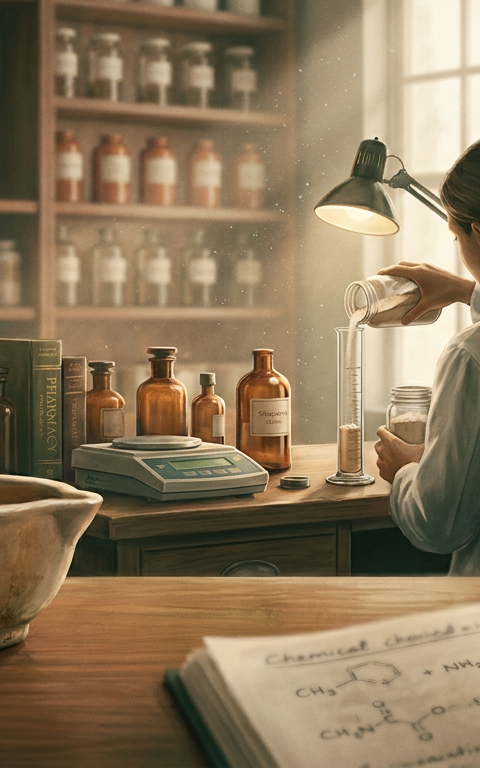
NAPLEX Nonsterile Compounding Practice Questions with Answers
Master NAPLEX Nonsterile Compounding with this guide on USP <795> standards, BUD calculations, and compounding techniques including practice questions and answers.
May 31, 2026
Medium NAPLEX Sterile Compounding Practice Questions
Medium NAPLEX Sterile Compounding Practice Questions
May 31, 2026

Hard NAPLEX Compounding Calculations Practice Questions
Hard NAPLEX Compounding Calculations Practice Questions
May 31, 2026

Hard NAPLEX Sterile Compounding Practice Questions
Hard NAPLEX Sterile Compounding Practice Questions
May 31, 2026
Medium NAPLEX Compounding Calculations Practice Questions
Master medium-level NAPLEX compounding calculations with this guide featuring alligation, mEq formulas, isotonicity problems, and 10 detailed practice questions.
May 31, 2026
Easy NAPLEX Compounding Calculations Practice Questions
Easy NAPLEX Compounding Calculations Practice Questions
May 31, 2026

Mastering USP 795 BUDs and Nonsterile Formulation Math
Easy NAPLEX Nonsterile Compounding Practice Questions
May 31, 2026