Medium NAPLEX Sterile Compounding Practice Questions
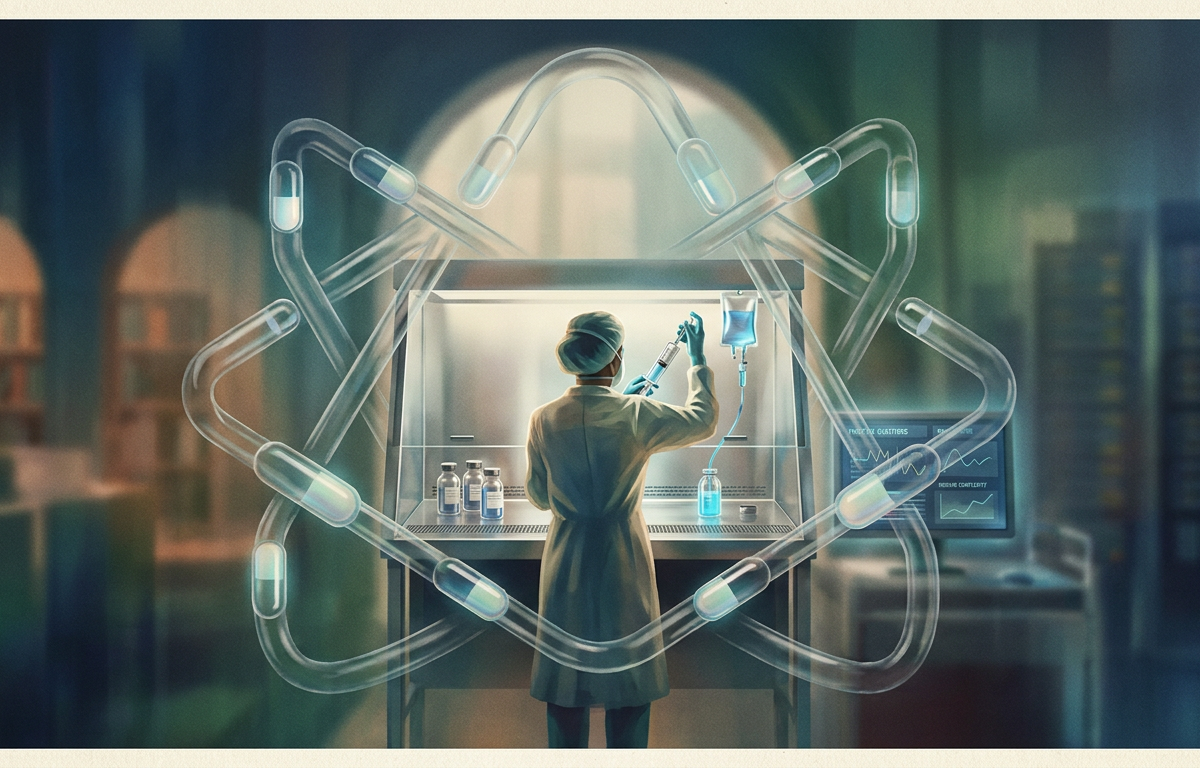
Medium NAPLEX Sterile Compounding Practice Questions
Mastering sterile compounding is essential for pharmacy students preparing for the NAPLEX, as it ensures patient safety by preventing contamination and dosing errors in injectable medications. This guide provides Medium NAPLEX Sterile Compounding Practice Questions designed to test your knowledge of USP <797> standards, cleanroom requirements, and beyond-use dating (BUD). Understanding these concepts is a core component of your NAPLEX Prep journey, bridging the gap between theoretical guidelines and clinical application.
Concept Explanation
Sterile compounding is the process of combining, admixing, or altering ingredients to create a sterile medication intended for administration via injection, infusion, or ophthalmic application. To maintain the sterility of these preparations, pharmacists must adhere to USP Chapter <797>, which outlines the environmental controls, personnel training, and quality assurance measures required. Key concepts include the classification of cleanrooms, where an ISO Class 5 environment (the Primary Engineering Control or PEC) must be maintained within an ISO Class 7 buffer room. Furthermore, the categorization of CSPs (Compounded Sterile Preparations) has shifted from risk levels (low, medium, high) to Category 1, 2, and 3 based on the environment in which they are made and their intended BUD. Proper garbing sequences, aseptic technique, and regular environmental monitoring are non-negotiable standards to prevent healthcare-associated infections. If you are also studying for pharmacotherapy topics, you might find our Medium NAPLEX Infectious Disease Practice Questions helpful, as sterile compounding often involves preparing the antimicrobials discussed there.
Solved Examples
Example: Garbing Sequence
Identify the correct order for donning personal protective equipment (PPE) before entering the buffer room.Don shoe covers, head/facial hair covers, and face masks.
Perform hand hygiene with soap and water for at least 30 seconds.
Don a non-shedding gown.
Enter the buffer room, perform hand sanitization with alcohol-based surgical hand scrub, and don sterile, powder-free gloves.
Example: Beyond-Use Date (BUD) Calculation
A pharmacist prepares a Category 2 CSP in a cleanroom suite (ISO 7 buffer room with ISO 8 ante-room). The preparation is made using only sterile components and is terminally sterilized. According to USP <797>, what is the maximum BUD if stored at room temperature?Identify the storage condition: Room temperature.
Identify the preparation type: Category 2, terminally sterilized.
Reference the USP table: For terminally sterilized Category 2 CSPs stored at room temperature, the BUD is 45 days.
Example: Pressure Differentials
A pharmacy is compounding hazardous sterile drugs. What should the pressure relationship be between the buffer room and the ante-room?Hazardous drug compounding requires negative pressure to protect personnel.
The buffer room must be at a lower pressure (negative) relative to the ante-room.
The pressure differential should be between and inches of water column.
Practice Questions
1. A technician is cleaning the laminar airflow workbench (LAFW). In what order and direction should the surfaces be cleaned to maintain sterility?
2. A multi-dose vial (MDV) of bacteriostatic water for injection is opened today. If stored according to the manufacturer's instructions, what is the maximum BUD for this vial?
3. Calculate the volume of a 50% dextrose solution and sterile water for injection (SWFI) needed to create 500 mL of a 12.5% dextrose solution. Use the allegation method.
Train like it’s exam day.
Build confidence with timed NAPLEX practice questions, mock exams, and performance analytics.
Start Timed Practice4. Which ISO classification is required for the ante-room if it opens into a negative-pressure buffer room used for hazardous drug compounding?
5. A pharmacist is preparing a CSP using a non-sterile powder that will be filtered using a 0.22-micron filter. According to USP <797>, this is considered a Category 2 CSP. If stored in the refrigerator, what is the BUD?
6. How often must a laminar airflow workbench undergo certification to ensure it meets ISO Class 5 standards?
7. During a media-fill test, how many days must the container be incubated, and at what temperatures, to ensure no microbial growth is present?
8. A Segregated Compounding Area (SCA) is used to prepare a Category 1 CSP. What is the maximum BUD for this preparation when stored at room temperature?
9. When using a horizontal laminar flow hood, where should the compounding take place to ensure the cleanest air reaches the preparation?
10. An IV bag contains 1 gram of vancomycin in 250 mL of D5W. If the infusion rate is set to 500 mg per hour, how many milliliters per hour will the patient receive?
Answers & Explanations
Answer: Top to bottom, back to front, and clean to dirty. Surfaces should be cleaned starting with the ceiling (top), then the sides, and finally the work surface (bottom). Each stroke should move from the back (near the HEPA filter) toward the front (the opening) to avoid dragging contaminants over cleaned areas.
Answer: 28 days. Per USP <797> guidelines, the BUD for an opened or entered multi-dose container with antimicrobial preservatives is 28 days unless otherwise specified by the manufacturer.
Answer: 125 mL of D50% and 375 mL of SWFI. Using allegation:
Answer: ISO Class 7. While an ante-room for positive-pressure rooms can be ISO Class 8, an ante-room opening into a negative-pressure buffer room (for hazardous drugs) must be ISO Class 7 to provide a cleaner transition.
Answer: 4 days. For Category 2 CSPs prepared from one or more non-sterile components (equivalent to the old "high-risk" level) and sterilized by filtration, if stored in the refrigerator, the BUD is 4 days. (Note: USP revisions may vary; always check current tables for Category 2 non-sterile to sterile storage).
Answer: Every 6 months. Primary engineering controls (PECs) and the cleanroom suite must be certified at least every 6 months and whenever the device or room is relocated or altered.
Answer: 14 days total. The containers are usually incubated at for 7 days followed by for 7 days (or vice versa) to detect a broad range of microorganisms.
Answer: 12 hours. Category 1 CSPs are prepared in an SCA (which does not meet full cleanroom suite standards). Their BUD is limited to 12 hours at room temperature or 24 hours in a refrigerator.
Answer: At least 6 inches inside the hood. To prevent turbulence and the entry of room air, all compounding must be performed at least 6 inches from the front edge of the laminar flow hood.
Answer: 125 mL/hr.
1. Which of the following describes the correct cleaning agent for a daily wipe-down of the PEC?
Frequently Asked Questions
What is the difference between Category 1 and Category 2 CSPs?
Category 1 CSPs have shorter beyond-use dates and are typically prepared in a segregated compounding area (SCA). Category 2 CSPs have longer beyond-use dates and must be prepared in a cleanroom suite consisting of an ante-room and a buffer room.
How often should the temperature of the medication refrigerator be recorded?
Temperature monitoring should occur at least once daily in pharmacies that store compounded sterile preparations. Many institutions use automated logging systems to ensure continuous monitoring and safety.
What is the required ISO class for the Primary Engineering Control (PEC)?
The PEC, such as a laminar airflow workbench or a compounding aseptic isolator, must maintain an ISO Class 5 environment. This level of air cleanliness is necessary to minimize the risk of contamination during the compounding process.
Can I use a single-dose vial (SDV) for multiple patients?
No, a single-dose vial is intended for a single patient for a single procedure. According to CDC guidelines and USP <797>, any remaining portion must be discarded after the initial entry.
What is the difference between a horizontal and vertical laminar flow hood?
In a horizontal hood, air flows from the back toward the operator, which is standard for non-hazardous compounding. In a vertical hood (like a Biological Safety Cabinet), air flows from the top down and is exhausted away, providing protection for the operator when handling hazardous drugs.
To further refine your clinical knowledge, you might want to explore our Medium NAPLEX Antimicrobial Stewardship Practice Questions. For those looking to streamline their study sessions, the AI Lecture Notes Enhancer can help convert complex sterile compounding regulations into easy-to-digest summaries.
Train like it’s exam day.
Build confidence with timed NAPLEX practice questions, mock exams, and performance analytics.
Start Timed Practice
Train like it’s exam day.
Build confidence with timed NAPLEX practice questions, mock exams, and performance analytics.
Start Timed PracticeTags
Enjoyed this article?
Share it with others who might find it helpful.
Related Articles

Hard NAPLEX Sterile Compounding Practice Questions
Hard NAPLEX Sterile Compounding Practice Questions
May 31, 2026
NAPLEX Sterile Compounding Practice Questions with Answers
NAPLEX Sterile Compounding Practice Questions with Answers
May 31, 2026

Hard NAPLEX Compounding Calculations Practice Questions
Hard NAPLEX Compounding Calculations Practice Questions
May 31, 2026

Hard NAPLEX Nonsterile Compounding Practice Questions
Hard NAPLEX Nonsterile Compounding Practice Questions
May 31, 2026
Medium NAPLEX Compounding Calculations Practice Questions
Master medium-level NAPLEX compounding calculations with this guide featuring alligation, mEq formulas, isotonicity problems, and 10 detailed practice questions.
May 31, 2026

Medium NAPLEX Nonsterile Compounding Practice Questions
Medium NAPLEX Nonsterile Compounding Practice Questions
May 31, 2026

Easy NAPLEX Compounding Calculations Practice Questions
Easy NAPLEX Compounding Calculations Practice Questions
May 31, 2026

Applying USP 797 Standards: Solving Sterile Compounding Scenarios
Easy NAPLEX Sterile Compounding Practice Questions
May 31, 2026