Hard NAPLEX Nonsterile Compounding Practice Questions

Hard NAPLEX Nonsterile Compounding Practice Questions
Mastering nonsterile compounding is a critical component for pharmacy graduates, as it requires a deep understanding of USP Chapter 795 standards, mathematical precision, and knowledge of chemical properties. These Hard NAPLEX Nonsterile Compounding Practice Questions are designed to challenge your ability to apply complex regulations and calculations to real-world pharmacy scenarios. To succeed on the exam, candidates must be proficient in determining beyond-use dates (BUDs), selecting appropriate equipment, and ensuring the safety and efficacy of customized medications for patients who cannot use commercially available products.
Concept Explanation
Nonsterile compounding is the process of combining, admixing, diluting, pooling, or otherwise altering a drug or bulk drug substance to create a medication tailored to the needs of an individual patient as determined by a practitioner. This practice is primarily governed by USP Chapter <795>, which establishes the standards for compounding quality and safety. Unlike sterile compounding, nonsterile preparations do not require a strictly aseptic environment but must still be prepared in a dedicated, clean space to prevent cross-contamination. Key concepts include the categorization of compounding (Simple, Moderate, Complex), the selection of ingredients (USP/NF grade preferred), and the rigorous calculation of beyond-use dates based on the water activity () and chemical stability of the final product. Understanding these fundamentals is essential for anyone utilizing a NAPLEX Prep program to prepare for the board exam.
Compounding involves several technical steps, such as levigation (reducing particle size with a liquid), trituration (grinding to a fine powder), and geometric dilution (ensuring a homogenous mix of potent ingredients). Pharmacists must also be familiar with the Master Formulation Record (the "recipe") and the Compounding Record (the specific log of a prepared batch). For those looking to sharpen their skills in other high-stakes areas, reviewing Hard NAPLEX Anticoagulation Practice Questions can provide additional clinical context.
Solved Examples
- Beyond-Use Date (BUD) Determination: A pharmacist compounds a topical cream containing 2% ketoconazole and 1% hydrocortisone using a commercially available moisturizing cream base that contains water. The preparation is stored at room temperature. What is the maximum BUD?
- Identify the preparation type: It is a water-containing topical/dermal semisolid.
- Refer to USP <795> guidelines: For water-containing topical formulations, the BUD is not to exceed 30 days.
- Final Answer: 30 days.
- Percentage Strength Calculation: How many grams of a 5% hydrocortisone ointment should be mixed with 120 g of a 1% hydrocortisone ointment to produce a 2.5% ointment?
- Use the allegation method. Set up the grid: High (5%), Low (1%), Target (2.5%).
- Calculate parts: parts of the 5% ointment; parts of the 1% ointment.
- Set up the ratio: .
- Solve for : .
- Final Answer: 72 grams of 5% ointment.
- HLB System Calculation: A pharmacist is asked to prepare an emulsion using 20 g of an emulsifier blend with a required HLB of 12. They have Tween 80 (HLB 15) and Span 80 (HLB 4.3). How much Tween 80 is needed?
- Set up the equation: .
- Solve for : .
- Calculate grams: .
- Final Answer: 14.39 g of Tween 80.
Practice Questions
- A pharmacist is compounding a progesterone oral suspension using a manufactured tablet as the source of the active ingredient and a preserved, water-containing vehicle. According to USP <795>, if no stability data is available, what is the maximum beyond-use date when stored in a refrigerator?
- Calculate the weight of 15% (w/w) salicylic acid ointment that can be prepared from 45 grams of pure salicylic acid powder.
- Anhydrous morphine sulfate powder is used to create a 5 mg/mL oral solution in a non-aqueous, preserved glycol base. If the preparation is stored at room temperature, what is the maximum allowable BUD under USP <795>?
Train like it’s exam day.
Build confidence with timed NAPLEX practice questions, mock exams, and performance analytics.
Start Timed Practice- A prescription calls for 60 grams of a 0.025% tretinoin cream. The pharmacy stocks 0.1% tretinoin cream and a moisturizing base. How many grams of the 0.1% cream and the base are required?
- Which of the following mortar and pestle types is most appropriate for mixing a liquid into a cream or for levigating a powder with a small amount of liquid?
- A pharmacist needs to prepare 30 mL of a 2% (w/v) solution of a drug. The stock solution available is 10% (w/v). How much diluent is needed to prepare this order?
- A nonsterile preparation of a cough syrup contains 15% alcohol v/v. If the total volume of the syrup is 473 mL, how many milliliters of 95% alcohol are required to achieve this concentration?
- According to USP <795>, what is the appropriate BUD for a non-aqueous formulation (such as a petrolatum-based ointment) when the stability of the ingredients is unknown?
- A compounder is using the AI Question Generator to study for the NAPLEX and encounters a question about the displacement value of cocoa butter. If a medicated suppository weighs 2.1 g and the blank cocoa butter suppository weighs 2.0 g, and the drug weight is 0.5 g, what is the displacement value of the drug?
- When performing geometric dilution, at what point should the active pharmaceutical ingredient (API) be added if the volume of the API is significantly smaller than the volume of the diluent?
Answers & Explanations
- Answer: 14 days. For water-containing oral formulations, USP <795> specifies a BUD of 14 days when stored under refrigerated conditions, unless stability data suggests otherwise.
- Answer: 300 grams. To find the total weight, use the formula: .
- Answer: 90 days. For non-aqueous oral formulations, USP <795> guidelines allow for a BUD of up to 90 days when stored at room temperature or refrigerated.
- Answer: 15 g of 0.1% cream and 45 g of base. Using : . The base needed is .
- Answer: Glass mortar and pestle. Glass is preferred for mixing liquids and semi-solids because it is non-porous and does not stain. Porcelain is better for grinding dry crystals into fine powders.
- Answer: 24 mL. First, find the volume of stock solution: . The diluent needed is .
- Answer: 74.68 mL. Use the formula : .
- Answer: 180 days. USP <795> states that for non-aqueous formulations, the BUD is not to exceed 180 days (6 months) at room temperature.
- Answer: 1.25. Displacement value is calculated as . The weight of base displaced is . Displacement value = .
- Answer: At the beginning. In geometric dilution, you start with the smallest volume ingredient (usually the API) and add an equal volume of diluent, repeating the process until all ingredients are incorporated.
1. Which USP chapter specifically addresses the standards for nonsterile compounding?
Frequently Asked Questions
What is the difference between simple and moderate compounding?
Simple compounding involves following a USP monograph or a peer-reviewed article with specific instructions, while moderate compounding requires more complex calculations or specialized equipment to ensure stability. Moderate compounding usually involves preparations where stability data for that specific formulation is not available.
Can I use tap water for nonsterile compounding?
No, tap water is not acceptable for nonsterile compounding because it contains minerals and microbial contaminants. According to FDA guidelines and USP standards, Purified Water (USP) or better must be used for all nonsterile preparations.
How do I determine the BUD if the ingredients have different expiration dates?
The BUD of a compounded preparation can never exceed the expiration date of any individual component. You must compare the calculated BUD based on USP <795> categories against the manufacturer's expiration dates on the ingredient bottles and use the earliest date.
What is the role of a levigating agent?
A levigating agent, such as mineral oil or glycerin, is used to reduce the particle size of a solid and help incorporate it into an ointment or cream base. It acts as a wetting agent to ensure the powder is evenly distributed without being gritty.
Where can I find more resources for NAPLEX math?
Practicing with a variety of clinical scenarios is the best way to prepare. You can find specialized practice in areas like Hard NAPLEX Renal Therapeutics Practice Questions or Hard NAPLEX Infectious Disease Practice Questions to build comprehensive clinical knowledge.
Train like it’s exam day.
Build confidence with timed NAPLEX practice questions, mock exams, and performance analytics.
Start Timed PracticeTags
Enjoyed this article?
Share it with others who might find it helpful.
Related Articles

Medium NAPLEX Nonsterile Compounding Practice Questions
Medium NAPLEX Nonsterile Compounding Practice Questions
May 31, 2026
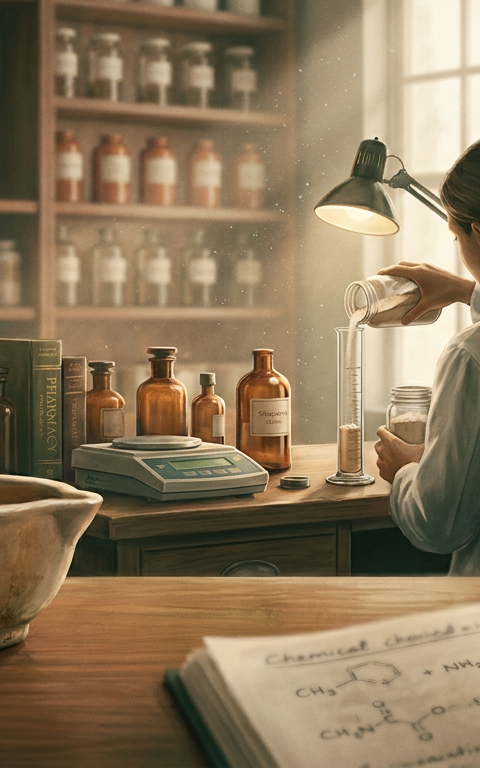
NAPLEX Nonsterile Compounding Practice Questions with Answers
Master NAPLEX Nonsterile Compounding with this guide on USP <795> standards, BUD calculations, and compounding techniques including practice questions and answers.
May 31, 2026
Medium NAPLEX Sterile Compounding Practice Questions
Medium NAPLEX Sterile Compounding Practice Questions
May 31, 2026

Hard NAPLEX Compounding Calculations Practice Questions
Hard NAPLEX Compounding Calculations Practice Questions
May 31, 2026

Hard NAPLEX Sterile Compounding Practice Questions
Hard NAPLEX Sterile Compounding Practice Questions
May 31, 2026
Medium NAPLEX Compounding Calculations Practice Questions
Master medium-level NAPLEX compounding calculations with this guide featuring alligation, mEq formulas, isotonicity problems, and 10 detailed practice questions.
May 31, 2026

Easy NAPLEX Compounding Calculations Practice Questions
Easy NAPLEX Compounding Calculations Practice Questions
May 31, 2026

Mastering USP 795 BUDs and Nonsterile Formulation Math
Easy NAPLEX Nonsterile Compounding Practice Questions
May 31, 2026