Molecular Formula Practice Questions with Answers
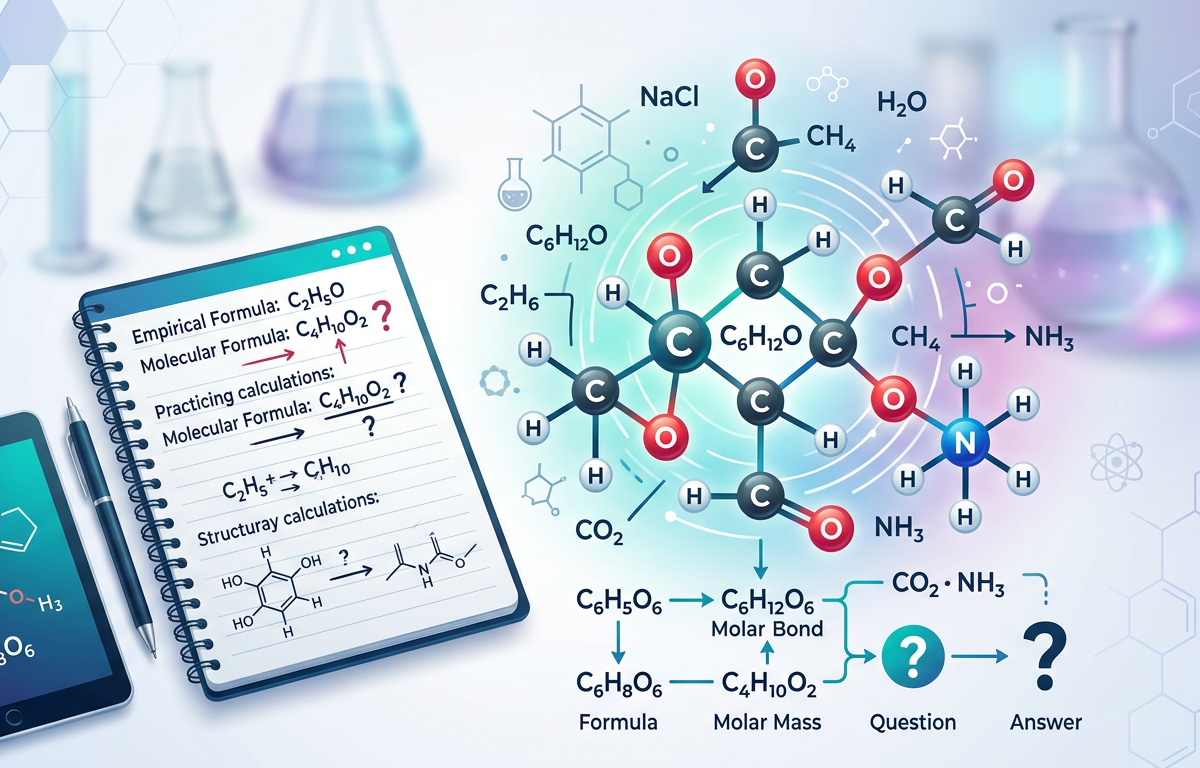
A molecular formula is a chemical formula that expresses the exact number and type of atoms of each element present in a single molecule of a substance. Understanding how to calculate a molecular formula is a cornerstone of stoichiometry practice questions and essential for identifying unknown chemical compounds in the laboratory. Unlike an empirical formula, which represents the simplest whole-number ratio of elements, the molecular formula provides the actual chemical identity of the compound, reflecting its true molar mass and properties.
Whether you are preparing for a general chemistry exam or working through mole concept practice questions, mastering the relationship between empirical and molecular formulas is vital. This guide provides a comprehensive overview of the concept, detailed solved examples, and a wide range of practice problems to sharpen your skills.
Concept Explanation
The molecular formula is the actual representation of a molecule's composition, indicating the specific number of atoms for every element within that molecule. To determine a molecular formula, you must know two key pieces of information: the compound's empirical formula and its experimental molar mass. The molecular formula is always a whole-number multiple of the empirical formula.
The relationship is expressed by the mathematical equation: Molecular Formula = (Empirical Formula) × n, where n is the molar mass of the compound divided by the molar mass of the empirical formula. This integer n represents how many empirical units fit into the actual molecule. For some substances, like water (H₂O) or methane (CH₄), the empirical and molecular formulas are identical because the ratio of atoms cannot be simplified further. However, for many organic compounds, such as glucose (C₆H₁₂O₆), the molecular formula is a larger multiple of the empirical formula (CH₂O).
According to the Wikipedia entry on chemical formulas, this distinction is critical because different compounds can share the same empirical formula but have vastly different chemical behaviors due to their specific molecular structures. To solve these problems effectively, students must often convert mass percentages to moles, a process also explored in moles to grams practice questions.
Solved Examples
Below are step-by-step solutions for common molecular formula problems, ranging from simple multipliers to full analysis from percent composition.
Example 1: Finding the Multiplier
A compound has an empirical formula of CH₂ and a molar mass of 42.08 g/mol. Determine its molecular formula.
Calculate the empirical formula mass: C (12.01) + 2 × H (1.008) = 14.026 g/mol.
Find the multiplier (n): 42.08 / 14.026 ≈ 3.
Multiply the empirical formula by 3: C(1×3) H(2×3) = C₃H₆.
Example 2: From Percent Composition
A substance contains 40.0% Carbon, 6.7% Hydrogen, and 53.3% Oxygen by mass. Its molar mass is 180.16 g/mol. Find the molecular formula.
Assume a 100g sample: 40.0g C, 6.7g H, 53.3g O.
Convert to moles: C = 40.0/12.01 = 3.33; H = 6.7/1.008 = 6.65; O = 53.3/16.00 = 3.33.
Divide by the smallest value (3.33): C=1, H=2, O=1. Empirical formula is CH₂O.
Empirical mass = 12.01 + 2.016 + 16.00 = 30.026 g/mol.
n = 180.16 / 30.026 = 6.
Molecular formula = C₆H₁₂O₆.
Example 3: Working with Nitrogen Oxides
An oxide of nitrogen has an empirical formula of NO₂ and a molar mass of 92.02 g/mol. What is its molecular formula?
Calculate empirical mass: 14.01 (N) + 2 × 16.00 (O) = 46.01 g/mol.
Determine n: 92.02 / 46.01 = 2.
Multiply: N(1×2)O(2×2) = N₂O₄.
Practice Questions
1. A compound with the empirical formula NH₂ has a molar mass of 32.05 g/mol. What is its molecular formula?
2. Analysis of a gas reveals it is 85.7% Carbon and 14.3% Hydrogen. If its molar mass is 56.12 g/mol, find its molecular formula.
3. A compound has an empirical formula of CH₂O and a molar mass of 60.06 g/mol. Determine the molecular formula.
Want unlimited practice questions like these?
Generate AI-powered questions with step-by-step solutions on any topic.
Try Question Generator Free →4. Caffeine has an empirical formula of C₄H₅N₂O and a molar mass of 194.19 g/mol. What is its molecular formula?
5. A sample is 24.78% Carbon, 2.08% Hydrogen, and 73.14% Chlorine. The molar mass is 290.8 g/mol. Find the molecular formula.
6. Benzene has an empirical formula of CH and a molar mass of 78.11 g/mol. Find the molecular formula.
7. A compound is 43.64% Phosphorus and 56.36% Oxygen. Its molar mass is 283.88 g/mol. What is the molecular formula?
8. Ethylene glycol (antifreeze) has an empirical formula of CH₃O and a molar mass of 62.07 g/mol. Determine the molecular formula.
9. A compound contains 82.66% Carbon and 17.34% Hydrogen. The molar mass is 58.12 g/mol. Find the molecular formula.
10. An unknown compound has an empirical formula of PCl₃ and a molar mass of 137.33 g/mol. What is its molecular formula?
Answers & Explanations
1. N₂H₄: Empirical mass of NH₂ is 16.03 g/mol. Molar mass (32.05) / 16.03 = 2. Multiplying NH₂ by 2 gives N₂H₄ (Hydrazine).
2. C₄H₈: Moles of C = 85.7/12.01 = 7.14. Moles of H = 14.3/1.008 = 14.19. Ratio 1:2, so empirical formula is CH₂. Empirical mass is 14.03. 56.12 / 14.03 = 4. Molecular formula is C₄H₈.
3. C₂H₄O₂: Empirical mass of CH₂O is 30.03 g/mol. 60.06 / 30.03 = 2. Molecular formula is C₂H₄O₂ (Acetic acid).
4. C₈H₁₀N₄O₂: Empirical mass of C₄H₅N₂O = (4×12.01) + (5×1.008) + (2×14.01) + (1×16.00) = 97.10 g/mol. 194.19 / 97.10 = 2. Molecular formula is C₈H₁₀N₄O₂.
5. C₆H₆Cl₆: Moles: C=2.06, H=2.06, Cl=2.06. Empirical formula is CHCl. Empirical mass = 48.47 g/mol. 290.8 / 48.47 = 6. Molecular formula is C₆H₆Cl₆.
6. C₆H₆: Empirical mass of CH is 13.02 g/mol. 78.11 / 13.02 = 6. Molecular formula is C₆H₆.
7. P₄O₁₀: Moles: P = 43.64/30.97 = 1.41; O = 56.36/16.00 = 3.52. Ratio P1O2.5, which simplifies to P₂O₅. Empirical mass = 141.94. 283.88 / 141.94 = 2. Molecular formula is P₄O₁₀.
8. C₂H₆O₂: Empirical mass of CH₃O = 12.01 + 3.024 + 16.00 = 31.03 g/mol. 62.07 / 31.03 = 2. Molecular formula is C₂H₆O₂.
9. C₄H₁₀: Moles: C = 82.66/12.01 = 6.88; H = 17.34/1.008 = 17.2. Ratio C1H2.5, simplifies to C₂H₅. Empirical mass = 29.06. 58.12 / 29.06 = 2. Molecular formula is C₄H₁₀.
10. PCl₃: Empirical mass = 30.97 + (3×35.45) = 137.32 g/mol. 137.33 / 137.32 = 1. The molecular formula is the same as the empirical formula: PCl₃.
1. Which piece of information is NOT required to find the molecular formula?
Frequently Asked Questions
What is the difference between an empirical and a molecular formula?
The empirical formula represents the simplest whole-number ratio of atoms in a compound, while the molecular formula shows the actual number of atoms of each element in a molecule. For example, the empirical formula of hydrogen peroxide is HO, but its molecular formula is H₂O₂.
How do you calculate the multiplier 'n'?
The multiplier n is calculated by dividing the experimentally determined molar mass of the compound by the mass of its empirical formula. This integer tells you how many empirical units make up the actual molecule.
Can two different compounds have the same molecular formula?
Yes, substances known as isomers have the same molecular formula but different structural arrangements, leading to different chemical and physical properties. This is common in organic chemistry, such as with butane and isobutane (both C₄H₁₀).
Why is the molecular formula important in chemistry?
The molecular formula is essential because it allows scientists to determine the exact composition of a substance, which is necessary for calculating reaction yields and understanding molecular structure. For further reading on chemical identification, visit the American Chemical Society resources.
Is it possible for 'n' to be a decimal?
No, the multiplier n must always be a whole number because you cannot have a fraction of an atom in a molecule. If your calculation results in a number like 1.99 or 2.01, you should round to the nearest whole number (2 in this case).
Want unlimited practice questions like these?
Generate AI-powered questions with step-by-step solutions on any topic.
Try Question Generator Free →Enjoyed this article?
Share it with others who might find it helpful.
Related Articles

Calculating High-Stakes Meds: BSA Mosteller Formula Practice
Master hard body surface area-based dosage calculations with our comprehensive guide, solved examples, and practice questions for healthcare students.
May 17, 2026

Solving High-Stakes IV Titrations and Weight-Based Infusions
Master advanced IV flow rate calculations with these hard practice questions. Covers weight-based dosing, titrations, and dimensional analysis for nurses.
May 17, 2026

Solving Weight-Based Dosing: The 2.2 Conversion and Rounding Logic
Weight-Based Dosage Calculations Practice Questions with Answers
May 17, 2026
Predicting Periodic Anomalies: Beyond Basic Trend Rules
Hard Periodic Trends Practice Questions
Apr 4, 2026

Hard Electron Configuration Practice Questions
Hard Electron Configuration Practice Questions
Apr 4, 2026
Medium Electron Configuration Practice Questions
Master medium-level electron configuration with our comprehensive guide, including solved examples, stability exceptions, and practice questions with answers.
Apr 4, 2026
Easy Electron Configuration Practice Questions
Master the basics of atomic structure with our Easy Electron Configuration Practice Questions. Learn the Aufbau principle and how to write configurations.
Apr 4, 2026
Electron Configuration Practice Questions with Answers
Master electron configuration with our comprehensive guide featuring solved examples, practice questions, and detailed explanations for chemistry students.
Apr 4, 2026