Mole-to-Mole Stoichiometry Practice Questions with Answers

Mole-to-Mole Stoichiometry Practice Questions with Answers
Mole-to-mole stoichiometry is the quantitative study of the relationships between the amounts of reactants used and products formed in a chemical reaction based on their molar ratios. Mastering this concept is essential for anyone studying chemistry, as it forms the foundation for more complex calculations like identifying limiting reagents or determining percent yield. By understanding how to interpret a balanced chemical equation, students can predict exactly how many moles of one substance are needed to react with or produce a specific amount of another.
Concept Explanation
Mole-to-mole stoichiometry is a method used to calculate the number of moles of one substance based on the known moles of another substance in a balanced chemical equation. This process relies entirely on the coefficients of the balanced equation, which represent the mole ratio between the species involved. For example, in the synthesis of water (2H₂ + O₂ → 2H₂O), the coefficients tell us that 2 moles of hydrogen gas react with 1 mole of oxygen gas to produce 2 moles of water.
To perform these calculations successfully, you must follow a consistent logical path:
Balance the Equation: You cannot perform stoichiometry without a balanced equation. The Law of Conservation of Mass, as explained by Wikipedia, requires that the number of atoms for each element remains constant.
Identify the Given and Unknown: Determine which substance you have information about and which substance you are trying to find.
Set up the Mole Ratio: Use the coefficients from the balanced equation to create a conversion factor. The unknown substance goes on top (numerator), and the given substance goes on the bottom (denominator).
Calculate: Multiply the given moles by the mole ratio to find the answer.
According to Khan Academy, stoichiometry is essentially "chemical bookkeeping." It ensures that scientists in fields like pharmacology and engineering use the correct proportions of chemicals to avoid waste and ensure safety. If you are just starting out, you might find it helpful to review our guide on mole ratio practice questions before tackling these complex problems.
Solved Examples
The following examples demonstrate how to use balanced equations to convert between moles of different substances.
Example 1: Synthesis of Ammonia
How many moles of ammonia (NH₃) are produced when 0.60 moles of nitrogen gas (N₂) react completely with hydrogen gas?
Equation: N₂ + 3H₂ → 2NH₃
Identify the ratio: The ratio of N₂ to NH₃ is 1:2.
Set up the conversion: 0.60 moles N₂ × (2 moles NH₃ / 1 mole N₂).
Calculate: 0.60 × 2 = 1.20 moles of NH₃.
Example 2: Combustion of Propane
How many moles of oxygen (O₂) are required to burn 2.5 moles of propane (C₃H₈)?
Equation: C₃H₈ + 5O₂ → 3CO₂ + 4H₂O
Identify the ratio: The ratio of C₃H₈ to O₂ is 1:5.
Set up the conversion: 2.5 moles C₃H₈ × (5 moles O₂ / 1 mole C₃H₈).
Calculate: 2.5 × 5 = 12.5 moles of O₂.
Example 3: Decomposition of Potassium Chlorate
If 0.50 moles of oxygen (O₂) are produced, how many moles of KClO₃ were decomposed?
Equation: 2KClO₃ → 2KCl + 3O₂
Identify the ratio: The ratio of O₂ to KClO₃ is 3:2.
Set up the conversion: 0.50 moles O₂ × (2 moles KClO₃ / 3 moles O₂).
Calculate: (0.50 × 2) / 3 = 0.33 moles of KClO₃.
Practice Questions
How many moles of H₂O are produced from 4.0 moles of O₂ in the reaction: 2H₂ + O₂ → 2H₂O?
In the reaction 2Al + 3Cl₂ → 2AlCl₃, how many moles of Aluminum (Al) are needed to react with 9.0 moles of Chlorine (Cl₂)?
Given the equation N₂ + 3H₂ → 2NH₃, how many moles of H₂ are needed to produce 10.0 moles of NH₃?
[CTA_BLOCK_0]
How many moles of CO₂ are produced when 0.75 moles of C₃H₈ burn? (Equation: C₃H₈ + 5O₂ → 3CO₂ + 4H₂O)
In the reaction 2Na + Cl₂ → 2NaCl, how many moles of NaCl are produced from 5.2 moles of Cl₂?
How many moles of O₂ react with 2.4 moles of Fe in the reaction: 4Fe + 3O₂ → 2Fe₂O₃?
If 1.5 moles of Cu are produced, how many moles of Al were used? (Equation: 2Al + 3CuCl₂ → 3Cu + 2AlCl₃)
How many moles of H₂ are required to react with 0.45 moles of N₂? (Equation: N₂ + 3H₂ → 2NH₃)
In the reaction 2H₂O₂ → 2H₂O + O₂, how many moles of O₂ are released from 6.0 moles of H₂O₂?
How many moles of P₄O₁₀ are produced from 1.2 moles of P₄? (Equation: P₄ + 5O₂ → P₄O₁₀)
Answers & Explanations
8.0 moles H₂O. The ratio of O₂ to H₂O is 1:2. Multiply 4.0 moles O₂ by 2.
6.0 moles Al. The ratio of Cl₂ to Al is 3:2. Calculation: 9.0 × (2/3) = 6.0.
15.0 moles H₂. The ratio of NH₃ to H₂ is 2:3. Calculation: 10.0 × (3/2) = 15.0.
2.25 moles CO₂. The ratio of C₃H₈ to CO₂ is 1:3. Calculation: 0.75 × 3 = 2.25.
10.4 moles NaCl. The ratio of Cl₂ to NaCl is 1:2. Calculation: 5.2 × 2 = 10.4.
1.8 moles O₂. The ratio of Fe to O₂ is 4:3. Calculation: 2.4 × (3/4) = 1.8.
1.0 mole Al. The ratio of Cu to Al is 3:2. Calculation: 1.5 × (2/3) = 1.0.
1.35 moles H₂. The ratio of N₂ to H₂ is 1:3. Calculation: 0.45 × 3 = 1.35.
3.0 moles O₂. The ratio of H₂O₂ to O₂ is 2:1. Calculation: 6.0 / 2 = 3.0.
1.2 moles P₄O₁₀. The ratio of P₄ to P₄O₁₀ is 1:1. Therefore, the moles remain the same.
Quick Quiz
Frequently Asked Questions
What is a mole ratio?
A mole ratio is a conversion factor derived from the coefficients of a balanced chemical equation that relates the amounts in moles of any two substances involved in the reaction. It allows chemists to switch from the known quantity of one substance to the unknown quantity of another.
Can I do mole-to-mole stoichiometry without balancing the equation?
No, you cannot perform accurate stoichiometry without a balanced equation because the coefficients provide the necessary ratios for the calculation. An unbalanced equation violates the Law of Conservation of Mass and will lead to incorrect results.
What is the difference between a mole and a molecule in stoichiometry?
A mole represents a specific large quantity of particles (6.022 x 10²³), whereas a molecule is a single unit of a covalent compound. In stoichiometry, the coefficients in an equation represent both the ratio of individual molecules and the ratio of moles.
Why is mole-to-mole stoichiometry important in real life?
This concept is vital in industries like medicine and manufacturing to ensure that the correct amount of reactants are used to produce a desired amount of product without wasting expensive materials. It is also used in environmental science to calculate pollutant emissions.
How do I know which number goes on top in a mole ratio?
In a mole ratio conversion factor, the coefficient of the substance you are trying to find (the unknown) always goes in the numerator. The coefficient of the substance you already have information about (the given) always goes in the denominator.
Do I need molar mass for mole-to-mole problems?
No, molar mass is not required for basic mole-to-mole stoichiometry problems because the conversion stays within the unit of moles. Molar mass is only necessary when you need to convert between grams and moles.
Want unlimited practice questions like these?
Generate AI-powered questions with step-by-step solutions on any topic.
Try Question Generator Free →Enjoyed this article?
Share it with others who might find it helpful.
Related Articles
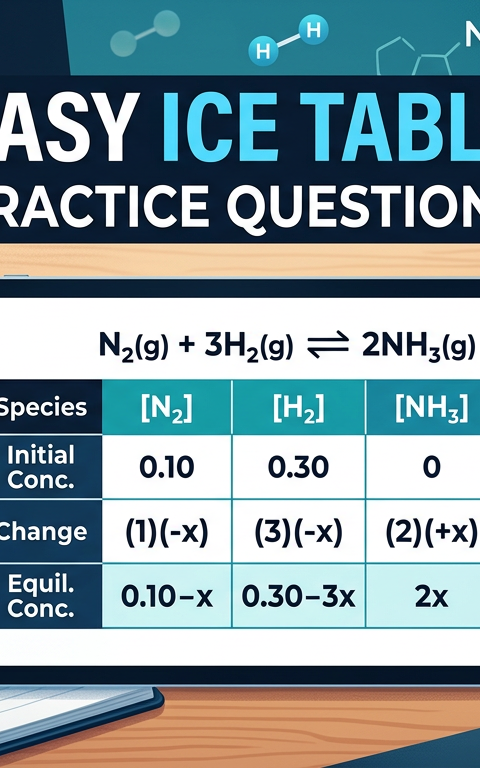
Solving Equilibrium Problems Without Losing Your Stoichiometry
Master chemical equilibrium with these easy ICE table practice questions. Learn to calculate concentrations and K values with step-by-step solved examples.
Mar 30, 2026

Solving Titration Math: From M1V1 to Polyprotic Stoichiometry
Master the basics of neutralization with our easy acid-base titration practice questions. Includes step-by-step solved examples and a quick quiz.
Mar 29, 2026

Stoichiometry of the Flask: Calculating Solute Mass and Dilutions
Master solution preparation with these easy practice questions. Learn to calculate molarity, mass, and dilutions with step-by-step examples and a quick quiz.
Mar 27, 2026

Stoichiometry Word Practice Questions with Answers
Master stoichiometry word problems with our comprehensive guide. Includes step-by-step solved examples, practice questions, and detailed answer explanations.
Mar 24, 2026
Gas Stoichiometry Practice Questions with Answers
Master gas stoichiometry with our comprehensive guide. Includes solved examples, PV=nRT practice questions, and detailed answers for chemistry students.
Mar 23, 2026
Predicting Reaction Yields: Grams-to-Grams Stoichiometry Guide
Master mass-to-mass stoichiometry with our comprehensive guide. Includes step-by-step solved examples, practice questions, and a quick quiz to test your knowledge.
Mar 21, 2026

Stoichiometry vs. Reality: Calculating Percent Yield in Chemistry
Master percent yield calculations with our guide. Includes step-by-step solved examples, practice questions, and a quiz to test your chemistry skills.
Mar 21, 2026

Calculating High-Stakes Meds: BSA Mosteller Formula Practice
Master hard body surface area-based dosage calculations with our comprehensive guide, solved examples, and practice questions for healthcare students.
May 17, 2026