Medium Strong Acid vs Weak Acid Practice Questions
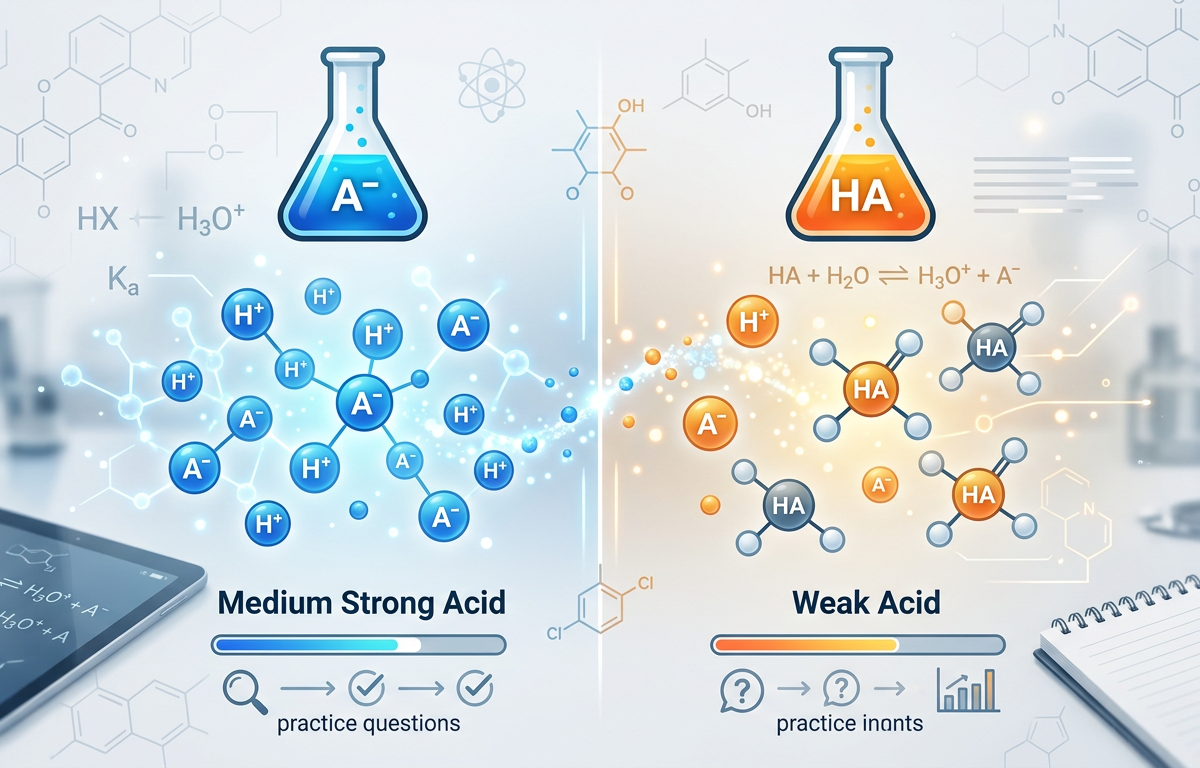
Concept Explanation
The primary difference between a strong acid and a weak acid is the extent to which they dissociate into ions when dissolved in water. A strong acid is a substance that undergoes 100% ionization in aqueous solution, meaning every molecule of the acid releases its proton to form hydronium ions (H₃O⁺). Examples include hydrochloric acid (HCl) and sulfuric acid (H₂SO₄). In contrast, a weak acid only partially dissociates, establishing a dynamic equilibrium between the intact molecular acid and its constituent ions. This behavior is quantified by the acid dissociation constant (Ka), where a smaller Ka indicates a weaker acid. Understanding this distinction is essential for performing pH calculation practice questions correctly, as strong acids allow for direct determination of [H⁺] from the initial concentration, while weak acids require equilibrium calculations.
To distinguish between these two categories, chemists often look at the bond strength and polarity of the H-A bond. In strong acids, the bond is weak enough that water molecules can easily pull the proton away. In weak acids, the bond is stronger or the resulting conjugate base is less stable, making the forward reaction less favorable. This concept is fundamental when working with buffer solution practice questions, which almost exclusively involve weak acids and their conjugate bases to resist pH changes.
Solved Examples
Review these worked examples to understand how to apply the principles of acid strength to mathematical problems.
Calculate the pH of a 0.025 M solution of Nitric Acid (HNO₃).
Identify the acid: HNO₃ is one of the seven common strong acids.
Determine [H⁺]: Since it is a strong acid, [H⁺] = [HNO₃] = 0.025 M.
Apply the pH formula: pH = -log[H⁺].
Calculate: pH = -log(0.025) = 1.60.
Determine the [H⁺] concentration in a 0.10 M solution of Acetic Acid (CH₃COOH) with a Ka of 1.8 x 10⁻⁵.
Identify the acid: Acetic acid is a weak acid (partial dissociation).
Set up the Ka expression: Ka = [H⁺][CH₃COO⁻] / [CH₃COOH].
Use the "x² / C" approximation: 1.8 x 10⁻⁵ = x² / 0.10.
Solve for x: x² = 1.8 x 10⁻⁶; x = √1.8 x 10⁻⁶ = 1.34 x 10⁻³ M.
Result: [H⁺] = 1.34 x 10⁻³ M.
Predict which solution has a lower pH: 0.1 M HF or 0.1 M HCl.
Analyze HCl: It is a strong acid, so [H⁺] = 0.1 M.
Analyze HF: It is a weak acid (Ka ≈ 6.6 x 10⁻⁴), so [H⁺] will be significantly less than 0.1 M.
Compare: Higher [H⁺] results in a lower pH.
Conclusion: 0.1 M HCl has a lower pH than 0.1 M HF.
Practice Questions
Identify whether HBr is a strong acid or a weak acid and calculate the pH of a 0.0045 M solution.
A 0.50 M solution of a monoprotic acid has a pH of 3.2. Is this a strong or weak acid?
Calculate the percent ionization of a 0.15 M solution of Hydrofluoric acid (HF) given Ka = 6.6 x 10⁻⁴.
Want unlimited practice questions like these?
Generate AI-powered questions with step-by-step solutions on any topic.
Try Question Generator Free →Which has a higher concentration of hydroxide ions (OH⁻): 0.1 M HCl or 0.1 M HCN (Ka = 4.9 x 10⁻¹⁰)?
If the Ka of an acid is 1.0 x 10⁻², what is the [H⁺] in a 0.20 M solution?
What is the pH of a 0.012 M solution of Perchloric acid (HClO₄)?
Compare the conductivity of 1.0 M Formic acid (HCOOH) and 1.0 M Hydrochloric acid (HCl). Which is higher and why?
An unknown acid HA has a pKa of 4.75. Calculate the pH of a 0.10 M solution. (Hint: See pKa and pKb practice questions for help with conversions).
Rank the following 0.1 M solutions in order of increasing pH: HI, HF, H₂O, and NH₄⁺.
If a solution of 0.10 M HA is 1.3% ionized, calculate the Ka of the acid.
Answers & Explanations
Strong acid; pH = 2.35. HBr is a strong acid that dissociates completely. pH = -log(0.0045) = 2.346.
Weak acid. If it were strong, the pH would be -log(0.50) = 0.30. Since the actual pH (3.2) is much higher, the acid is weak.
6.6%. Set up Ka = x² / 0.15. x = √(6.6 x 10⁻⁴ * 0.15) = 0.00995. Percent ionization = (0.00995 / 0.15) * 100 = 6.63%.
0.1 M HCN. HCl is a strong acid, producing more H⁺, which results in a lower OH⁻ concentration (due to Kw). HCN is a weak acid, producing less H⁺, allowing for a higher [OH⁻].
0.045 M. Using the quadratic formula (since Ka is relatively large): x² + 0.01x - 0.002 = 0. Resulting in x ≈ 0.040 M (or 0.045 M if using successive approximations).
1.92. HClO₄ is a strong acid. pH = -log(0.012) = 1.92.
1.0 M HCl. Conductivity depends on ion concentration. HCl dissociates 100%, providing more ions than the partially dissociated HCOOH.
2.88. First, Ka = 10⁻⁴.⁷⁵ = 1.78 x 10⁻⁵. Then, x = √(1.78 x 10⁻⁵ * 0.10) = 0.00133. pH = -log(0.00133) = 2.88.
HI < HF < NH₄⁺ < H₂O. HI is a strong acid (lowest pH), HF is a weak acid, NH₄⁺ is a very weak acid, and H₂O is neutral.
1.7 x 10⁻⁵. [H⁺] = 0.10 * 0.013 = 0.0013 M. Ka = (0.0013)² / (0.10 - 0.0013) ≈ 1.71 x 10⁻⁵. For more on this, check Ka and Kb calculations practice questions.
1. Which of the following is a characteristic of a weak acid?
Frequently Asked Questions
What makes an acid "strong"?
An acid is considered strong if it completely ionizes in water, meaning the bond between the hydrogen atom and the rest of the molecule is easily broken by water molecules. This results in a high concentration of hydronium ions relative to the initial concentration of the acid.
Is Hydrofluoric acid (HF) a strong acid?
No, HF is a weak acid despite fluorine being highly electronegative. The H-F bond is exceptionally strong, and the hydration of the resulting ions does not provide enough energy to favor complete dissociation in water.
How can I tell if an acid is weak just by looking at its formula?
Most organic acids containing the carboxyl group (-COOH) are weak. If an acid is not one of the seven common strong acids (HCl, HBr, HI, HNO₃, H₂SO₄, HClO₃, HClO₄), it is generally safe to assume it is a weak acid.
Does a low pH always mean a strong acid is present?
Not necessarily, as pH depends on both the strength and the concentration of the acid. A very concentrated weak acid can have a lower pH than a very dilute strong acid.
Why do strong acids not have Ka values listed in most tables?
Strong acids dissociate so completely that the concentration of the non-ionized acid in the denominator of the Ka expression is essentially zero. This makes the Ka value approach infinity, rendering it impractical for standard equilibrium calculations.
Want unlimited practice questions like these?
Generate AI-powered questions with step-by-step solutions on any topic.
Try Question Generator Free →Enjoyed this article?
Share it with others who might find it helpful.
Related Articles
Hard Le Chatelier’s Principle Practice Questions
Master Hard Le Chatelier’s Principle Practice Questions with our comprehensive guide featuring solved examples, practice problems, and detailed explanations.
Mar 30, 2026
Hard Reaction Quotient (Q) Practice Questions
Hard Reaction Quotient (Q) Practice Questions
Mar 30, 2026
Grams to Moles Practice Questions with Answers
Master grams to moles conversions with our comprehensive guide. Includes step-by-step examples, practice questions, and detailed answers for chemistry students.
Mar 26, 2026
Avogadro’s Number Practice Questions with Answers
Master the mole concept with our Avogadro’s Number practice questions. Includes step-by-step solved examples, a quick quiz, and detailed explanations.
Mar 26, 2026
Empirical Formulas: Solving Ratios from Mass and Percent Data
Master empirical formula calculations with 10 practice questions, worked answers, and a free step-by-step calculator for mass, percentage, and combustion problems.
Mar 26, 2026