Medium Reaction Quotient (Q) Practice Questions
Concept Explanation
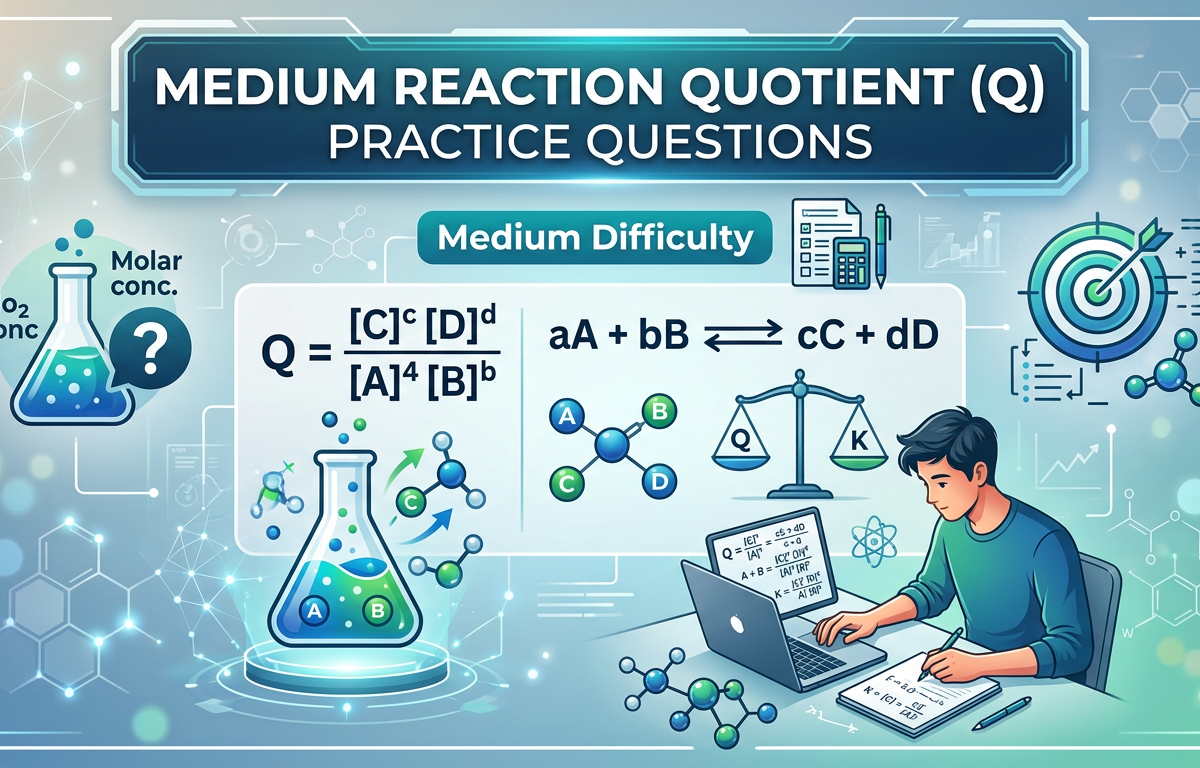
The reaction quotient (Q) is a mathematical expression that describes the relative amounts of products and reactants present in a reaction at any given time, whether the system has reached equilibrium or not. By comparing the value of Q to the equilibrium constant (K), chemists can predict the direction in which a net reaction will proceed to achieve equilibrium. The formula for Q is identical to that of K: the product of the concentrations (or partial pressures) of the products raised to their stoichiometric coefficients, divided by the product of the concentrations of the reactants raised to their stoichiometric coefficients. According to Wikipedia, the reaction quotient is a function of the activities of the chemical species involved, which in dilute solutions are approximated by molarity.
Understanding the relationship between Q and K is vital for mastering chemical kinetics and thermodynamics. There are three possible scenarios when comparing these values:
Q < K: The ratio of products to reactants is less than the equilibrium ratio. The reaction will proceed in the forward direction (right) to form more products.
Q > K: The ratio of products to reactants is greater than the equilibrium ratio. The reaction will proceed in the reverse direction (left) to form more reactants.
Q = K: The system is at chemical equilibrium, and no net change in concentrations will occur.
When calculating Q, remember that pure solids and liquids are excluded from the expression because their activities are defined as one. This concept is closely related to other thermodynamic principles, such as those found in medium enthalpy change practice questions, which also help describe the behavior of chemical systems under varying conditions.
Solved Examples
Example 1: Calculating Q for a Gaseous Reaction
For the reaction N₂(g) + 3H₂(g) ⇌ 2NH₃(g), the equilibrium constant Kp is 4.3 × 10⁻⁴ at 400°C. If a container holds 0.50 atm N₂, 0.20 atm H₂, and 0.010 atm NH₃, determine the direction of the reaction.
Write the expression for Qp: Qp = (P_NH₃)² / (P_N₂)(P_H₂)³.
Substitute the given partial pressures: Qp = (0.010)² / (0.50)(0.20)³.
Calculate the value: Qp = 0.0001 / (0.50 × 0.008) = 0.0001 / 0.004 = 0.025.
Compare Qp to Kp: 0.025 > 4.3 × 10⁻⁴. Since Q > K, the reaction shifts to the left (toward reactants).
Example 2: Aqueous Concentration Shifts
Consider the decomposition of dinitrogen tetroxide: N₂O₄(g) ⇌ 2NO₂(g) with Kc = 0.00466 at 25°C. A 2.0 L flask contains 0.10 mol N₂O₄ and 0.02 mol NO₂. Determine the reaction direction.
Calculate molar concentrations: [N₂O₄] = 0.10 mol / 2.0 L = 0.050 M; [NO₂] = 0.02 mol / 2.0 L = 0.010 M.
Write the Qc expression: Qc = [NO₂]² / [N₂O₄].
Calculate Qc: (0.010)² / 0.050 = 0.0001 / 0.050 = 0.002.
Compare Qc to Kc: 0.002 < 0.00466. Since Q < K, the reaction shifts to the right (toward products).
Example 3: Heterogeneous Equilibrium
For the reaction CaCO₃(s) ⇌ CaO(s) + CO₂(g), Kp = 1.16 at 800°C. If a reaction vessel contains CO₂ at a pressure of 1.50 atm, what will happen?
Write the Qp expression: Qp = P_CO₂ (solids are excluded).
Determine Qp: Qp = 1.50.
Compare Qp to Kp: 1.50 > 1.16.
Conclusion: Since Q > K, the reaction will shift to the left, consuming CO₂ and forming more CaCO₃.
Practice Questions
1. The reaction H₂(g) + I₂(g) ⇌ 2HI(g) has a Kc of 54.3 at 430°C. If a system contains [H₂] = 0.10 M, [I₂] = 0.10 M, and [HI] = 0.50 M, calculate Qc and predict the shift.
2. For the reaction 2SO₂(g) + O₂(g) ⇌ 2SO₃(g), Kc = 280. A mixture contains 0.0020 M SO₂, 0.0010 M O₂, and 0.015 M SO₃. Is the system at equilibrium? If not, which way will it shift?
3. Carbon monoxide reacts with water vapor to form CO₂ and H₂ (Kc = 5.10 at 700 K). If [CO] = 0.020 M, [H₂O] = 0.020 M, [CO₂] = 0.050 M, and [H₂] = 0.050 M, calculate Q and determine the direction of net change.
Want unlimited practice questions like these?
Generate AI-powered questions with step-by-step solutions on any topic.
Try Question Generator Free →4. In the Haber process, N₂(g) + 3H₂(g) ⇌ 2NH₃(g), Kc is 0.060 at 500°C. A 1.0 L vessel contains 0.25 mol N₂, 0.15 mol H₂, and 0.20 mol NH₃. Calculate Qc and predict the direction.
5. The reaction PCl₅(g) ⇌ PCl₃(g) + Cl₂(g) has Kc = 0.042 at 250°C. If a 5.0 L flask contains 0.10 mol PCl₅, 0.05 mol PCl₃, and 0.05 mol Cl₂, determine the value of Q and the reaction shift.
6. For the reaction 2NO(g) + O₂(g) ⇌ 2NO₂(g), Kc = 1.0 × 10⁶. If the concentrations are [NO] = 0.050 M, [O₂] = 0.020 M, and [NO₂] = 10.0 M, calculate Q and determine if the system is at equilibrium.
7. The dissociation of phosgene, COCl₂(g) ⇌ CO(g) + Cl₂(g), has Kc = 0.0083 at 100°C. If a vessel contains 0.50 M COCl₂, 0.02 M CO, and 0.02 M Cl₂, which way will the reaction proceed?
8. For the heterogeneous reaction C(s) + CO₂(g) ⇌ 2CO(g), Kc = 0.10 at 1100 K. If a container has [CO₂] = 0.50 M and [CO] = 0.20 M, calculate Q and predict the shift.
Answers & Explanations
1. Answer: Qc = 25.0; Shifts Right.
Qc = [HI]² / ([H₂][I₂]) = (0.50)² / (0.10 × 0.10) = 0.25 / 0.01 = 25.0. Since 25.0 < 54.3 (Kc), the reaction must produce more HI to reach equilibrium, shifting to the right.
2. Answer: Qc = 56250; Shifts Left.
Qc = [SO₃]² / ([SO₂]²[O₂]) = (0.015)² / ((0.0020)² × 0.0010) = 0.000225 / (0.000004 × 0.0010) = 56250. Since 56250 > 280 (Kc), the reaction shifts left to consume products.
3. Answer: Qc = 6.25; Shifts Left.
Qc = ([CO₂][H₂]) / ([CO][H₂O]) = (0.050 × 0.050) / (0.020 × 0.020) = 0.0025 / 0.0004 = 6.25. Since 6.25 > 5.10 (Kc), the reaction shifts left.
4. Answer: Qc = 47.4; Shifts Left.
Qc = [NH₃]² / ([N₂][H₂]³) = (0.20)² / (0.25 × (0.15)³) = 0.04 / (0.25 × 0.003375) = 0.04 / 0.00084375 ≈ 47.4. Since 47.4 > 0.060, the reaction shifts left.
5. Answer: Qc = 0.005; Shifts Right.
Concentrations: [PCl₅] = 0.02 M, [PCl₃] = 0.01 M, [Cl₂] = 0.01 M. Qc = (0.01 × 0.01) / 0.02 = 0.005. Since 0.005 < 0.042, the reaction shifts right.
6. Answer: Qc = 2.0 × 10⁶; Shifts Left.
Qc = [NO₂]² / ([NO]²[O₂]) = (10.0)² / ((0.050)² × 0.020) = 100 / (0.0025 × 0.020) = 100 / 0.00005 = 2.0 × 10⁶. Since 2.0 × 10⁶ > 1.0 × 10⁶, it shifts left.
7. Answer: Qc = 0.0008; Shifts Right.
Qc = ([CO][Cl₂]) / [COCl₂] = (0.02 × 0.02) / 0.50 = 0.0004 / 0.50 = 0.0008. Since 0.0008 < 0.0083, the reaction shifts right.
8. Answer: Qc = 0.08; Shifts Right.
Qc = [CO]² / [CO₂] = (0.20)² / 0.50 = 0.04 / 0.50 = 0.08. Since 0.08 < 0.10, the reaction shifts right.
1. If Q < K, which of the following is true?
Frequently Asked Questions
What is the main difference between Q and K?
The reaction quotient Q can be calculated at any point in time during a reaction using the current concentrations, whereas the equilibrium constant K is a specific value of Q that only occurs when the system is at equilibrium. Comparing Q to K allows one to determine how far the system is from equilibrium and in which direction it will move.
Can the reaction quotient be negative?
No, the reaction quotient cannot be negative because it is calculated using concentrations or partial pressures, which are always zero or positive values. A Q value of zero indicates that no products are present, meaning the reaction must proceed forward.
How does temperature affect the reaction quotient?
Temperature does not directly change the value of Q at a specific moment in time, but it does change the value of the equilibrium constant K. Because K changes with temperature, the comparison between Q and K changes, which might shift the direction of the reaction. To understand how heat affects these shifts, you might review medium heat of reaction practice questions.
Why are solids and liquids ignored in Q?
Pure solids and liquids are excluded from the Q and K expressions because their activity (effective concentration) is constant regardless of how much of the substance is present. Since their concentration does not change as the reaction proceeds, they are incorporated into the equilibrium constant itself.
What does it mean if Q = 0?
If Q = 0, it means the concentration of at least one product is zero. Under these conditions, the reaction will proceed spontaneously in the forward direction to produce products, as Q must eventually increase to equal K. This concept is fundamental when setting up an ICE table, which is also used in medium Ka and Kb calculations practice questions.
Want unlimited practice questions like these?
Generate AI-powered questions with step-by-step solutions on any topic.
Try Question Generator Free →
Want unlimited practice questions like these?
Generate AI-powered questions with step-by-step solutions on any topic.
Try Question Generator Free →Enjoyed this article?
Share it with others who might find it helpful.
Related Articles
Hard Le Chatelier’s Principle Practice Questions
Master Hard Le Chatelier’s Principle Practice Questions with our comprehensive guide featuring solved examples, practice problems, and detailed explanations.
Mar 30, 2026

Hard Reaction Quotient (Q) Practice Questions
Hard Reaction Quotient (Q) Practice Questions
Mar 30, 2026
Grams to Moles Practice Questions with Answers
Master grams to moles conversions with our comprehensive guide. Includes step-by-step examples, practice questions, and detailed answers for chemistry students.
Mar 26, 2026
Avogadro’s Number Practice Questions with Answers
Master the mole concept with our Avogadro’s Number practice questions. Includes step-by-step solved examples, a quick quiz, and detailed explanations.
Mar 26, 2026

Empirical Formulas: Solving Ratios from Mass and Percent Data
Master empirical formula calculations with 10 practice questions, worked answers, and a free step-by-step calculator for mass, percentage, and combustion problems.
Mar 26, 2026