Medium Molality Practice Questions
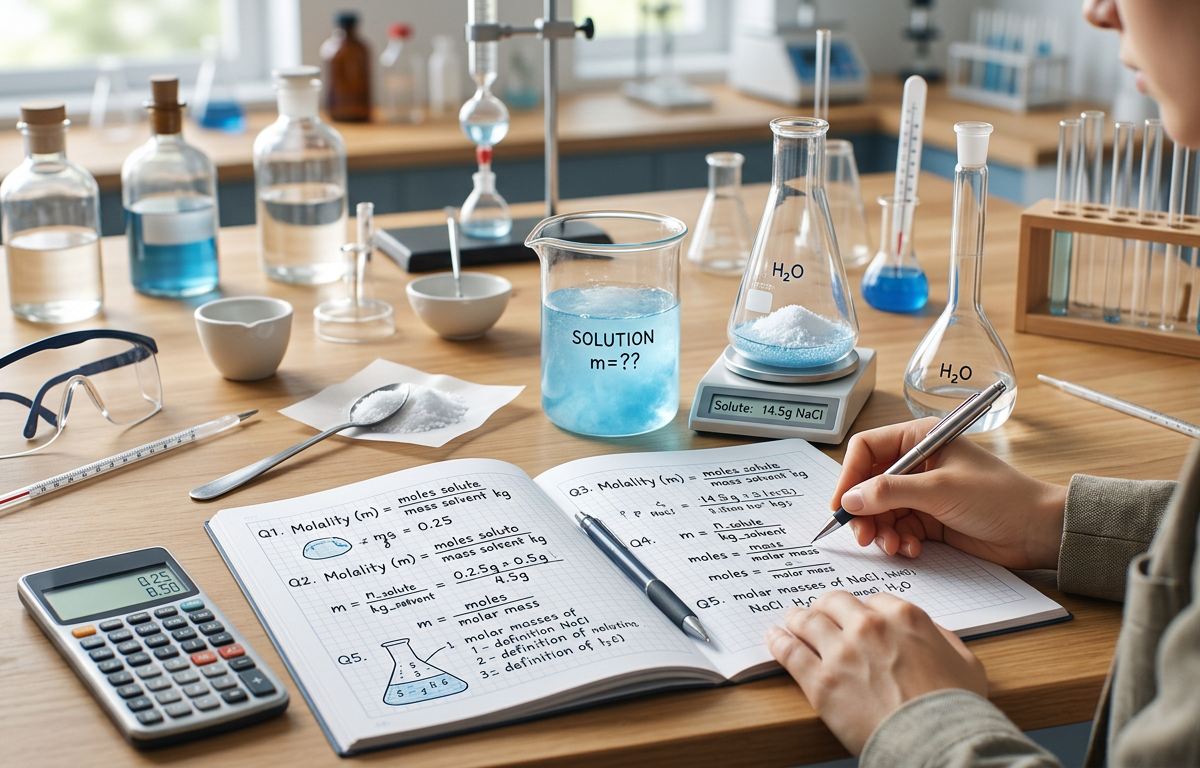
Concept Explanation
Molality is a measure of solute concentration defined as the number of moles of solute per kilogram of solvent. Unlike molarity, which depends on the total volume of the solution, molality focuses strictly on the mass of the solvent, making it an essential unit in thermodynamics because it remains constant regardless of changes in temperature or pressure. This property is particularly useful when calculating colligative properties such as boiling point elevation or freezing point depression, as explained by the Clausius-Clapeyron relation and Raoult's Law.
To calculate molality (represented by the lowercase letter m), you use the following formula:
Molality (m) = Moles of Solute / Kilograms of Solvent
When solving Medium Molality Practice Questions, you will often need to perform preliminary steps before applying the formula. These steps frequently involve converting grams to moles using the molar mass of the substance or converting the solvent's mass from grams to kilograms. In more complex scenarios, you might be given the density of a solution and asked to find the molality, requiring you to distinguish between the mass of the solute and the mass of the solvent. Understanding the essential difference between molarity and molality is crucial for avoiding common errors in these calculations.
Solved Examples
Review these step-by-step solutions to master the logic behind molality calculations.
Example 1: Calculating Molality from Mass
A solution is prepared by dissolving 45.0 grams of Glucose (C6H12O6) in 250 grams of water. What is the molality of the solution?Find the molar mass of glucose: (6 × 12.01) + (12 × 1.01) + (6 × 16.00) = 180.18 g/mol.
Convert grams of glucose to moles: 45.0 g / 180.18 g/mol = 0.2497 moles.
Convert mass of solvent (water) to kg: 250 g = 0.250 kg.
Apply the formula: 0.2497 mol / 0.250 kg = 0.999 m.
Answer: 0.999 m
Example 2: Finding Solute Mass from Molality
How many grams of Sodium Chloride (NaCl) are needed to prepare a 0.500 m solution using 1.50 kg of water?Rearrange the molality formula to find moles: Moles = Molality × kg Solvent.
Calculate moles: 0.500 mol/kg × 1.50 kg = 0.750 moles.
Find the molar mass of NaCl: 22.99 + 35.45 = 58.44 g/mol.
Convert moles to grams: 0.750 mol × 58.44 g/mol = 43.83 g.
Answer: 43.83 g
Example 3: Molality from Density
A 1.20 M sulfuric acid (H2SO4) solution has a density of 1.08 g/mL. Calculate its molality.Assume 1.0 L (1000 mL) of solution. This contains 1.20 moles of H2SO4.
Calculate total mass of solution: 1000 mL × 1.08 g/mL = 1080 g.
Calculate mass of solute: 1.20 mol × 98.08 g/mol = 117.7 g.
Calculate mass of solvent: 1080 g (total) - 117.7 g (solute) = 962.3 g = 0.9623 kg.
Calculate molality: 1.20 mol / 0.9623 kg = 1.247 m.
Answer: 1.247 m
Practice Questions
Calculate the molality of a solution containing 15.5 g of KCl dissolved in 400 g of water.
What is the molality of a solution made by dissolving 12.0 g of urea (NH2CONH2) in 250 g of methanol?
How many grams of MgCl2 must be added to 750 g of water to produce a 0.40 m solution?
Want unlimited practice questions like these?
Generate AI-powered questions with step-by-step solutions on any topic.
Try Question Generator Free →A solution of ethanol (C2H5OH) in water is 2.50 m. If the solution contains 500 g of water, what mass of ethanol is present?
Calculate the molality of a phosphoric acid (H3PO4) solution that is 15% by mass.
What is the molality of a 3.0 M NaOH solution if the density of the solution is 1.11 g/mL?
Determine the molality of a solution prepared by mixing 25.0 mL of benzene (density = 0.877 g/mL) with 75.0 mL of toluene (density = 0.867 g/mL). Assume benzene is the solute.
How much water (in kg) is needed to dissolve 120 g of CaBr2 to create a 0.65 m solution?
A solution is 1.85 m in naphthalene (C10H8) using benzene as a solvent. If 50.0 g of naphthalene is used, what mass of benzene is required?
If you have a 10.0% by mass aqueous solution of NaCl, what is its molality?
Answers & Explanations
0.520 m: Molar mass of KCl = 74.55 g/mol. Moles = 15.5 / 74.55 = 0.208 mol. Solvent = 0.400 kg. Molality = 0.208 / 0.400 = 0.520 m.
0.800 m: Molar mass of urea = 60.06 g/mol. Moles = 12.0 / 60.06 = 0.200 mol. Solvent = 0.250 kg. Molality = 0.200 / 0.250 = 0.800 m.
28.56 g: Moles = 0.40 mol/kg × 0.750 kg = 0.30 moles. Molar mass MgCl2 = 95.21 g/mol. Mass = 0.30 × 95.21 = 28.56 g.
57.59 g: Moles = 2.50 mol/kg × 0.500 kg = 1.25 moles. Molar mass ethanol = 46.07 g/mol. Mass = 1.25 × 46.07 = 57.59 g.
1.80 m: In 100 g of solution, there are 15 g H3PO4 and 85 g water. Moles H3PO4 = 15 / 98.00 = 0.153 mol. Molality = 0.153 / 0.085 kg = 1.80 m.
3.03 m: 1 L solution = 1110 g. Solute = 3.0 mol × 40.00 g/mol = 120 g. Solvent = 1110 - 120 = 990 g = 0.990 kg. Molality = 3.0 / 0.990 = 3.03 m.
4.31 m: Mass benzene = 25.0 × 0.877 = 21.925 g. Moles benzene = 21.925 / 78.11 = 0.2807 mol. Mass toluene = 75.0 × 0.867 = 65.025 g = 0.065025 kg. Molality = 0.2807 / 0.065025 = 4.31 m.
0.923 kg: Molar mass CaBr2 = 199.89 g/mol. Moles = 120 / 199.89 = 0.600 mol. kg Solvent = 0.600 mol / 0.65 m = 0.923 kg.
211 g: Molar mass naphthalene = 128.17 g/mol. Moles = 50.0 / 128.17 = 0.390 mol. kg Solvent = 0.390 / 1.85 = 0.211 kg = 211 g.
1.90 m: 10 g NaCl, 90 g water. Moles NaCl = 10 / 58.44 = 0.171 mol. Molality = 0.171 / 0.090 kg = 1.90 m.
1. Which of the following units is used to express molality?
Frequently Asked Questions
What is the main difference between molarity and molality?
Molarity is the number of moles of solute per liter of solution, whereas molality is the number of moles of solute per kilogram of solvent. Because volume changes with temperature but mass does not, molality is temperature-independent.
How do you calculate the mass of solvent if you only have the total solution mass?
You must subtract the mass of the solute from the total mass of the solution to find the mass of the solvent. This is a common step when solving molality problems involving percentage composition.
Can molality and molarity ever be the same?
Molality and molarity are approximately equal in very dilute aqueous solutions at room temperature. This is because the density of water is roughly 1.0 g/mL, meaning 1 liter of solution is nearly equal to 1 kilogram of solvent.
Why does molality use solvent mass instead of solution mass?
Molality uses solvent mass to ensure the concentration value remains constant across different temperatures. Since the mass of the solvent is fixed, the ratio of solute to solvent stays the same even if the solution expands or contracts.
Is molality used for gas concentrations?
Molality is rarely used for gases because gas concentrations are typically measured by pressure or volume. It is primarily used for liquid solutions where colligative properties like freezing point depression are being studied, as noted by Encyclopedia Britannica.
Want unlimited practice questions like these?
Generate AI-powered questions with step-by-step solutions on any topic.
Try Question Generator Free →
Want unlimited practice questions like these?
Generate AI-powered questions with step-by-step solutions on any topic.
Try Question Generator Free →Enjoyed this article?
Share it with others who might find it helpful.
Related Articles

Hard Le Chatelier’s Principle Practice Questions
Master Hard Le Chatelier’s Principle Practice Questions with our comprehensive guide featuring solved examples, practice problems, and detailed explanations.
Mar 30, 2026

Hard Reaction Quotient (Q) Practice Questions
Hard Reaction Quotient (Q) Practice Questions
Mar 30, 2026
Grams to Moles Practice Questions with Answers
Master grams to moles conversions with our comprehensive guide. Includes step-by-step examples, practice questions, and detailed answers for chemistry students.
Mar 26, 2026
Avogadro’s Number Practice Questions with Answers
Master the mole concept with our Avogadro’s Number practice questions. Includes step-by-step solved examples, a quick quiz, and detailed explanations.
Mar 26, 2026

Empirical Formulas: Solving Ratios from Mass and Percent Data
Master empirical formula calculations with 10 practice questions, worked answers, and a free step-by-step calculator for mass, percentage, and combustion problems.
Mar 26, 2026