MCAT Organic Reactions Practice Questions with Answers
Concept Explanation
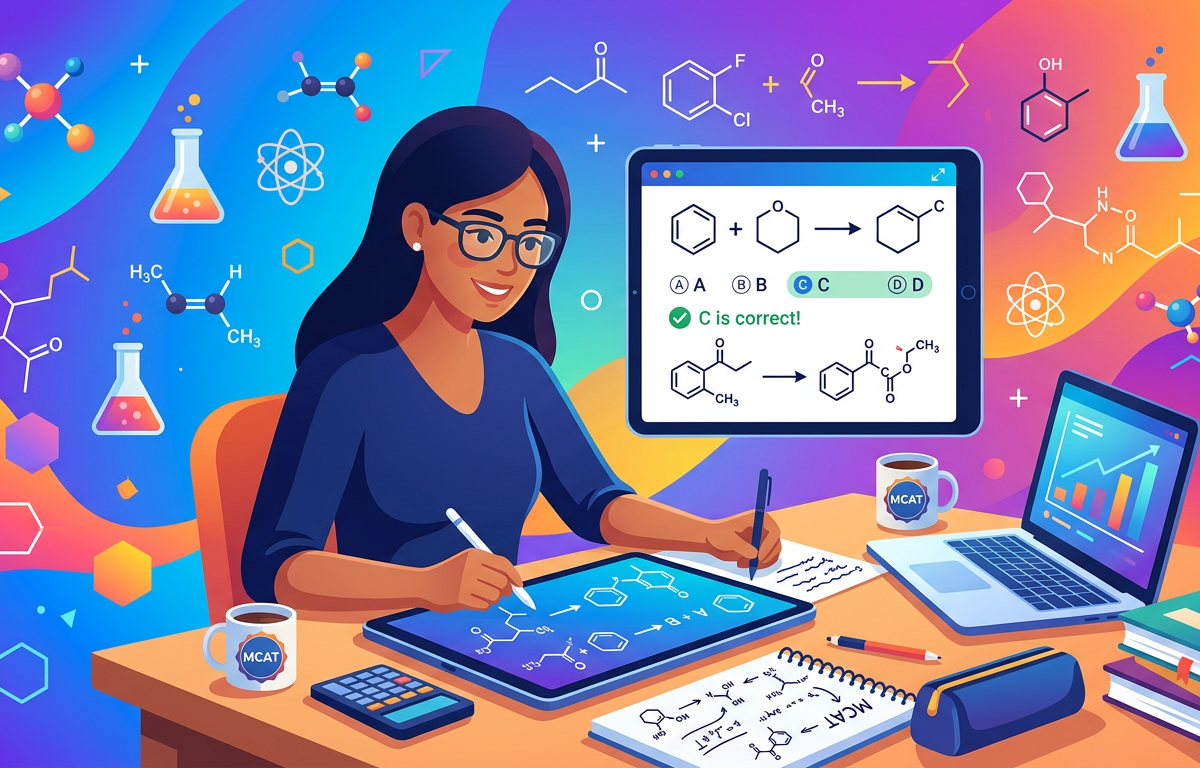
MCAT Organic Reactions encompass the chemical transformations of carbon-containing molecules, focusing on nucleophilic substitutions, eliminations, additions, and oxidation-reduction processes. Mastering these reactions requires an understanding of electron density, molecular geometry, and thermodynamic stability. To succeed on the exam, students must move beyond memorization and utilize retrieval practice for medical students to internalize reaction mechanisms and reagent functions. Key concepts include identifying nucleophiles (electron-rich species) and electrophiles (electron-poor species), as well as predicting the stability of intermediates like carbocations or carbanions. The MCAT frequently tests the regioselectivity (e.g., Markovnikov’s rule) and stereochemistry (e.g., inversion vs. retention of configuration) of these transformations.
According to Wikipedia, organic reactions are classified by the type of bond formation and the functional groups involved. For the MCAT, the most critical reactions involve carbonyl chemistry, such as nucleophilic acyl substitution and aldol condensations, because of their prevalence in biological systems like the citric acid cycle and glycolysis. Understanding the electronic effects of substituents—such as induction and resonance—is essential for predicting how a molecule will react under specific conditions.
Solved Examples
- Problem: Predict the major product of the reaction between 2-bromo-2-methylpropane and ethanol under reflux conditions.
Solution:- Identify the substrate: 2-bromo-2-methylpropane is a tertiary alkyl halide.
- Identify the reagent: Ethanol is a weak nucleophile and a weak base.
- Determine the mechanism: Tertiary substrates with weak nucleophiles/bases favor and pathways. Since heat (reflux) is applied, the elimination () product is often favored.
- Form the carbocation: The leaving group (Br-) departs, forming a stable tertiary carbocation.
- Final Product: 2-methylpropene (via ) and 2-ethoxy-2-methylpropane (via ).
- Problem: What is the product of the reaction between propanal and , followed by an acid workup?
Solution:- Identify the functional group: Propanal is an aldehyde.
- Identify the reagent: (Lithium Aluminum Hydride) is a strong reducing agent.
- Mechanism: The hydride ion () attacks the electrophilic carbonyl carbon, breaking the pi bond.
- Workup: The resulting alkoxide is protonated by the acid.
- Final Product: Propan-1-ol (a primary alcohol).
- Problem: Determine the product when methyl acetate reacts with excess Grignard reagent () followed by water.
Solution:- Identify the functional group: Methyl acetate is an ester.
- Identify the reagent: Grignard reagents are strong nucleophiles.
- First addition: The first equivalent of attacks the carbonyl, and the methoxy group () leaves, forming acetone.
- Second addition: Because Grignard is in excess, a second equivalent attacks the ketone (acetone).
- Final Product: 2-methylpropan-2-ol (a tertiary alcohol).
Practice Questions
Test your knowledge with these MCAT organic reactions practice questions. Using retrieval practice and the testing effect is the most efficient way to ensure you can apply these rules under timed conditions.
- Which of the following solvents would best facilitate an reaction between sodium cyanide and 1-bromobutane?
A) Water
B) Ethanol
C) Dimethyl sulfoxide (DMSO)
D) Acetic acid - What is the major product of the reaction of 1-methylcyclohexene with followed by ?
- Rank the following carboxylic acid derivatives in order of decreasing reactivity toward nucleophilic acyl substitution: Acyl chloride, Amide, Ester, Acid anhydride.
Don’t just reread. Train for recall.
Use Bevinzey’s active recall and retrieval practice tools to improve long-term memory and MCAT performance.
Try Active Recall Free- In an reaction, what happens to the stereochemistry of a chiral center if it is the site of attack?
- Which reagent is most suitable for oxidizing a primary alcohol to an aldehyde without further oxidation to a carboxylic acid?
- Which compound will react fastest in an reaction: chloromethane, 2-chloropropane, or 2-chloro-2-methylpropane?
- What are the products of the ozonolysis of 2-methyl-2-butene using followed by ?
- What is the purpose of the acid catalyst in a Fischer esterification reaction?
- Identify the electrophile and nucleophile in the first step of an aldol condensation between two molecules of acetaldehyde in the presence of base.
- True or False: Tertiary alcohols can be easily oxidized to ketones using Chromic acid ().
Answers & Explanations
- Answer: C. reactions are favored by polar aprotic solvents like DMSO. Polar protic solvents (like water, ethanol, or acetic acid) solvate the nucleophile via hydrogen bonding, decreasing its nucleophilicity.
- Answer: trans-2-methylcyclohexanol. Hydroboration-oxidation is an anti-Markovnikov, syn-addition of water across a double bond. The group adds to the less substituted carbon.
- Answer: Acyl chloride > Acid anhydride > Ester > Amide. Reactivity depends on the leaving group's ability to stabilize a negative charge (basicity). Chloride is the weakest base and best leaving group.
- Answer: Inversion of configuration. The nucleophile attacks from the backside, opposite the leaving group, leading to a "Walden inversion."
- Answer: Pyridinium chlorochromate (PCC). PCC is a mild oxidant that stops at the aldehyde. Stronger oxidants like or would oxidize it to a carboxylic acid.
- Answer: 2-chloro-2-methylpropane. rate depends on carbocation stability. Tertiary carbocations are much more stable than secondary or primary ones due to inductive effects and hyperconjugation.
- Answer: Acetone and Acetaldehyde. Ozonolysis cleaves the bond. 2-methyl-2-butene () splits into a ketone (propanone/acetone) and an aldehyde (ethanal/acetaldehyde).
- Answer: To protonate the carbonyl oxygen. This makes the carbonyl carbon more electrophilic, allowing the weak nucleophile (alcohol) to attack more effectively.
- Answer: Nucleophile = Enolate of acetaldehyde; Electrophile = Neutral acetaldehyde. The base removes an alpha-proton to form the enolate, which then attacks the carbonyl of another acetaldehyde molecule.
- Answer: False. Tertiary alcohols lack an alpha-hydrogen (a hydrogen on the carbon bearing the group), which is necessary for the oxidation mechanism to proceed.
1. Which of the following is a characteristic of an SN2 reaction?
Frequently Asked Questions
What is the difference between SN1 and SN2 reactions?
is a two-step unimolecular reaction involving a carbocation intermediate, while is a one-step bimolecular reaction involving a transition state and inversion of configuration.
How does solvent choice affect nucleophilicity?
In polar protic solvents, nucleophilicity increases down a group (e.g., ) due to solvation shells, whereas in polar aprotic solvents, nucleophilicity follows basicity (e.g., ).
What makes a good leaving group in organic reactions?
A good leaving group is a weak base, which means it is the conjugate base of a strong acid, allowing it to stably hold a negative charge after departing.
Why are aldehydes more reactive than ketones?
Aldehydes are more reactive because they are less sterically hindered and their carbonyl carbon is more electrophilic due to having only one electron-donating alkyl group.
What is the role of the alpha-hydrogen in carbonyl chemistry?
Alpha-hydrogens are acidic due to resonance stabilization of the resulting enolate, making them the starting point for reactions like aldol condensations and alpha-alkylations.
How does temperature influence elimination vs. substitution?
Higher temperatures generally favor elimination (/) over substitution (/) because elimination increases the number of particles in the system, which is entropically favorable.
Don’t just reread. Train for recall.
Use Bevinzey’s active recall and retrieval practice tools to improve long-term memory and MCAT performance.
Try Active Recall FreeReviewed by
Michael Danquah, MS, PhD
Dr. Michael Danquah is a professor of pharmaceutical sciences and founder of several educational technology platforms focused on improving student learning and performance.
Enjoyed this article?
Share it with others who might find it helpful.
Related Articles
Hard MCAT Organic Reactions Practice Questions
Hard MCAT Organic Reactions Practice Questions
May 11, 2026
Medium MCAT Organic Reactions Practice Questions
Medium MCAT Organic Reactions Practice Questions
May 11, 2026
Hard MCAT Organic Chemistry Practice Questions
Hard MCAT Organic Chemistry Practice Questions
May 11, 2026
Medium MCAT Organic Chemistry Practice Questions
Medium MCAT Organic Chemistry Practice Questions
May 11, 2026
Predicting MCAT Organic Products: From PCC to SN2 Mechanisms
Easy MCAT Organic Reactions Practice Questions
May 11, 2026
Easy MCAT Organic Chemistry Practice Questions
Easy MCAT Organic Chemistry Practice Questions
May 11, 2026

Hard MCAT Philosophy Passage Practice Questions
Master Hard MCAT Philosophy Passage Practice Questions with our comprehensive guide featuring solved examples, practice questions, and expert explanations.
May 17, 2026

Hard MCAT Humanities Passage Practice Questions
Master Hard MCAT Humanities Passage Practice Questions with our comprehensive guide featuring solved examples, practice questions, and expert strategies.
May 17, 2026