Predicting MCAT Organic Products: From PCC to SN2 Mechanisms
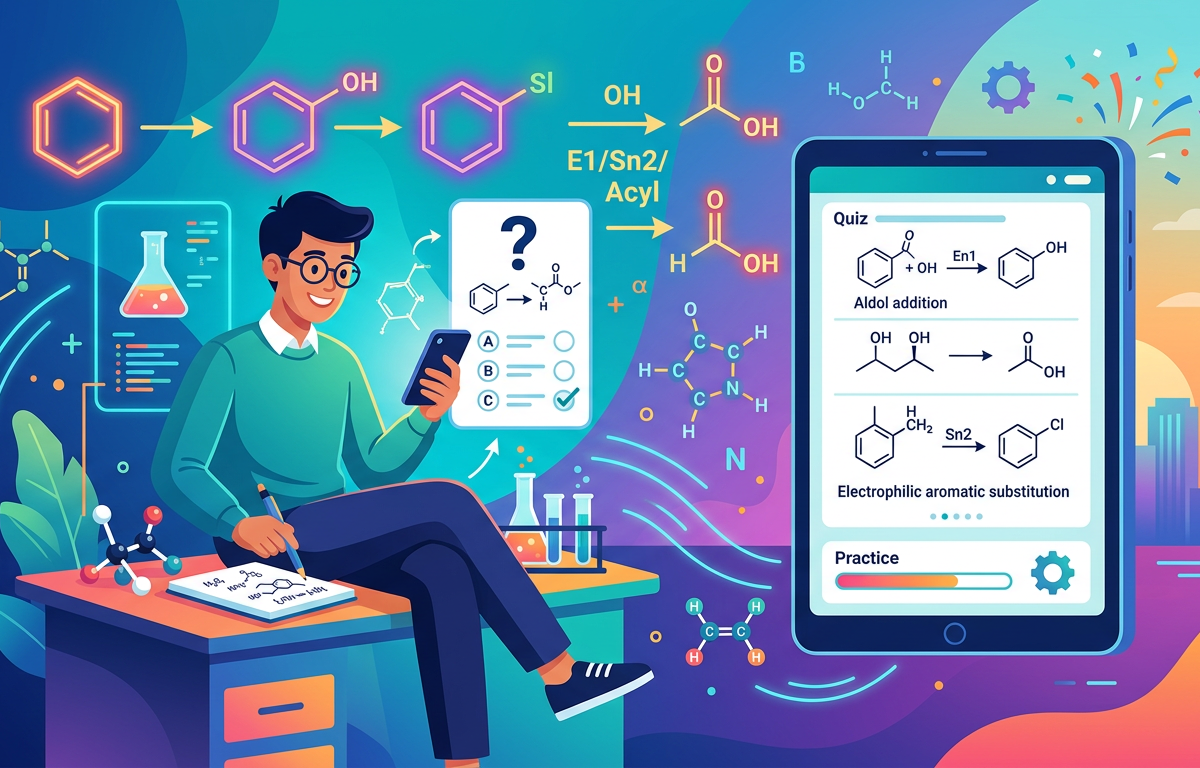
When you see 2-butanol react with pyridinium chlorochromate (PCC), the challenge isn't just remembering that PCC is an oxidant. The real test is recognizing that because the hydroxyl group sits on a secondary carbon, the reaction stops at a ketone regardless of the reagent's strength. Many students mistakenly try to over-oxidize secondary alcohols into carboxylic acids, a transformation that is chemically impossible without breaking carbon-carbon bonds. Success on the MCAT depends on this specific ability to categorize the substrate first and the reagent second.
Consider the electrophilic addition of HBr to propene. While it is easy to recite Markovnikov's rule, the exam often tests the underlying stability of the carbocation intermediate. You must visualize the positive charge landing on the secondary carbon rather than the primary one to explain why 2-bromopropane forms instead of 1-bromopropane. Transitioning from rote memorization to identifying electron-rich nucleophiles and electron-poor electrophiles allows you to predict outcomes even when you encounter a reagent you have not seen in weeks.
Core Mechanisms and Electron Flow
Easy MCAT organic reactions focus on the fundamental transformations of functional groups, primarily involving nucleophilic substitutions, additions to carbonyls, and basic oxidation-reduction processes. Mastering these reactions requires an understanding of electron flow, where nucleophiles (electron-rich species) attack electrophiles (electron-poor species). On the MCAT, success stems from recognizing patterns rather than memorizing every possible reagent. For instance, knowing that a primary alcohol can be oxidized to an aldehyde or a carboxylic acid depending on the strength of the oxidizing agent is a foundational skill. By applying retrieval practice for medical students, you can solidify these reaction mechanisms in your long-term memory. Key concepts include Markovnikov's rule for additions, the difference between and mechanisms, and the reactivity of carboxylic acid derivatives. Understanding these basics is essential before moving on to complex multi-step syntheses often found in higher-level biochemistry contexts.
Solved Examples
- Question: Predict the major product of the reaction between 2-butanol and pyridinium chlorochromate (PCC) in dichloromethane.
Solution:- Identify the functional group: 2-butanol is a secondary alcohol.
- Identify the reagent: PCC is a mild oxidizing agent.
- Determine the outcome: Primary alcohols are oxidized to aldehydes by PCC, while secondary alcohols are oxidized to ketones.
- Final Product: 2-butanone.
- Question: What is the product of the reaction between propene and hydrobromic acid ()?
Solution:- Identify the reaction type: Electrophilic addition to an alkene.
- Apply Markovnikov’s Rule: The hydrogen atom adds to the carbon with more hydrogens (C1), and the bromide ion adds to the more substituted carbon (C2).
- Analyze the intermediate: A secondary carbocation forms at C2, which is more stable than a primary carbocation.
- Final Product: 2-bromopropane.
- Question: Describe the mechanism and product when methyl iodide reacts with sodium hydroxide ().
Solution:- Identify the substrate: Methyl iodide is a methyl halide (unhindered).
- Identify the nucleophile: is a strong nucleophile.
- Determine the mechanism: Because the substrate is primary/methyl and the nucleophile is strong, an mechanism occurs.
- Final Product: Methanol ().
Practice Questions
1. Which of the following reagents would successfully convert a carboxylic acid directly into a primary alcohol?
2. Predict the product formed when ethanoic acid reacts with ethanol in the presence of an acid catalyst ().
3. In an reaction, which of the following carbocations is the most stable intermediate?
Study smarter for the MCAT.
Turn practice into performance with AI-powered MCAT tools designed to help students retain more and score higher.
Start Learning Free4. What is the major product of the acid-catalyzed hydration of 2-methyl-2-butene?
5. Which functional group is produced when a secondary amine reacts with a ketone under mildly acidic conditions?
6. Identify the reagent needed to convert cyclohexene into cyclohexane.
7. What is the result of reacting an aldehyde with a Grignard reagent () followed by a water workup?
8. Which of the following leaving groups is the most effective in a nucleophilic substitution reaction: , , , or ?
Answers & Explanations
- 1. Lithium Aluminum Hydride (): Carboxylic acids are difficult to reduce. While is too weak, is a strong reducing agent capable of reducing the carbonyl group all the way to a primary alcohol.
- 2. Ethyl ethanoate (an ester): This is a Fischer esterification. The oxygen of the alcohol attacks the carbonyl carbon of the acid, followed by the loss of water. For more on how to structure your study of these mechanisms, check out our guide on building a retrieval practice study plan.
- 3. Tertiary Carbocation: Carbocation stability increases with alkyl substitution due to inductive effects and hyperconjugation. A tertiary carbocation is more stable than secondary, primary, or methyl cations.
- 4. 2-methyl-2-butanol: Acid-catalyzed hydration follows Markovnikov's rule. The group adds to the most substituted carbon involved in the double bond.
- 5. Enamine: When a primary amine reacts with a ketone, an imine is formed. However, a secondary amine cannot form a double bond with the nitrogen while maintaining neutral charge, so it forms an enamine (a double bond between the alpha and beta carbons).
- 6. with a metal catalyst (e.g., or ): This is a hydrogenation reaction that reduces an alkene to an alkane.
- 7. Secondary Alcohol: The Grignard reagent acts as a nucleophile, attacking the electrophilic carbonyl carbon. After protonation by water, the aldehyde transforms into a secondary alcohol (unless the starting material was formaldehyde, which yields a primary alcohol).
- 8. (Iodide): Effective leaving groups are weak bases. Since is the strongest acid among the hydrohalic acids, its conjugate base is the weakest base and therefore the best leaving group. This is a common topic in retrieval practice for STEM subjects.
1. Which reagent is most commonly used to oxidize a primary alcohol to a carboxylic acid?
Frequently Asked Questions
What is the difference between SN1 and SN2 reactions?
SN1 is a two-step unimolecular reaction that involves a carbocation intermediate and prefers tertiary substrates, while SN2 is a one-step bimolecular reaction that involves a transition state and prefers primary substrates. SN1 results in racemization of stereochemistry, whereas SN2 results in a complete inversion of configuration.
Why is PCC used instead of KMnO4 for making aldehydes?
PCC is a mild oxidizing agent that stops the oxidation of primary alcohols at the aldehyde stage. Stronger reagents like Potassium permanganate (KMnO4) or Jones reagent will continue to oxidize the aldehyde into a carboxylic acid.
What does Markovnikov's rule state?
Markovnikov's rule states that in the addition of a protic acid (HX) to an asymmetric alkene, the hydrogen atom attaches to the carbon with the greater number of hydrogen atoms. This occurs because the reaction proceeds through the most stable carbocation intermediate, as explained in resources from LibreTexts Chemistry.
How do Grignard reagents behave in organic reactions?
Grignard reagents () act as strong nucleophiles and strong bases, attacking electrophilic carbonyl carbons to form new carbon-carbon bonds. They are highly reactive and must be used in anhydrous conditions to prevent them from reacting with water or alcohols to form alkanes.
What is the most stable type of carbocation?
The stability of carbocations follows the trend: tertiary > secondary > primary > methyl. Resonance-stabilized cations, such as allylic or benzylic carbocations, are even more stable than standard alkyl cations due to electron delocalization across the pi system.
Study smarter for the MCAT.
Turn practice into performance with AI-powered MCAT tools designed to help students retain more and score higher.
Start Learning FreeReviewed by
Michael Danquah, MS, PhD
Dr. Michael Danquah is a professor of pharmaceutical sciences and founder of several educational technology platforms focused on improving student learning and performance.
Enjoyed this article?
Share it with others who might find it helpful.
Related Articles
MCAT Psych/Soc Practice: Distinguishing Theory from Application
Master MCAT behavior concepts with our comprehensive practice questions and explanations. Cover psychology, sociology, and biological foundations for a top score.
May 17, 2026

Solving MCAT Force Problems: From Inclined Planes to Blood Flow
MCAT Force Practice Questions with Answers
May 17, 2026

Solving MCAT Sound Problems: From Decibel Logs to Doppler Shifts
MCAT Waves and Sound Practice Questions with Answers
May 14, 2026
Solving MCAT Fluid Dynamics: From Poiseuille’s Law to Blood Flow
MCAT Fluid Mechanics Practice Questions with Answers
May 14, 2026
Hard MCAT Organic Reactions Practice Questions
Hard MCAT Organic Reactions Practice Questions
May 11, 2026
Hard MCAT Organic Chemistry Practice Questions
Hard MCAT Organic Chemistry Practice Questions
May 11, 2026
Medium MCAT Organic Reactions Practice Questions
Medium MCAT Organic Reactions Practice Questions
May 11, 2026
Predicting SN1 vs SN2 Outcomes: Sterics, Solvents, and Symmetry
Medium MCAT SN1 SN2 Practice Questions
May 11, 2026