9 Fatal Study Mistakes Students Make (And How to Fix Them)

Many learners spend hours staring at textbooks only to find their minds blank when the exam paper arrives. This frustrating disconnect often stems from common study mistakes students make, such as confusing familiarity with actual mastery. When you read a chapter three times, you become familiar with the text, but you haven't necessarily encoded that data into your long-term memory.
Research suggests that students often choose the most demanding yet least effective ways to learn. By relying on outdated habits, you aren't just wasting time; you are actively increasing your stress levels. Building effective study habits requires a shift from passive consumption to active engagement.
The High Cost of Inefficient Studying
Inefficient studying creates an "illusion of competence" where you feel like you know the material because it is sitting right in front of you. This psychological trap occurs when students mistake the ease of recognition for the ability to recall. You recognize the words on the page, so your brain tells you that you've learned them. However, recognition is a low-level cognitive task, while exam performance requires high-level retrieval.
Modern students face a unique set of challenges compared to previous generations, primarily due to the constant barrage of digital interruptions. In the past, a student might have sat with a single book for three hours; today, that same student likely toggles between a digital textbook, three browser tabs, and a smartphone. This constant context switching prevents the brain from entering "deep work," a state of intense concentration where real learning happens. According to American Psychological Association research, even brief mental blocks created by shifting between tasks can cost as much as 40 percent of someone's productive time.
When students focus on "busy work", like rewriting notes to make them look aesthetic or color-coding a calendar, they often feel productive without actually learning. High grades don't come from the number of hours you sit at a desk; they come from the intensity of your focus. Using outdated methods like re-reading leads to a cycle of burnout and anxiety. You work harder, but your results plateau, leading you to believe you aren't "smart enough" when the real culprit is simply your methodology.
Common Cognitive Errors: Why Your Brain Isn't Retaining Information

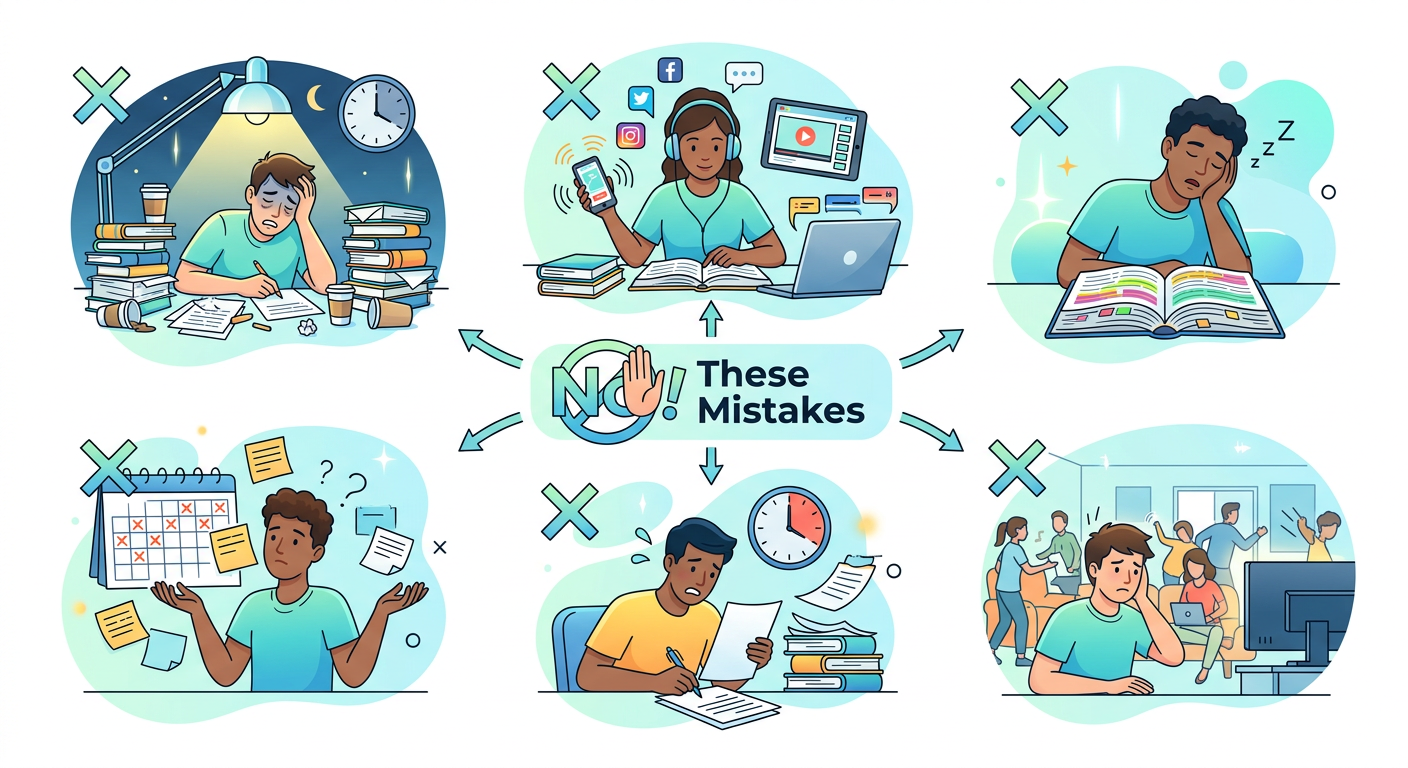
Common cognitive errors, such as passive reviewing and highlighting, are among the most frequent study mistakes students make because they feel helpful while providing zero cognitive challenge. Highlighting a sentence requires almost no mental effort. If the brain isn't struggling to process information, it won't prioritize storing it. You are essentially decorating a page rather than building a mental model.
Mistake #1: Passive Reviewing and Highlighting
Passive reading involves scanning text without questioning it or connecting it to prior knowledge. It is a shallow processing activity. To move information into long-term memory, you must engage with the material through active recall techniques. This means closing the book and forcing your brain to retrieve the information from scratch, which strengthens neural pathways.
Mistake #2: The Cramming Culture
Cramming is a biological gamble that rarely pays off in the long run. While "massed practice" might help you pass a quiz tomorrow morning, the information will likely vanish within 48 hours. This is due to the Ebbinghaus Forgetting Curve, which demonstrates that memory retention drops off sharply unless we review the material at increasing intervals. Students who ignore this curve find themselves relearning the same basic concepts every single time a final exam rolls around.
Mistake #3: Over-reliance on Rote Memorization
Memorizing definitions without understanding the underlying logic is a recipe for failure in higher education. Exams often ask you to apply concepts to new scenarios, a task that rote memorization cannot handle. For example, if you are studying chemistry, simply memorizing a formula won't help if you don't understand the relationship between variables. You might struggle with hard molarity practice questions because you haven't grasped the conceptual "why" behind the "how."
Environmental and Behavioral Traps in the Study Process

Studying in the wrong environment can sabotage even the most well-intentioned student. If you study in bed, your brain associates that space with relaxation and sleep, leading to decreased alertness. Conversely, if you try to sleep in the same spot where you experience high-stakes study stress, you may develop insomnia. Finding a dedicated, neutral space is essential for cognitive signaling.
Multitasking is arguably the biggest myth in modern education. Human brains are not wired to focus on two complex tasks simultaneously; we simply switch back and forth very quickly. This "switch-cost" results in slower progress and more errors. Every time you check a notification, it can take several minutes to return to the same level of deep immersion you had before the interruption. High-performance students utilize science-backed secrets to minimize these distractions.
Furthermore, ignoring biological needs like sleep and nutrition is a strategic error. Sleep is not "time off" for the brain; it is the period when memory consolidation occurs. If you don't sleep after studying, you effectively prevent your brain from "saving" the day's work. The Harvard Health Blog highlights that physical health and cognitive function are deeply linked, meaning a poor diet and lack of exercise directly correlate to lower GPA outcomes.
Ready to Stop Making These Mistakes?
Don't let inefficient study habits hold you back. Bevinzey uses proven cognitive science to help you master complex subjects like chemistry, biology, and math in half the time.
Get Started FreeStrategic Failures: Missing the Big Picture
Strategic failures occur when students fail to treat their education like a managed project. One of the most prevalent study mistakes students make is starting with the easiest tasks first to feel a sense of accomplishment. This is often called "pseudo-studying." By the time you get to the difficult, high-stakes material, your mental energy is depleted. Experts suggest "Eating the Frog", tackling the hardest subject first thing in the morning when your cognitive load capacity is at its peak.
Many learners also fail to use the tools already provided to them, such as the syllabus or the grading rubric. These documents are literally a roadmap to what the instructor deems important. If you spend five hours perfecting the formatting of a lab report but only thirty minutes on the data analysis that accounts for 80% of the grade, you are misallocating your resources. This is particularly common when dealing with technical subjects like molarity calculations, where students focus on the math but forget the chemical theory.
Solitary studying can sometimes lead to "tunnel vision," where you focus intensely on minor details while missing the overarching theme. However, "social" study sessions often devolve into mere hangouts. The best approach is a hybrid: study solo to learn the core concepts, then join a focused group to test each other. This allows you to benefit from metacognition in education, thinking about your own thinking by explaining concepts to others.
How to Pivot: Science-Backed Fixes for Every Mistake
Active Recall is the gold standard of learning. Instead of looking at your notes, you should ask yourself questions and try to answer them without help. If you are preparing for a chemistry exam, don't just read about concentrations; try easy molality practice questions to see if you can actually perform the steps. This discomfort you feel when you can't remember an answer is actually the feeling of your brain growing stronger.
Another powerful fix is "interleaving." Most students use "block practice," where they study one topic for hours before moving to the next. Interleaving involves mixing different topics or types of problems within a single session. This forces your brain to constantly figure out which strategy to apply to which problem. While it feels harder and slower, the Scientific American reports that interleaving leads to significantly better long-term retention than blocking.
To manage your energy and avoid the trap of avoiding procrastination in college, use the Pomodoro Technique. Set a timer for 25 minutes of intense, single-task focus, followed by a 5-minute break. These structured intervals prevent cognitive fatigue and help you maintain a high level of performance throughout the day. During your study sessions, you can also use the Feynman Technique: try to explain a concept in simple terms to a child. If you can't explain it simply, you don't understand it well enough yet.
The Role of Metacognition: Thinking About How You Think
Building a sustainable routine requires deep self-awareness. You must be able to identify when you are actually "stuck" on a problem versus when you are simply "bored" and looking for a reason to check your phone. This is the essence of metacognition. It involves reflecting after every study session: "What did I learn today? What gave me the most trouble? How will I change my approach tomorrow?"
Adopting a growth mindset is critical for long-term success. Instead of seeing a low grade as a final judgment on your intelligence, view it as a data point. It is an indication that your current system has a flaw. Use mistakes—like the ones found in common molarity mistakes, as a diagnostic tool. By identifying exactly where your logic failed, you can patch those holes before the next evaluation.
Lastly, remember that time management for students isn't about doing more; it's about doing what matters. By eliminating the most common study mistakes students make and replacing them with active, evidence-based strategies, you can achieve better results in less time. Learning is a skill in itself, and like any skill, it improves with the right practice and persistence.
Master Your Exams with Bevinzey
Stop guessing and start knowing. Access thousands of practice questions, expert explanations, and personalized study paths designed to help you succeed.
Get Started FreeFrequently Asked Questions
What is the most common study mistake?
The most common mistake is passive learning, specifically re-reading notes and highlighting. These activities create an illusion of mastery without actually forcing the brain to store or retrieve information.
Is listening to music while studying a mistake?
It depends. Instrumental or lo-fi music can help mask distracting background noise, but music with lyrics often competes with the language-processing parts of your brain, reducing your efficiency.
How can I recover from poor study habits?
Start by identifying one passive habit to replace. Instead of re-reading a chapter, try to write down everything you remember from it on a blank sheet of paper before looking at your notes again.
Why do I forget everything I studied during the exam?
This often happens because you relied on recognition rather than retrieval during your study sessions. If you only practice with your notes open, your brain hasn't practiced the "search and find" process required during an exam.
Is pulling an all-nighter better than not studying at all?
Rarely. Lack of sleep impairs cognitive function, memory, and reasoning to a level similar to alcohol intoxication. You are usually better off getting 6 hours of sleep and studying less than staying up all night.
How many hours should a student study per day?
Quality matters more than quantity. For most students, 2 to 4 hours of "deep work" (zero distractions, high intensity) is far more effective than 8 hours of "pseudo-studying" with frequent interruptions.
Enjoyed this article?
Share it with others who might find it helpful.
Related Articles

How to Solve Molarity Problems: Step-by-Step Mastery
Learn how to solve molarity problems step-by-step with formulas, unit tips, and worked examples so you can calculate concentration with confidence.
Mar 26, 2026
Avoid These 7 Common Molarity Mistakes in Chemistry
Master chemistry calculations! Avoid common molarity mistakes with our expert guide on unit conversions, dilution errors, and proper lab techniques.
Mar 26, 2026

What Is Molarity? The Complete Guide to Molar Concentration
Master molarity with our complete guide. Learn the formula, step-by-step calculations, and the critical differences between molarity and molality.
Mar 26, 2026

Why Molarity Matters: Converting Mass to Moles for Lab Solutions
Master chemistry with our guide to the molarity formula. Learn how to calculate concentration with step-by-step examples, units, and practical lab tips.
Mar 26, 2026

Molarity vs Molality: The Essential Difference Explained
Master the difference between molarity vs molality. Learn the formulas, key differences, and when to use each in this comprehensive chemistry guide.
Mar 26, 2026