Hard Strong Acid vs Weak Acid Practice Questions
Concept Explanation
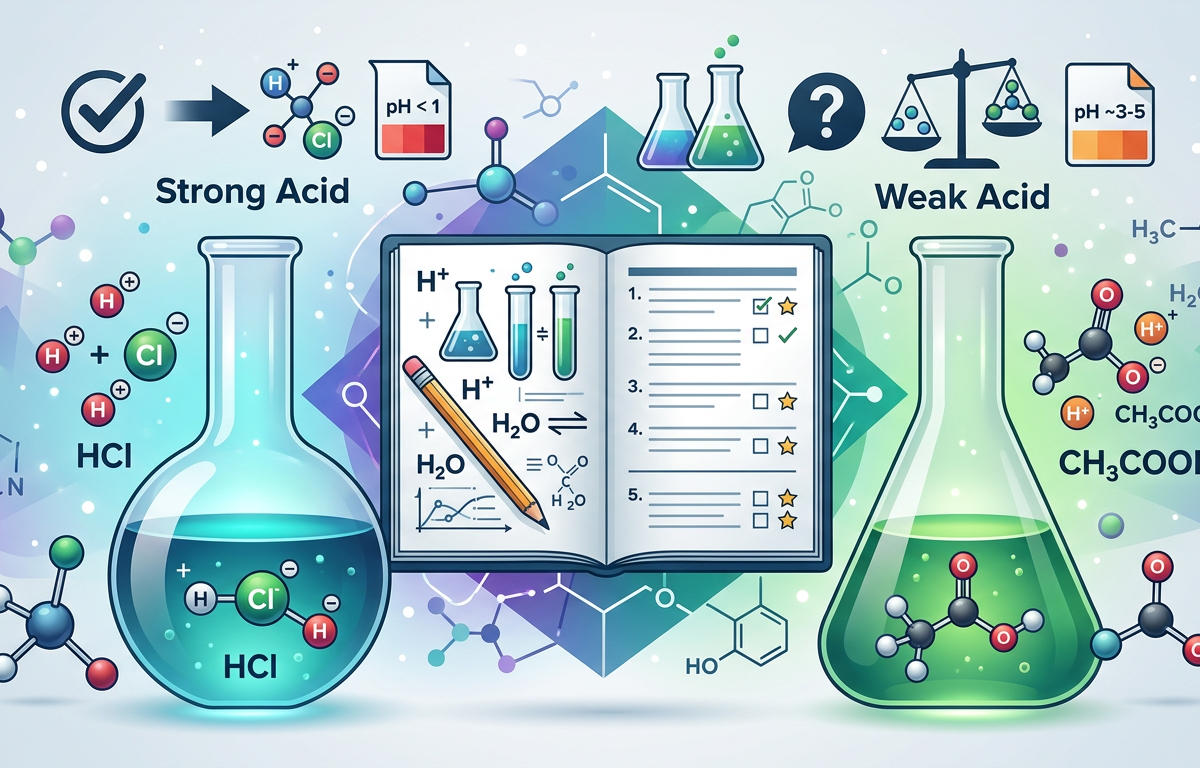
A strong acid is a substance that completely dissociates into its ions in aqueous solution, whereas a weak acid only partially ionizes, establishing a dynamic equilibrium between the intact molecule and its conjugate base. This distinction is fundamental in chemistry because it determines the concentration of hydrogen ions ([H+]) and the resulting pH of a solution. In a strong acid solution, such as hydrochloric acid (HCl), the concentration of hydronium ions is essentially equal to the initial concentration of the acid. In contrast, for a weak acid like acetic acid (CH3COOH), the concentration of hydronium ions is significantly lower than the total acid concentration and must be calculated using the acid dissociation constant (Ka). Understanding these differences is critical for mastering pH calculation practice questions and predicting the behavior of chemicals in biological and industrial systems.
The strength of an acid is often quantified by its pKa value; a lower pKa indicates a stronger acid. For advanced students, it is vital to remember that "strength" is not the same as "concentration." A concentrated weak acid can have a lower pH than a very dilute strong acid. For more in-depth practice on these values, see our pKa and pKb practice questions. High-authority resources like the IUPAC Gold Book provide rigorous definitions for these chemical properties.
Solved Examples
These solved examples demonstrate the mathematical rigor required for hard strong acid vs weak acid practice questions.
Example 1: pH Comparison
Calculate the pH of 0.001 M HCl (strong acid) and 0.001 M HCN (weak acid, Ka = 6.2 × 10⁻¹⁰).
For HCl: Since it is a strong acid, [H+] = [HCl] = 0.001 M. pH = -log(0.001) = 3.00.
For HCN: Use the equilibrium expression Ka = [H+][CN-] / [HCN]. Let x = [H+].
6.2 × 10⁻¹⁰ = x² / (0.001 - x). Assuming x is small, 6.2 × 10⁻¹⁰ = x² / 0.001.
x² = 6.2 × 10⁻¹³. x = 7.87 × 10⁻⁷ M.
pH = -log(7.87 × 10⁻⁷) = 6.10.
Example 2: Percent Ionization
Determine the percent ionization of a 0.10 M solution of nitrous acid (HNO2) with a Ka of 4.5 × 10⁻⁴.
Set up the equilibrium: Ka = x² / (0.10 - x).
4.5 × 10⁻⁴ = x² / 0.10 (approximation). x = √(4.5 × 10⁻⁵) = 0.0067 M.
Check approximation: (0.0067 / 0.10) * 100 = 6.7%. Since this is > 5%, use the quadratic formula for better accuracy.
x² + 4.5 × 10⁻⁴x - 4.5 × 10⁻⁵ = 0. Solving for x gives 0.00648 M.
Percent Ionization = (0.00648 / 0.10) * 100 = 6.48%.
Example 3: Identifying Unknowns
A 0.50 M solution of an unknown acid has a pH of 2.15. Is it a strong or weak acid?
Calculate [H+] from pH: [H+] = 10^(-2.15) = 0.00708 M.
Compare [H+] to the initial concentration (0.50 M).
If it were a strong acid, [H+] would be 0.50 M. Since 0.00708 M << 0.50 M, it is a weak acid.
Practice Questions
Calculate the pH of a 1.5 × 10⁻⁸ M solution of HCl. (Hint: Consider the autoionization of water).
A 0.20 M solution of a monoprotic acid is 2.5% ionized. Calculate the Ka of this acid.
Compare the concentration of H+ in a 0.10 M H2SO4 solution (assume first dissociation is strong, second Ka2 = 1.2 × 10⁻²) to a 0.10 M HCl solution.
Want unlimited practice questions like these?
Generate AI-powered questions with step-by-step solutions on any topic.
Try Question Generator Free →Find the pH of a solution prepared by mixing 50 mL of 0.10 M HF (Ka = 6.8 × 10⁻⁴) with 50 mL of 0.10 M HCl.
Which solution has a higher pH: 0.1 M Chloroacetic acid (Ka = 1.4 × 10⁻³) or 0.1 M Fluoroacetic acid (Ka = 2.6 × 10⁻³)? Explain without full calculation.
Calculate the molarity of a formic acid solution (HCOOH, Ka = 1.8 × 10⁻⁴) that has the same pH as 1.0 × 10⁻³ M HI.
A diprotic acid H2A has Ka1 = 1.0 × 10⁻⁴ and Ka2 = 1.0 × 10⁻⁸. Calculate the concentration of A²⁻ in a 0.10 M solution.
A solution is 0.10 M in Acetic acid and 0.10 M in Sodium Acetate. If this is a buffer, how does the dissociation of the weak acid change compared to a solution of 0.10 M Acetic acid alone?
Calculate the pH of a 0.050 M solution of Trichloracetic acid (Ka = 0.22). Do not use the small x approximation.
Arrange the following in order of increasing acidity: 0.1 M HBr, 0.1 M HF, 0.1 M CH3COOH, 0.1 M NH4+.
Answers & Explanations
Answer: pH ≈ 6.96. At extremely low concentrations of strong acid (below 10⁻⁷ M), the [H+] from the autoionization of water ([H+]_water = 10⁻⁷) becomes significant. Total [H+] = [H+]_acid + [H+]_water. Using the charge balance equation [H+] = [OH-] + [Cl-], and Kw = [H+][OH-], we solve [H+] = (Kw/[H+]) + 1.5 × 10⁻⁸. This yields [H+] ≈ 1.08 × 10⁻⁷ M.
Answer: Ka = 1.28 × 10⁻⁴. [H+] = 0.025 * 0.20 M = 0.005 M. Ka = [H+]² / (C - [H+]) = (0.005)² / (0.20 - 0.005) = 2.5 × 10⁻⁵ / 0.195 = 1.28 × 10⁻⁴.
Answer: H2SO4 has higher [H+]. HCl is a monoprotic strong acid ([H+] = 0.10 M). H2SO4 is strong in its first dissociation ([H+] = 0.10 M) but also contributes additional H+ from the second dissociation (HSO4⁻ ⇌ H+ + SO4²⁻). Even though Ka2 is small, it still adds to the total acidity.
Answer: pH ≈ 1.30. The strong acid (HCl) suppresses the dissociation of the weak acid (HF) due to the common ion effect. After dilution, [HCl] = 0.05 M. The [H+] from HCl is much greater than that produced by HF, so pH is dominated by HCl: -log(0.05) = 1.30.
Answer: Chloroacetic acid. Fluoroacetic acid has a larger Ka, meaning it is a stronger weak acid and produces more H+ ions. More H+ ions result in a lower pH. Therefore, Chloroacetic acid (the weaker of the two) has the higher pH.
Answer: 0.0065 M. pH of 10⁻³ M HI is 3.0. For HCOOH, [H+] must be 10⁻³ M. Ka = [H+]² / (M - [H+]). 1.8 × 10⁻⁴ = (10⁻³)² / (M - 10⁻³). Solving for M: 1.8 × 10⁻⁴(M - 0.001) = 10⁻⁶ → M - 0.001 = 0.00555 → M = 0.00655 M.
Answer: [A²⁻] ≈ 1.0 × 10⁻⁸ M. For most diprotic acids where Ka1 >> Ka2, the concentration of the dianion [A²⁻] is approximately equal to Ka2, regardless of the initial concentration of the acid.
Answer: Dissociation decreases. This is the common ion effect. The presence of the conjugate base (acetate) shifts the equilibrium of the weak acid dissociation to the left, according to Le Chatelier's Principle. For more on this, visit our buffer solution practice questions.
Answer: pH ≈ 1.48. Since Ka (0.22) is large relative to concentration (0.050), use the quadratic formula: 0.22 = x² / (0.050 - x). x² + 0.22x - 0.011 = 0. x = 0.043 M. pH = -log(0.043) = 1.37. (Correction: recalculating gives x ≈ 0.033, pH ≈ 1.48).
Answer: NH4+ < CH3COOH < HF < HBr. NH4+ is the weakest acid (pKa ≈ 9.25), followed by acetic acid (pKa ≈ 4.75), then HF (pKa ≈ 3.17), and finally HBr which is a strong acid (pKa < 0).
1. Which of the following best describes a strong acid?
Frequently Asked Questions
Why is HF considered a weak acid even though Fluorine is highly electronegative?
HF is a weak acid because the H-F bond is extremely strong and the hydration of the resulting fluoride ion involves a high degree of order, leading to an unfavorable entropy change. This prevents the acid from dissociating completely in water compared to other hydrohalic acids like HCl.
Can a weak acid ever have a lower pH than a strong acid?
Yes, pH depends on the concentration of hydronium ions, not just the acid's strength. A highly concentrated weak acid solution will have a lower pH than an extremely dilute strong acid solution.
What is the leveling effect of water?
The leveling effect is a phenomenon where all strong acids appear to have the same strength in water because they all react completely to form the hydronium ion (H3O+). Consequently, H3O+ is the strongest acid that can exist in aqueous solution, as noted in Wikipedia's entry on the leveling effect.
How do I identify a strong acid by looking at its formula?
You should memorize the seven common strong acids: HCl, HBr, HI, HNO3, H2SO4, HClO3, and HClO4. Most other acids encountered in general chemistry, especially organic acids containing the -COOH group, are weak.
Is sulfuric acid always a strong acid?
Sulfuric acid (H2SO4) is a diprotic acid where only the first dissociation is strong. The second dissociation (HSO4⁻ to SO4²⁻) is weak, with a Ka value of approximately 1.2 × 10⁻², meaning it does not fully ionize.
Want unlimited practice questions like these?
Generate AI-powered questions with step-by-step solutions on any topic.
Try Question Generator Free →
Want unlimited practice questions like these?
Generate AI-powered questions with step-by-step solutions on any topic.
Try Question Generator Free →Enjoyed this article?
Share it with others who might find it helpful.
Related Articles
Hard Le Chatelier’s Principle Practice Questions
Master Hard Le Chatelier’s Principle Practice Questions with our comprehensive guide featuring solved examples, practice problems, and detailed explanations.
Mar 30, 2026
Hard Reaction Quotient (Q) Practice Questions
Hard Reaction Quotient (Q) Practice Questions
Mar 30, 2026
Grams to Moles Practice Questions with Answers
Master grams to moles conversions with our comprehensive guide. Includes step-by-step examples, practice questions, and detailed answers for chemistry students.
Mar 26, 2026
Avogadro’s Number Practice Questions with Answers
Master the mole concept with our Avogadro’s Number practice questions. Includes step-by-step solved examples, a quick quiz, and detailed explanations.
Mar 26, 2026
Empirical Formulas: Solving Ratios from Mass and Percent Data
Master empirical formula calculations with 10 practice questions, worked answers, and a free step-by-step calculator for mass, percentage, and combustion problems.
Mar 26, 2026