Hard Combined Gas Law Practice Questions
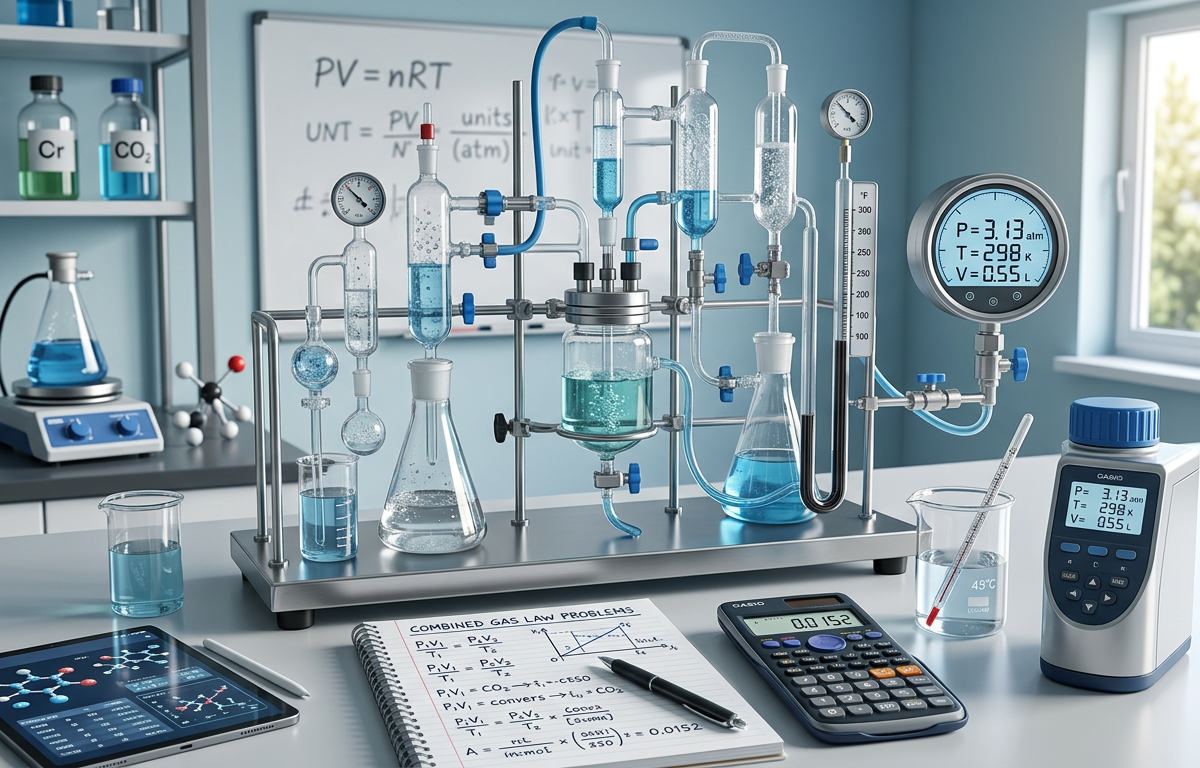
Mastering the Hard Combined Gas Law Practice Questions requires a deep understanding of how pressure, volume, and temperature interact when all three variables change simultaneously. The Combined Gas Law is an essential tool in chemistry that merges Boyle's Law, Charles's Law, and Gay-Lussac's Law into a single, versatile equation. For students aiming to excel in advanced chemistry, practicing complex scenarios—such as those involving unit conversions or non-standard conditions—is the best way to ensure success on high-stakes exams like the MCAT or AP Chemistry.
Concept Explanation
The Combined Gas Law is a mathematical relationship that states the ratio of the product of pressure and volume to the absolute temperature of a gas remains constant if the amount of gas is unchanged. It is expressed by the formula (P₁V₁)/T₁ = (P₂V₂)/T₂, where P represents pressure, V represents volume, and T represents temperature in Kelvin. This law is particularly useful because it allows you to calculate the final state of a gas system when multiple conditions are altered at once, making it a more practical tool than the individual gas laws in real-world laboratory settings.
To solve Hard Combined Gas Law Practice Questions, you must adhere to several critical rules. First, temperature must always be converted to the Kelvin scale (K = °C + 273.15) to avoid mathematical errors involving zero or negative Celsius values. Second, the units for pressure and volume must be consistent on both sides of the equation. For instance, if P₁ is in atmospheres (atm), P₂ must also be in atmospheres. If you are struggling with the basics, you might want to review Boyle’s Law Practice Questions or Charles’s Law Practice Questions before tackling these advanced problems.
In advanced scenarios, you will often encounter Standard Temperature and Pressure (STP), which is defined as 0°C (273.15 K) and 1 atm (101.325 kPa). Harder problems may also require you to calculate gas density or molar mass by integrating the Ideal Gas Law principles into your workflow. Understanding the kinetic molecular theory of gases provides the theoretical backbone for why these relationships hold true under ideal conditions.
Solved Examples
Below are three fully worked examples demonstrating the step-by-step process for solving complex gas law problems.
- Example 1: Changing All Variables
A weather balloon contains 150.0 L of helium at 25.0°C and 1.00 atm. The balloon rises to an altitude where the temperature is -40.0°C and the pressure is 0.350 atm. What is the new volume of the balloon?
- Identify knowns: P₁ = 1.00 atm, V₁ = 150.0 L, T₁ = 25.0 + 273.15 = 298.15 K.
- Identify unknowns: P₂ = 0.350 atm, T₂ = -40.0 + 273.15 = 233.15 K, V₂ = ?
- Rearrange the formula for V₂: V₂ = (P₁V₁T₂) / (P₂T₁).
- Substitute values: V₂ = (1.00 atm × 150.0 L × 233.15 K) / (0.350 atm × 298.15 K).
- Calculate: V₂ = 34972.5 / 104.3525 = 335.1 L.
- Example 2: Finding Final Pressure
A rigid 5.00 L tank contains gas at 2.50 atm and 300 K. If the gas is transferred to a 2.00 L flexible container and heated to 600 K, what is the new pressure?
- Identify knowns: P₁ = 2.50 atm, V₁ = 5.00 L, T₁ = 300 K.
- Identify unknowns: V₂ = 2.00 L, T₂ = 600 K, P₂ = ?
- Rearrange for P₂: P₂ = (P₁V₁T₂) / (V₂T₁).
- Substitute values: P₂ = (2.50 atm × 5.00 L × 600 K) / (2.00 L × 300 K).
- Calculate: P₂ = 7500 / 600 = 12.5 atm.
- Example 3: Unit Conversion Challenge
A gas sample occupies 450 mL at 740 mmHg and 20°C. Calculate the volume at STP.
- Convert units: P₁ = 740 mmHg, V₁ = 0.450 L, T₁ = 293.15 K.
- STP conditions: P₂ = 760 mmHg, T₂ = 273.15 K.
- Rearrange for V₂: V₂ = (P₁V₁T₂) / (P₂T₁).
- Substitute: V₂ = (740 × 0.450 × 273.15) / (760 × 293.15).
- Calculate: V₂ = 90958.95 / 222794 = 0.408 L or 408 mL.
Practice Questions
1. A sample of neon gas at 320 K and 0.850 atm occupies 12.5 L. If the pressure is increased to 1.50 atm and the volume is decreased to 8.00 L, what is the final temperature in Celsius?
2. A high-altitude research cylinder has a volume of 25.0 L at 15.0°C and 101.3 kPa. It is released into the stratosphere where the pressure drops to 15.0 kPa and the temperature is -55.0°C. What is the final volume?
3. A gas occupies 2.50 L at 1.20 atm and 25°C. What pressure is required to compress the gas to 0.75 L if the temperature is raised to 100°C?
Want unlimited practice questions like these?
Generate AI-powered questions with step-by-step solutions on any topic.
Try Question Generator Free →4. An underwater bubble has a volume of 1.50 cm³ at the bottom of a lake where the pressure is 3.50 atm and the temperature is 8.0°C. When the bubble reaches the surface (1.00 atm, 22.0°C), what is its new volume?
5. A mass of oxygen gas at 273 K and 760 torr occupies 22.4 L. If the pressure is doubled and the temperature is tripled, what is the new volume?
6. A 500.0 mL sample of nitrogen is at 100.0 kPa and 25.0°C. If the volume is reduced to 150.0 mL and the pressure increases to 450.0 kPa, what is the final temperature in Kelvin?
7. A gas at STP (0°C, 1 atm) is compressed from 10.0 L to 2.5 L and the temperature is increased to 546°C. What is the final pressure in atmospheres?
8. A piston-cylinder contains 0.85 L of gas at 1.5 atm and 298 K. The gas is heated to 450 K and the pressure is increased to 3.0 atm. Calculate the final volume.
9. A sample of argon gas has a volume of 155 mL at 25.0°C and 745 mmHg. What is the volume of this gas at STP?
10. If a gas sample occupies 1.00 L at 0.00°C and 1.00 atm, at what temperature (in °C) would it occupy 0.500 L at 2.00 atm?
Answers & Explanations
- Answer: 178.6°C
Using T₂ = (P₂V₂T₁) / (P₁V₁): T₂ = (1.50 × 8.00 × 320) / (0.850 × 12.5) = 3840 / 10.625 = 461.4 K. Convert to Celsius: 461.4 - 273.15 = 188.25°C. (Note: Slight rounding differences may occur). - Answer: 127.8 L
V₂ = (P₁V₁T₂) / (P₂T₁) = (101.3 × 25.0 × 218.15) / (15.0 × 288.15) = 552464 / 4322.25 = 127.8 L. - Answer: 5.01 atm
P₂ = (P₁V₁T₂) / (V₂T₁) = (1.20 × 2.50 × 373.15) / (0.75 × 298.15) = 1119.45 / 223.6 = 5.01 atm. - Answer: 5.47 cm³
V₂ = (3.50 × 1.50 × 295.15) / (1.00 × 281.15) = 1549.5 / 281.15 = 5.47 cm³. - Answer: 33.6 L
If P₂ = 2P₁ and T₂ = 3T₁, then V₂ = (P₁ × 22.4 × 3T₁) / (2P₁ × T₁). The P₁ and T₁ cancel out, leaving V₂ = (22.4 × 3) / 2 = 33.6 L. - Answer: 402.5 K
T₂ = (P₂V₂T₁) / (P₁V₁) = (450.0 × 150.0 × 298.15) / (100.0 × 500.0) = 20125125 / 50000 = 402.5 K. - Answer: 12.0 atm
T₁ = 273.15 K, T₂ = 546 + 273.15 = 819.15 K. P₂ = (1.0 × 10.0 × 819.15) / (2.5 × 273.15) = 8191.5 / 682.875 = 12.0 atm. - Answer: 0.64 L
V₂ = (1.5 × 0.85 × 450) / (3.0 × 298) = 573.75 / 894 = 0.64 L. - Answer: 139.3 mL
V₂ = (745 × 155 × 273.15) / (760 × 298.15) = 3154131 / 226594 = 139.3 mL. - Answer: 0.00°C
P₁V₁/T₁ = (1.00 × 1.00) / 273.15. P₂V₂/T₂ = (2.00 × 0.500) / T₂. Since 1.00 × 1.00 = 2.00 × 0.500, then T₂ must equal T₁, which is 273.15 K or 0.00°C.
1. Which temperature scale must be used for all Combined Gas Law calculations?
Frequently Asked Questions
What is the most common mistake when solving combined gas law problems?
The most frequent error is failing to convert temperature from Celsius to Kelvin, which leads to incorrect ratios. Always add 273.15 to the Celsius temperature before beginning your calculations.
Can I use different units for pressure in the same equation?
No, the units for pressure (and volume) must be identical on both sides of the equation. If one pressure is in atm and the other is in kPa, you must convert one to match the other using standard conversion factors.
How do I handle a variable that remains constant in the problem?
If a variable like volume or temperature stays constant, you can simply remove it from the Combined Gas Law equation. This effectively turns the formula back into one of the simpler laws, such as Dalton's Law or Boyle's Law.
Why is the Combined Gas Law useful in real-world science?
In real-world environments, it is rare for only one variable to change; for example, as a weather balloon rises, both the atmospheric pressure and the outside temperature drop simultaneously. The Combined Gas Law allows scientists to predict the resulting volume change accurately.
Does the Combined Gas Law apply to all gases?
The law applies to "ideal gases," which are theoretical gases that follow the gas laws perfectly. While real gases deviate slightly at very high pressures or very low temperatures, the Combined Gas Law remains a highly accurate approximation for most gases at standard conditions.
What is the difference between the Combined Gas Law and the Ideal Gas Law?
The Combined Gas Law compares the same substance under two different sets of conditions (before and after), whereas the Ideal Gas Law (PV=nRT) relates all variables for a single state of a gas, including the amount of substance in moles.
Enjoyed this article?
Share it with others who might find it helpful.
Related Articles
Easy Combined Gas Law Practice Questions
Master the Combined Gas Law with easy practice questions, step-by-step solved examples, and a quick quiz to test your chemistry knowledge.
Apr 2, 2026

Medium Combined Gas Law Practice Questions
Master the combined gas law with our medium-level practice questions, worked examples, and detailed explanations for chemistry students.
Apr 2, 2026
Solving Combined Gas Law Problems: Managing Three Changing Variables
Master the Combined Gas Law with this comprehensive guide featuring clear explanations, step-by-step solved examples, and 10 practice questions with answers.
Apr 2, 2026

Calculating High-Stakes Meds: BSA Mosteller Formula Practice
Master hard body surface area-based dosage calculations with our comprehensive guide, solved examples, and practice questions for healthcare students.
May 17, 2026

Solving High-Stakes IV Titrations and Weight-Based Infusions
Master advanced IV flow rate calculations with these hard practice questions. Covers weight-based dosing, titrations, and dimensional analysis for nurses.
May 17, 2026

Solving Weight-Based Dosing: The 2.2 Conversion and Rounding Logic
Weight-Based Dosage Calculations Practice Questions with Answers
May 17, 2026

Predicting Periodic Anomalies: Beyond Basic Trend Rules
Hard Periodic Trends Practice Questions
Apr 4, 2026
Hard Electron Configuration Practice Questions
Hard Electron Configuration Practice Questions
Apr 4, 2026