Boyle’s Law Practice Questions with Answers
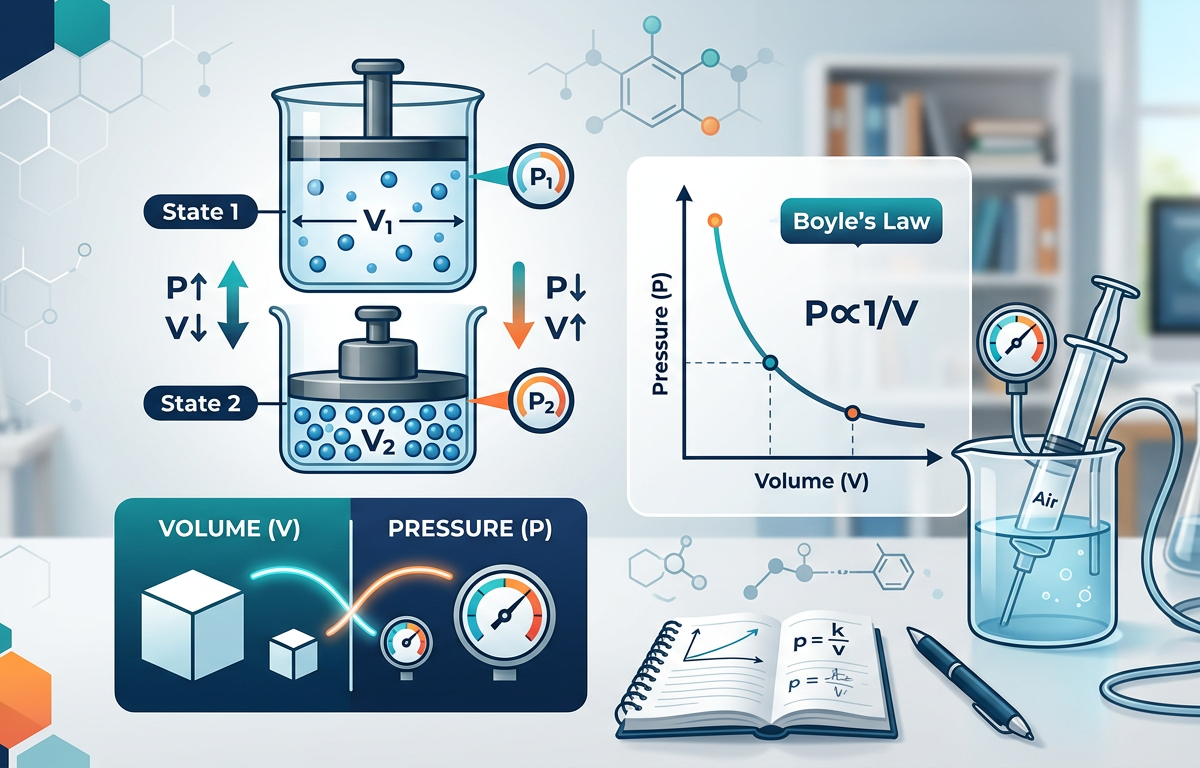
Boyle’s Law is a fundamental principle in chemistry and physics that describes the inverse relationship between the pressure and volume of a gas at a constant temperature. Understanding this relationship is crucial for students preparing for competitive exams, whether you are learning how to study for exams in high school or tackling advanced topics for the MCAT. By mastering Boyle’s Law practice questions, you develop a strong foundation in gas behavior that applies to everything from scuba diving to the mechanics of human breathing.
Concept Explanation
Boyle’s Law states that for a fixed amount of an ideal gas kept at a constant temperature, the pressure (P) and volume (V) are inversely proportional to each other. This means that as the volume of a container decreases, the pressure exerted by the gas increases, provided the temperature and the number of gas molecules remain unchanged. Mathematically, this relationship is expressed as P ∝ 1/V or PV = k, where k is a constant value.
When comparing the same substance under two different sets of conditions, we use the standard formula:
P1V1 = P2V2
In this equation, P1 and V1 represent the initial pressure and volume, while P2 and V2 represent the final pressure and volume. It is essential to ensure that units are consistent on both sides of the equation. Common units for pressure include atmospheres (atm), millimeters of mercury (mmHg), or Pascals (Pa), while volume is typically measured in liters (L) or milliliters (mL). According to Wikipedia's entry on Boyle's Law, this was the first physical law to be expressed as an equation describing the functional dependence of two variable quantities.
Key Assumptions of Boyle's Law
- Constant Temperature: The kinetic energy of the particles must not change.
- Closed System: No gas molecules can enter or leave the container.
- Ideal Gas Behavior: The law assumes the gas behaves ideally, which is most accurate at low pressures and high temperatures.
Solved Examples
To succeed when you study for exams in college, you must walk through the logic of a problem before attempting it alone. Here are three fully worked examples.
Example 1: Finding Final Pressure
A sample of oxygen gas occupies a volume of 2.5 L at a pressure of 1.2 atm. If the volume is compressed to 1.5 L at a constant temperature, what will be the new pressure?
- Identify the known values: P1 = 1.2 atm, V1 = 2.5 L, V2 = 1.5 L.
- Identify the unknown: P2.
- Set up the equation: P1V1 = P2V2.
- Substitute the values: (1.2 atm)(2.5 L) = P2(1.5 L).
- Solve for P2: 3.0 / 1.5 = 2.0 atm.
- Answer: 2.0 atm.
Example 2: Finding Initial Volume
A gas at a pressure of 760 mmHg has its pressure increased to 1520 mmHg, resulting in a final volume of 500 mL. What was the original volume?
- Identify the known values: P1 = 760 mmHg, P2 = 1520 mmHg, V2 = 500 mL.
- Identify the unknown: V1.
- Set up the equation: (760)(V1) = (1520)(500).
- Calculate the right side: 1520 * 500 = 760,000.
- Divide by P1: V1 = 760,000 / 760 = 1000 mL.
- Answer: 1000 mL (or 1.0 L).
Example 3: Working with Different Units
A balloon contains 2.0 L of air at 101.3 kPa. If the balloon is squeezed until the pressure reaches 250 kPa, what is the new volume?
- Identify the known values: P1 = 101.3 kPa, V1 = 2.0 L, P2 = 250 kPa.
- Set up the equation: (101.3)(2.0) = (250)(V2).
- Multiply: 202.6 = 250 * V2.
- Solve: V2 = 202.6 / 250 = 0.8104 L.
- Answer: 0.81 L (rounded to two significant figures).
Practice Questions
Test your knowledge with these Boyle’s Law practice questions. Ensure you convert units if necessary and keep track of significant figures.
1. A gas occupies 12.3 liters at a pressure of 40.0 mmHg. What is the volume when the pressure is increased to 60.0 mmHg?
2. If a gas at 25.0 atm occupies 3.6 liters, what pressure is required to compress the gas to 1.2 liters?
3. A container holds 500 mL of nitrogen at 200 kPa. If the volume is increased to 2.0 L, what is the new pressure in kPa?
Want unlimited practice questions like these?
Generate AI-powered questions with step-by-step solutions on any topic.
Try Question Generator Free →4. A syringe contains 10.0 mL of air at 1.0 atm. If the plunger is pulled out to a volume of 25.0 mL, what is the new pressure?
5. A diver exhales a bubble with a volume of 15 mL at a depth where the pressure is 3.5 atm. What is the volume of the bubble when it reaches the surface where the pressure is 1.0 atm?
6. A tank of helium has a volume of 50.0 L and a pressure of 150 atm. How many 2.5 L balloons can be filled at 1.0 atm pressure? (Assume all gas is transferred).
7. A sample of neon gas at 0.8 atm occupies 400 mL. If the pressure is changed to 1.2 atm, what is the new volume?
8. A piston compresses a gas from 100 cm³ to 20 cm³. If the initial pressure was 101,325 Pa, what is the final pressure?
9. A gas has a volume of 4.0 L at a pressure of 2.0 atm. If the volume is doubled, what happens to the pressure?
10. What was the initial pressure of a gas if it occupied 5.0 L and then moved to a 10.0 L container where the pressure was measured at 0.4 atm?
Answers & Explanations
Review the detailed solutions below to check your work and understand the logic behind each calculation.
1. Answer: 8.2 L
Using P1V1 = P2V2: (40.0 mmHg)(12.3 L) = (60.0 mmHg)(V2). 492 = 60V2. V2 = 492 / 60 = 8.2 L. As pressure increased, volume decreased, which follows the law.
2. Answer: 75.0 atm
(25.0 atm)(3.6 L) = (P2)(1.2 L). 90 = 1.2P2. P2 = 90 / 1.2 = 75 atm. Since the volume was reduced by a factor of 3, the pressure must increase by a factor of 3.
3. Answer: 50 kPa
First, convert 500 mL to 0.5 L so units match. (200 kPa)(0.5 L) = (P2)(2.0 L). 100 = 2.0P2. P2 = 50 kPa.
4. Answer: 0.4 atm
(1.0 atm)(10.0 mL) = (P2)(25.0 mL). 10 = 25P2. P2 = 10 / 25 = 0.4 atm.
5. Answer: 52.5 mL
(3.5 atm)(15 mL) = (1.0 atm)(V2). V2 = 52.5 mL. This explains why bubbles expand as they rise in water.
6. Answer: 3000 balloons
First, find the total volume at 1.0 atm: (150 atm)(50.0 L) = (1.0 atm)(V2). V2 = 7500 L. Now divide by the volume per balloon: 7500 / 2.5 = 3000.
7. Answer: 266.7 mL
(0.8 atm)(400 mL) = (1.2 atm)(V2). 320 = 1.2V2. V2 = 266.67 mL.
8. Answer: 506,625 Pa
(101,325 Pa)(100 cm³) = (P2)(20 cm³). 10,132,500 = 20P2. P2 = 506,625 Pa.
9. Answer: 1.0 atm
(2.0 atm)(4.0 L) = (P2)(8.0 L). 8 = 8P2. P2 = 1.0 atm. Doubling the volume halves the pressure.
10. Answer: 0.8 atm
(P1)(5.0 L) = (0.4 atm)(10.0 L). 5P1 = 4. P1 = 4 / 5 = 0.8 atm.
1. According to Boyle's Law, if the volume of a gas is tripled while temperature remains constant, what happens to the pressure?
Frequently Asked Questions
What is the relationship between pressure and volume in Boyle's Law?
The relationship is inversely proportional, meaning that as one value increases, the other decreases at the same rate. This is because reducing volume forces gas particles into a smaller space, increasing the frequency of collisions with the container walls.
Can Boyle's Law be used if the temperature changes?
No, Boyle's Law only applies when the temperature is held constant. If temperature changes, you must use the Combined Gas Law or the Ideal Gas Law to account for the thermal energy affecting the gas particles.
What units should I use for pressure and volume in Boyle's Law?
You can use any units for pressure (atm, kPa, mmHg) and volume (L, mL, cm³) as long as they are consistent on both sides of the equation. For example, if P1 is in atm, P2 must also be in atm.
Why is Boyle's Law important in scuba diving?
As a diver descends, the water pressure increases, causing the volume of air in their lungs or equipment to decrease. Conversely, as they rise, the pressure drops and the air expands, which can be dangerous if a diver holds their breath. For more science-based study tips, check out Khan Academy's guide to gas laws.
Is Boyle's Law applicable to liquids?
Boyle's Law is specifically for gases because gas molecules have significant space between them and are highly compressible. Liquids and solids are generally considered incompressible, so their volume does not change significantly with pressure.
How do I solve Boyle's Law problems with different units?
Always convert your units to match before plugging them into the formula P1V1 = P2V2. For example, if one volume is in liters and the other in milliliters, convert both to liters to avoid calculation errors. This is a key tip for understanding the chemistry of gas laws effectively.
Enjoyed this article?
Share it with others who might find it helpful.
Related Articles
Hard Le Chatelier’s Principle Practice Questions
Master Hard Le Chatelier’s Principle Practice Questions with our comprehensive guide featuring solved examples, practice problems, and detailed explanations.
Mar 30, 2026
Hard Reaction Quotient (Q) Practice Questions
Hard Reaction Quotient (Q) Practice Questions
Mar 30, 2026
Grams to Moles Practice Questions with Answers
Master grams to moles conversions with our comprehensive guide. Includes step-by-step examples, practice questions, and detailed answers for chemistry students.
Mar 26, 2026
Avogadro’s Number Practice Questions with Answers
Master the mole concept with our Avogadro’s Number practice questions. Includes step-by-step solved examples, a quick quiz, and detailed explanations.
Mar 26, 2026
Empirical Formulas: Solving Ratios from Mass and Percent Data
Master empirical formula calculations with 10 practice questions, worked answers, and a free step-by-step calculator for mass, percentage, and combustion problems.
Mar 26, 2026