Ideal Gas Law (PV = nRT) Practice Questions with Answers

Concept Explanation
The Ideal Gas Law is a fundamental equation of state for a hypothetical ideal gas, expressed as PV = nRT, which relates the pressure, volume, temperature, and amount of a gas. This law combines several individual gas laws, including Boyle's Law, Charles's Law, and Avogadro's Law, into a single equation that describes the behavior of gases under various conditions. When you are preparing to study for exams in engineering school or chemistry, mastering this formula is essential for calculating unknown properties of a gas sample.
The variables in the equation are defined as follows:
P (Pressure): Measured in atmospheres (atm), kilopascals (kPa), or mmHg.
V (Volume): Measured in liters (L).
n (Moles): The amount of substance in the gas.
R (Ideal Gas Constant): A constant that depends on the units of pressure (0.0821 L·atm/mol·K or 8.314 J/mol·K).
T (Temperature): Must always be in Kelvin (K). To convert Celsius to Kelvin, add 273.15.
An deal gas is a theoretical model where gas particles have no volume and do not exert intermolecular forces on each other. While no real gas is perfectly ideal, most gases behave ideally at high temperatures and low pressures. For students who struggle with feeling overwhelmed by complex formulas, breaking down the units first is the best way to ensure accuracy.
Standard Temperature and Pressure (STP)
In many Ideal Gas Law practice questions, you will see the term STP. This refers to a standard set of conditions used for comparisons. At STP, the temperature is 273.15 K (0°C) and the pressure is 1 atm (101.325 kPa). One mole of any ideal gas at STP occupies a volume of 22.4 liters.
Solved Examples
These worked examples demonstrate how to manipulate the PV = nRT formula to solve for different variables.
Example 1: Solving for Volume
What is the volume of 2.50 moles of nitrogen gas at a pressure of 1.50 atm and a temperature of 300 K?
Identify the knowns: n = 2.50 mol, P = 1.50 atm, T = 300 K, R = 0.0821 L·atm/mol·K.
Rearrange the formula to solve for V: V = nRT / P.
Substitute the values: V = (2.50 * 0.0821 * 300) / 1.50.
Calculate: V = 61.575 / 1.50 = 41.05 L.
Example 2: Solving for Pressure
A 5.0 L container holds 0.80 moles of Helium at 25°C. What is the pressure in atm?
Convert temperature to Kelvin: 25 + 273.15 = 298.15 K.
Identify variables: V = 5.0 L, n = 0.80 mol, T = 298.15 K, R = 0.0821 L·atm/mol·K.
Rearrange the formula: P = nRT / V.
Substitute and solve: P = (0.80 * 0.0821 * 298.15) / 5.0 = 3.92 atm.
Example 3: Solving for Moles
How many moles of gas are contained in a 10.0 L tank at 100 kPa and 27°C?
Convert units: T = 300.15 K. Since pressure is in kPa, use R = 8.314 L·kPa/mol·K.
Rearrange the formula: n = PV / RT.
Substitute: n = (100 * 10.0) / (8.314 * 300.15).
Calculate: n = 1000 / 2495.45 = 0.40 moles.
Practice Questions
1. Calculate the pressure exerted by 0.50 moles of Oxygen gas in a 2.0 L container at 280 K.
2. A balloon is filled with 1.2 moles of Hydrogen. If the pressure is 1.1 atm and the temperature is 20°C, what is the volume of the balloon?
3. How many moles of Carbon Dioxide are in a 15 L cylinder at 3.0 atm and 350 K?
Start Learning Smarter Today
Join thousands of students using AI-powered study tools to achieve better results.
Get Started Free
Start Learning Smarter Today
Join thousands of students using AI-powered study tools to achieve better results.
Get Started Free4. What temperature (in Kelvin) is required for 0.10 moles of gas to occupy 1.5 L at 2.5 atm?
5. A rigid 25 L tank contains 3.5 moles of gas at 400 kPa. What is the temperature in Celsius?
6. Find the volume of 0.25 moles of gas at STP.
7. If a gas occupies 500 mL at 0.95 atm and 25°C, how many moles are present?
8. A sample of gas at 5.0 atm and 300 K occupies 12 L. If the volume is doubled and the temperature is held constant, what is the new pressure? (Use PV=nRT or Boyle's Law logic).
9. What is the density of Methane (CH₄, molar mass 16.04 g/mol) at 1.0 atm and 273 K?
10. A 2.0 L flask contains 4.0 g of Helium (He). If the temperature is 300 K, what is the pressure?
Answers & Explanations
1. Answer: 5.75 atm
Using P = nRT/V: P = (0.50 * 0.0821 * 280) / 2.0 = 5.747. Rounded to 5.75 atm.
2. Answer: 26.2 L
Convert 20°C to 293.15 K. V = nRT/P: V = (1.2 * 0.0821 * 293.15) / 1.1 = 26.24 L.
3. Answer: 1.57 moles
n = PV/RT: n = (3.0 * 15) / (0.0821 * 350) = 45 / 28.735 = 1.566 moles.
4. Answer: 456.8 K
T = PV/nR: T = (2.5 * 1.5) / (0.10 * 0.0821) = 3.75 / 0.00821 = 456.76 K.
5. Answer: 70.8°C
T = PV/nR: T = (400 * 25) / (3.5 * 8.314) = 10000 / 29.099 = 343.65 K. Convert to Celsius: 343.65 - 272.85 = 70.8°C.
6. Answer: 5.6 L
At STP, 1 mole = 22.4 L. So, 0.25 moles * 22.4 L/mol = 5.6 L.
7. Answer: 0.019 moles
Convert 500 mL to 0.5 L and 25°C to 298.15 K. n = (0.95 * 0.5) / (0.0821 * 298.15) = 0.475 / 24.478 = 0.0194 moles.
8. Answer: 2.5 atm
According to Boyle's law (derived from PV=nRT), if volume doubles, pressure halves when n and T are constant. 5.0 / 2 = 2.5 atm.
9. Answer: 0.716 g/L
Density (d) = PM/RT. d = (1.0 * 16.04) / (0.0821 * 273) = 16.04 / 22.41 = 0.7157 g/L.
10. Answer: 12.3 atm
First, find moles: 4.0 g / 4.00 g/mol = 1.0 mole. P = (1.0 * 0.0821 * 300) / 2.0 = 12.315 atm.
1. Which of the following is the correct value for the gas constant R when pressure is measured in atmospheres?
Frequently Asked Questions
What is the R value in the Ideal Gas Law?
The R value is the universal gas constant, which acts as a proportionality factor to relate the energy scale to the temperature scale. Its value changes depending on the units used for pressure, such as 0.0821 L·atm/mol·K or 8.314 J/mol·K.
How do you convert Celsius to Kelvin for gas law problems?
To convert Celsius to Kelvin, you simply add 273.15 to the Celsius temperature. This conversion is necessary because the Ideal Gas Law requires an absolute temperature scale where zero represents a total lack of thermal energy.
Why is the Ideal Gas Law considered ideal?
It is called ideal because it assumes that gas particles have no physical volume and do not attract or repel one another. While these assumptions are not perfectly true for real gases, the law provides a very accurate approximation for most gases under standard laboratory conditions.
Can I use the Ideal Gas Law for liquids?
No, the Ideal Gas Law is specifically designed to describe the behavior of substances in the gaseous phase. Liquids and solids have much stronger intermolecular forces and significantly less empty space between particles, requiring different equations of state.
What happens to a gas at absolute zero?
Theoretically, at absolute zero (0 Kelvin), the volume of an ideal gas would become zero as all molecular motion stops. In reality, all gases condense into liquids or solids before reaching this temperature, as discussed in thermodynamics studies.
How does the Ideal Gas Law relate to the Combined Gas Law?
The Combined Gas Law (P1V1/T1 = P2V2/T2) is derived from the Ideal Gas Law by assuming the amount of gas (n) remains constant. It is useful for predicting how a change in one condition affects the others without needing to know the exact number of moles. If you are preparing to study for the MCAT, knowing how to toggle between these laws is a high-yield skill.
Start Learning Smarter Today
Join thousands of students using AI-powered study tools to achieve better results.
Get Started FreeEnjoyed this article?
Share it with others who might find it helpful.
Related Articles

Hard Ideal Gas Law (PV = nRT) Practice Questions
Master complex gas law problems with these hard Ideal Gas Law (PV = nRT) practice questions, including density, molar mass, and stoichiometry calculations.
Apr 2, 2026
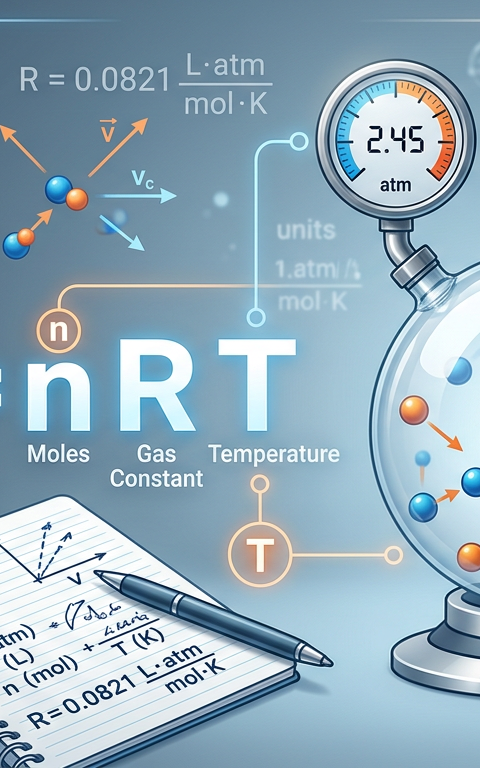
Medium Ideal Gas Law (PV = nRT) Practice Questions
Master the Ideal Gas Law (PV = nRT) with these medium-level practice questions, solved examples, and a quick quiz to boost your chemistry exam scores.
Apr 2, 2026

Calculating High-Stakes Meds: BSA Mosteller Formula Practice
Master hard body surface area-based dosage calculations with our comprehensive guide, solved examples, and practice questions for healthcare students.
May 17, 2026

Solving High-Stakes IV Titrations and Weight-Based Infusions
Master advanced IV flow rate calculations with these hard practice questions. Covers weight-based dosing, titrations, and dimensional analysis for nurses.
May 17, 2026

Solving Weight-Based Dosing: The 2.2 Conversion and Rounding Logic
Weight-Based Dosage Calculations Practice Questions with Answers
May 17, 2026

Predicting Periodic Anomalies: Beyond Basic Trend Rules
Hard Periodic Trends Practice Questions
Apr 4, 2026

Hard Electron Configuration Practice Questions
Hard Electron Configuration Practice Questions
Apr 4, 2026
Medium Electron Configuration Practice Questions
Master medium-level electron configuration with our comprehensive guide, including solved examples, stability exceptions, and practice questions with answers.
Apr 4, 2026