Dalton’s Law Practice Questions with Answers
Concept Explanation
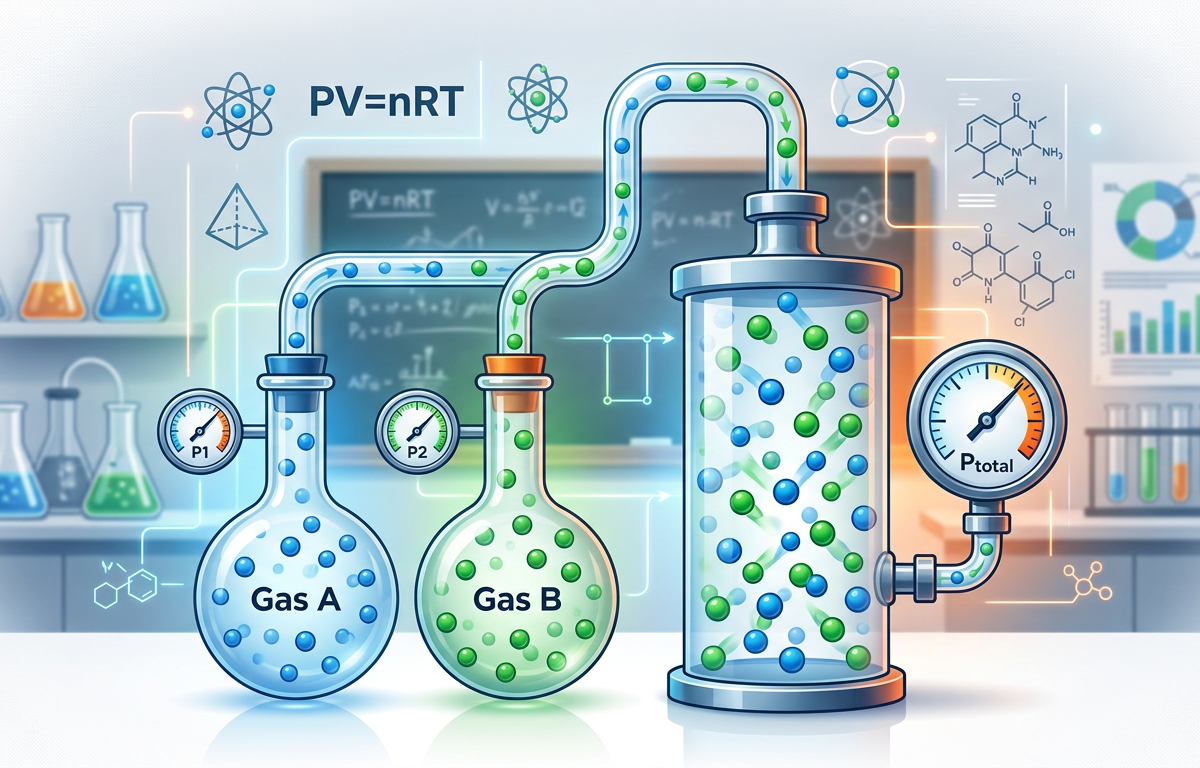
Dalton’s Law of Partial Pressures states that the total pressure exerted by a mixture of non-reactive gases is equal to the sum of the partial pressures of each individual gas in the mixture. This fundamental principle of gas laws implies that each gas in a container behaves independently of the others, contributing its own pressure as if it were the only gas present. The mathematical expression for Dalton’s Law is Ptotal = P1 + P2 + P3 + ... + Pn, where Pn represents the partial pressure of each gas.
Understanding Dalton’s Law is essential for students who want to study for exams to get straight A’s in chemistry. Beyond simple addition, Dalton’s Law relates to the mole fraction of a gas. The partial pressure of a specific gas (Pi) can be calculated by multiplying the total pressure (Ptotal) by the mole fraction (Xi) of that gas, which is the ratio of the moles of that gas to the total moles in the mixture. This relationship is often used in laboratory settings, such as when collecting a gas over water, where one must subtract the vapor pressure of water from the total atmospheric pressure to find the pressure of the "dry" gas.
Solved Examples
Below are three solved examples that demonstrate how to apply Dalton’s Law in different scenarios, ranging from simple addition to using mole fractions.
- Example 1: Calculating Total Pressure
A scuba tank contains a mixture of oxygen, nitrogen, and helium. If the partial pressure of oxygen is 0.20 atm, nitrogen is 0.80 atm, and helium is 0.50 atm, what is the total pressure in the tank?- Identify the known values: PO2 = 0.20 atm, PN2 = 0.80 atm, PHe = 0.50 atm.
- Apply Dalton’s Law: Ptotal = PO2 + PN2 + PHe.
- Substitute and solve: Ptotal = 0.20 + 0.80 + 0.50 = 1.50 atm.
- Result: The total pressure is 1.50 atm.
- Example 2: Finding Partial Pressure from Mole Fraction
A gas mixture contains 4.0 moles of Neon and 1.0 mole of Argon. If the total pressure is 2.0 atm, find the partial pressure of Neon.- Calculate total moles: ntotal = 4.0 + 1.0 = 5.0 moles.
- Calculate the mole fraction of Neon (XNe): XNe = 4.0 / 5.0 = 0.8.
- Apply the formula PNe = XNe × Ptotal.
- Substitute and solve: PNe = 0.8 × 2.0 atm = 1.6 atm.
- Result: The partial pressure of Neon is 1.6 atm.
- Example 3: Gas Collected Over Water
Hydrogen gas is collected over water at 25°C. The total pressure is 765 mmHg. If the vapor pressure of water at 25°C is 23.8 mmHg, what is the partial pressure of the hydrogen gas?- Identify the knowns: Ptotal = 765 mmHg, Pwater = 23.8 mmHg.
- Rearrange Dalton’s Law: Phydrogen = Ptotal - Pwater.
- Substitute and solve: Phydrogen = 765 - 23.8 = 741.2 mmHg.
- Result: The pressure of the dry hydrogen gas is 741.2 mmHg.
Practice Questions
Testing your knowledge with Dalton's Law practice questions is a great way to prepare, especially if you study for exams for the MCAT where gas behavior is frequently tested.
1. A container holds 2.5 atm of Oxygen and 4.2 atm of Nitrogen. What is the total pressure of the system?
2. A mixture of three gases has a total pressure of 1200 mmHg. If Gas A has a pressure of 350 mmHg and Gas B has a pressure of 420 mmHg, what is the partial pressure of Gas C?
3. A balloon is filled with 0.5 moles of Helium and 0.5 moles of Hydrogen. If the total pressure is 1.0 atm, what is the partial pressure of Helium?
Want unlimited practice questions like these?
Generate AI-powered questions with step-by-step solutions on any topic.
Try Question Generator Free →4. Oxygen gas is collected over water at 20°C (vapor pressure of water = 17.5 mmHg). The total pressure is 750.0 mmHg. Calculate the partial pressure of the dry oxygen.
5. A 10.0 L flask contains 0.200 mol of methane and 0.300 mol of ethane at 300 K. Calculate the total pressure (R = 0.0821 L·atm/mol·K).
6. In a mixture of Nitrogen and Oxygen, the mole fraction of Nitrogen is 0.78. If the total pressure is 101.3 kPa, find the partial pressure of Oxygen.
7. A sample of gas contains 5.0g of H2 and 16.0g of O2. If the total pressure is 1500 torr, what is the partial pressure of H2? (Atomic weights: H=1, O=16).
8. If the total pressure of a gas mixture is 5.0 atm and the partial pressures of the components are in a ratio of 1:2:2, what are the individual partial pressures?
9. A diving tank has a total pressure of 200 atm. It contains 2% Oxygen and 98% Helium by mole. What is the partial pressure of Oxygen in the tank?
10. Carbon dioxide is collected over water at 30°C. The total pressure is 1.05 atm. If the water vapor pressure at this temperature is 0.042 atm, what is the pressure of the CO2?
Answers & Explanations
- Answer: 6.7 atm. Explanation: Using Ptotal = P1 + P2, we add 2.5 atm + 4.2 atm = 6.7 atm.
- Answer: 430 mmHg. Explanation: PC = Ptotal - (PA + PB). Thus, 1200 - (350 + 420) = 1200 - 770 = 430 mmHg.
- Answer: 0.5 atm. Explanation: Total moles = 0.5 + 0.5 = 1.0. Mole fraction of Helium = 0.5 / 1.0 = 0.5. Partial pressure = 0.5 × 1.0 atm = 0.5 atm.
- Answer: 732.5 mmHg. Explanation: Pdry gas = Ptotal - Pwater. 750.0 - 17.5 = 732.5 mmHg.
- Answer: 1.23 atm. Explanation: First, find total moles (n = 0.2 + 0.3 = 0.5). Use the Ideal Gas Law P = nRT/V. P = (0.5 mol × 0.0821 L·atm/mol·K × 300 K) / 10.0 L = 1.2315 atm.
- Answer: 22.29 kPa. Explanation: If XN2 = 0.78, then XO2 = 1 - 0.78 = 0.22. PO2 = 0.22 × 101.3 kPa = 22.286 kPa.
- Answer: 1250 torr. Explanation: Moles H2 = 5.0g / 2.0g/mol = 2.5 mol. Moles O2 = 16.0g / 32.0g/mol = 0.5 mol. Total moles = 3.0. XH2 = 2.5 / 3.0 = 0.833. PH2 = 0.833 × 1500 = 1250 torr.
- Answer: 1.0 atm, 2.0 atm, 2.0 atm. Explanation: The ratio parts sum to 1 + 2 + 2 = 5. Each "part" is 5.0 atm / 5 = 1.0 atm. The pressures are 1(1.0), 2(1.0), and 2(1.0).
- Answer: 4 atm. Explanation: 2% by mole means XO2 = 0.02. PO2 = 0.02 × 200 atm = 4 atm.
- Answer: 1.008 atm. Explanation: Subtract the vapor pressure from the total: 1.05 atm - 0.042 atm = 1.008 atm.
1. Which formula correctly represents Dalton’s Law of Partial Pressures?
Frequently Asked Questions
What is a partial pressure?
Partial pressure is the pressure that an individual gas in a mixture would exert if it alone occupied the entire volume of the container at the same temperature. It is a measure of the thermodynamic activity of the gas molecules. According to LibreTexts Chemistry, each gas in a mixture contributes to the total pressure independently.
How do you calculate the mole fraction for Dalton's Law?
The mole fraction is calculated by dividing the number of moles of a specific component by the total number of moles of all components in the mixture. This value is a dimensionless ratio between 0 and 1. If you study for exams when overwhelmed, remember that mole fractions in a mixture must always sum up to exactly 1.0.
Does Dalton’s Law apply to real gases?
Dalton’s Law is strictly accurate only for ideal gases where molecules do not interact with one another. In real-world scenarios with high pressures or low temperatures, intermolecular forces can cause deviations from the law. However, for most general chemistry applications, it provides a very close approximation of reality.
How is Dalton’s Law used in scuba diving?
Scuba divers use Dalton’s Law to calculate the partial pressure of oxygen (ppO2) at various depths to avoid oxygen toxicity or nitrogen narcosis. As a diver descends and the total pressure increases, the partial pressure of each gas in their breathing mix also increases proportionally. This is a critical concept for those who study for exams for the USMLE or other medical certifications involving physiology.
Can I use Dalton's Law with units other than atm?
Yes, Dalton’s Law works with any unit of pressure, including mmHg, torr, kPa, or psi, as long as all pressures in the equation use the same units. You should always convert all individual pressures to a common unit before adding them together to find the total pressure. For more detailed data on pressure standards, refer to NIST resources.
Enjoyed this article?
Share it with others who might find it helpful.
Related Articles
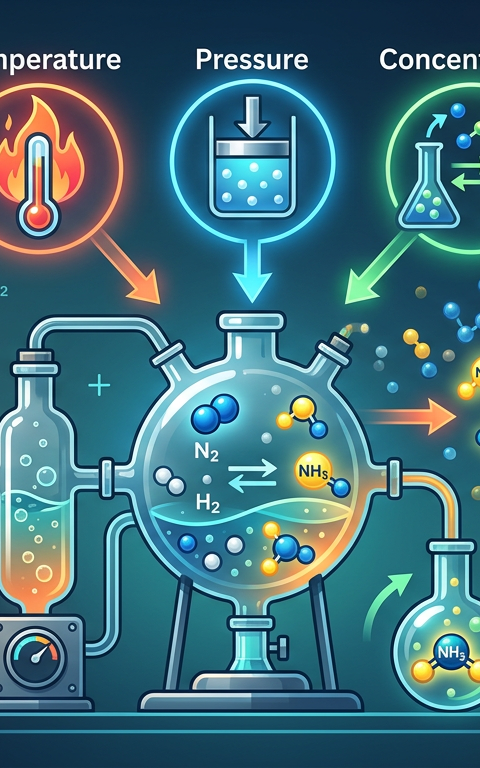
Hard Le Chatelier’s Principle Practice Questions
Master Hard Le Chatelier’s Principle Practice Questions with our comprehensive guide featuring solved examples, practice problems, and detailed explanations.
Mar 30, 2026

Hard Reaction Quotient (Q) Practice Questions
Hard Reaction Quotient (Q) Practice Questions
Mar 30, 2026
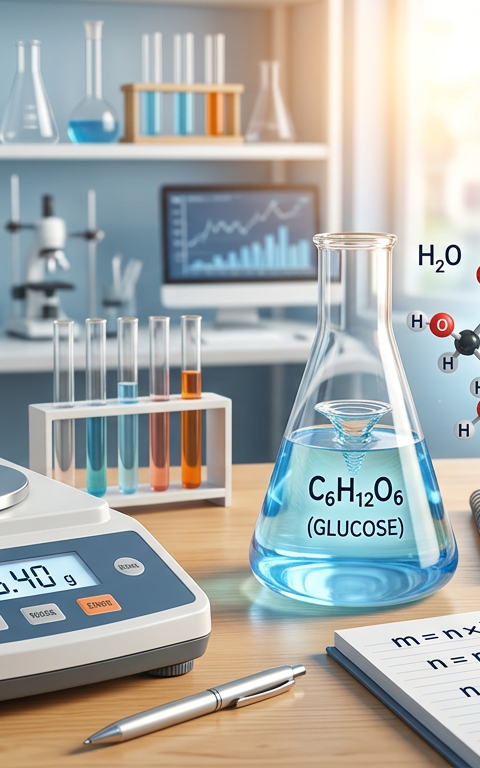
Grams to Moles Practice Questions with Answers
Master grams to moles conversions with our comprehensive guide. Includes step-by-step examples, practice questions, and detailed answers for chemistry students.
Mar 26, 2026
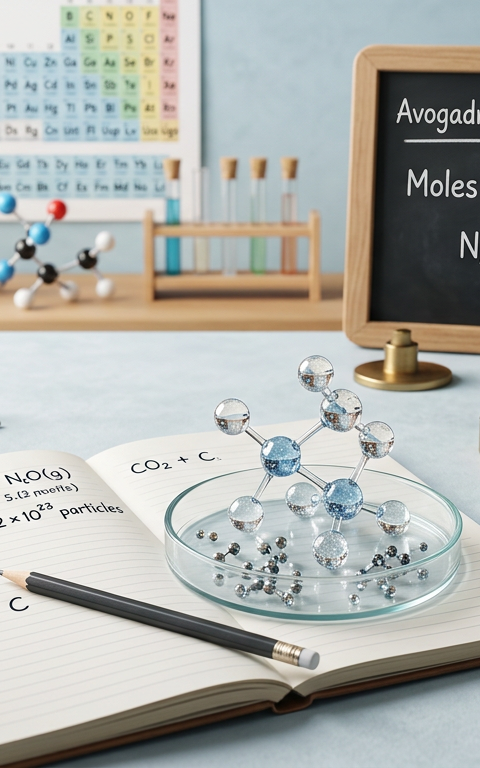
Avogadro’s Number Practice Questions with Answers
Master the mole concept with our Avogadro’s Number practice questions. Includes step-by-step solved examples, a quick quiz, and detailed explanations.
Mar 26, 2026

Empirical Formulas: Solving Ratios from Mass and Percent Data
Master empirical formula calculations with 10 practice questions, worked answers, and a free step-by-step calculator for mass, percentage, and combustion problems.
Mar 26, 2026