Hard Acid-Base Titration Practice Questions
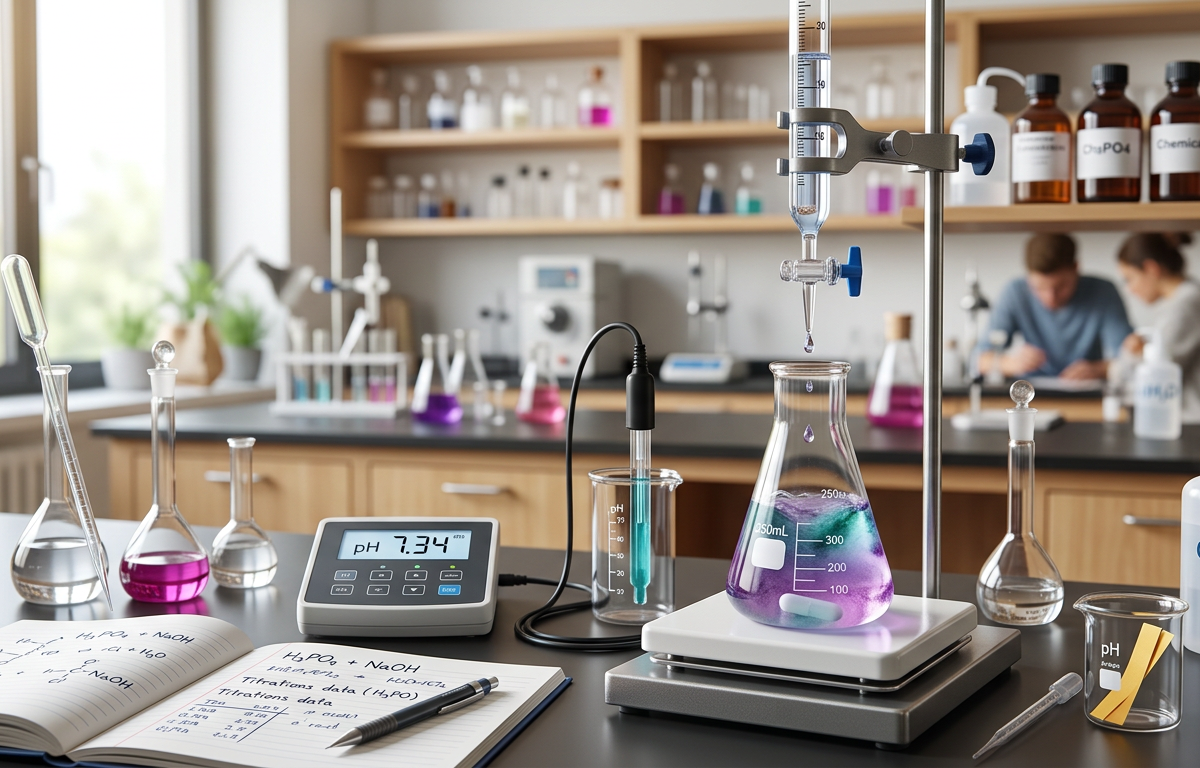
Mastering Hard Acid-Base Titration Practice Questions requires a deep understanding of stoichiometry, chemical equilibrium, and the specific behavior of weak acids and bases. This guide provides challenging problems designed to push your analytical skills beyond simple neutralization calculations.
Concept Explanation
An acid-base titration is a laboratory technique used to determine the unknown concentration of an acid or base by reacting it with a standard solution of known concentration. At its core, the procedure relies on the principle of equivalence, where the moles of titrant added are stoichiometrically equal to the moles of the substance being analyzed. Advanced titration scenarios often involve weak acids or bases, requiring the use of the Henderson-Hasselbalch Equation to calculate the pH in the buffer region. Unlike strong acid-strong base titrations where the equivalence point is always at pH 7.0, the titration of a weak species results in a salt that undergoes hydrolysis, shifting the equivalence point pH. For example, titrating a weak acid with a strong base results in a basic equivalence point (pH > 7) due to the presence of the conjugate base. Understanding these nuances is critical for selecting the correct indicator and predicting the shape of the titration curve.
Solved Examples
Weak Acid Titration: Calculate the pH of a 50.0 mL solution of 0.100 M acetic acid (CH₃COOH, Ka = 1.8 × 10⁻⁵) after adding 25.0 mL of 0.100 M NaOH.
Calculate initial moles: Moles acid = 0.050 L × 0.100 M = 0.005 mol. Moles OH⁻ added = 0.025 L × 0.100 M = 0.0025 mol.
Reaction: CH₃COOH + OH⁻ → CH₃COO⁻ + H₂O. The OH⁻ is the limiting reactant.
Post-reaction moles: [CH₃COOH] = 0.005 - 0.0025 = 0.0025 mol. [CH₃COO⁻] = 0.0025 mol.
Since moles of acid equal moles of conjugate base, this is the half-equivalence point. pH = pKa.
pH = -log(1.8 × 10⁻⁵) = 4.74.
Equivalence Point pH: Determine the pH at the equivalence point when 25.0 mL of 0.20 M HF (Ka = 6.6 × 10⁻⁴) is titrated with 0.20 M KOH.
At equivalence, moles HF = moles KOH. Volume of KOH needed = 25.0 mL. Total volume = 50.0 mL.
Moles of F⁻ formed = 0.025 L × 0.20 M = 0.005 mol.
Concentration [F⁻] = 0.005 mol / 0.050 L = 0.10 M.
F⁻ is a weak base. Kb = Kw / Ka = 1.0 × 10⁻¹⁴ / 6.6 × 10⁻⁴ = 1.52 × 10⁻¹¹.
[OH⁻] = √(Kb × [F⁻]) = √(1.52 × 10⁻¹¹ × 0.10) = 1.23 × 10⁻⁶ M.
pOH = -log(1.23 × 10⁻⁶) = 5.91. pH = 14 - 5.91 = 8.09.
Polyprotic Acid: A 20.0 mL sample of 0.10 M H₂SO₃ (Ka1 = 1.5 × 10⁻², Ka2 = 1.2 × 10⁻⁷) is titrated with 0.10 M NaOH. What is the pH after 30.0 mL of NaOH is added?
Initial moles H₂SO₃ = 0.002 mol. Moles OH⁻ added = 0.003 mol.
First 0.002 mol OH⁻ converts H₂SO₃ to HSO₃⁻. Remaining OH⁻ = 0.001 mol.
The 0.001 mol OH⁻ reacts with 0.002 mol HSO₃⁻ to form 0.001 mol SO₃²⁻.
Remaining [HSO₃⁻] = 0.001 mol; [SO₃²⁻] = 0.001 mol.
This is the second half-equivalence point. pH = pKa2 = -log(1.2 × 10⁻⁷) = 6.92.
Practice Questions
Calculate the pH of a solution formed by mixing 40.0 mL of 0.15 M NH₃ (Kb = 1.8 × 10⁻⁵) with 20.0 mL of 0.30 M HCl.
A 0.500 g sample of an unknown monoprotic weak acid is dissolved in 50.0 mL of water and titrated with 0.100 M NaOH. The equivalence point is reached after 40.0 mL of NaOH is added. If the pH at the half-equivalence point is 4.20, what is the molar mass of the acid?
Calculate the pH at the equivalence point for the titration of 0.10 M hydroxylamine (NH₂OH, Kb = 1.1 × 10⁻⁸) with 0.10 M HCl.
Want unlimited practice questions like these?
Generate AI-powered questions with step-by-step solutions on any topic.
Try Question Generator Free →A 25.0 mL sample of 0.12 M Pyridine (C₅H₅N, Kb = 1.7 × 10⁻⁹) is titrated with 0.10 M HCl. Calculate the pH after 15.0 mL of HCl has been added.
Calculate the pH of a 0.10 M solution of Na₂CO₃, given that for H₂CO₃, Ka1 = 4.3 × 10⁻⁷ and Ka2 = 5.6 × 10⁻¹¹.
In the titration of 50.0 mL of 0.10 M Malonic acid (H₂C₃H₂O₄, Ka1 = 1.5 × 10⁻³, Ka2 = 2.0 × 10⁻⁶) with 0.10 M NaOH, what is the pH at the first equivalence point?
What volume of 0.50 M HNO₃ must be added to 100 mL of 0.20 M NaC₂H₃O₂ to reach a pH of 4.00? (Ka of acetic acid = 1.8 × 10⁻⁵).
A mixture contains 0.10 M HCl and 0.10 M HOCl (Ka = 3.0 × 10⁻⁸). If 50.0 mL of this mixture is titrated with 0.10 M NaOH, calculate the pH after 60.0 mL of NaOH is added.
Calculate the pH when 10.0 mL of 0.10 M NaOH is added to 40.0 mL of 0.025 M H₂SO₄.
Determine the pH of a solution prepared by adding 0.01 mol of solid Ba(OH)₂ to 1.0 L of a buffer that is 0.10 M in NH₃ and 0.10 M in NH₄Cl (Kb for NH₃ = 1.8 × 10⁻⁵).
Answers & Explanations
pH = 5.28. Moles NH₃ = 0.006; Moles HCl = 0.006. This is the equivalence point. All NH₃ is converted to NH₄⁺. [NH₄⁺] = 0.006 mol / 0.060 L = 0.10 M. Ka = Kw/Kb = 5.56 × 10⁻¹⁰. [H⁺] = √(Ka × [NH₄⁺]) = 7.45 × 10⁻⁶. pH = 5.13. (Correction: Check stoichiometry—if moles are equal, it's a weak acid problem).
Molar Mass = 125 g/mol. Moles NaOH = 0.040 L × 0.100 M = 0.004 mol. At equivalence, moles acid = 0.004 mol. Molar mass = 0.500 g / 0.004 mol = 125 g/mol. (pKa = 4.20, but not needed for molar mass).
pH = 3.52. At equivalence, total volume = 200 mL. [NH₃OH⁺] = 0.05 M. Ka = 10⁻¹⁴ / 1.1 × 10⁻⁸ = 9.09 × 10⁻⁷. [H⁺] = √(9.09 × 10⁻⁷ × 0.05) = 2.13 × 10⁻⁴. pH = 3.67.
pH = 5.23. Moles Pyridine = 0.003; Moles HCl = 0.0015. This is the half-equivalence point. pH = pKa. pKb = 8.77, so pKa = 14 - 8.77 = 5.23.
pH = 11.63. CO₃²⁻ is a base. Kb = Kw / Ka2 = 1.79 × 10⁻⁴. [OH⁻] = √(1.79 × 10⁻⁴ × 0.10) = 4.23 × 10⁻³ M. pOH = 2.37. pH = 11.63.
pH = 4.26. For the first equivalence point of a diprotic acid, pH ≈ (pKa1 + pKa2) / 2. pKa1 = 2.82, pKa2 = 5.70. pH = (2.82 + 5.70) / 2 = 4.26. Refer to pKa and pKb Practice Questions for more on these constants.
33.9 mL. Use the Buffer Solution principles. pH = pKa + log([A⁻]/[HA]). 4.00 = 4.74 + log((0.02 - x)/x). Solve for x (moles HNO₃), then find volume.
pH = 7.12. First 50 mL NaOH neutralizes HCl. Next 10 mL reacts with HOCl. Moles HOCl remaining = 0.004; Moles OCl⁻ formed = 0.001. pH = 7.52 + log(0.001/0.004) = 6.92.
pH = 7.00. H₂SO₄ is a strong acid. Moles H⁺ = 0.040 L × 0.025 M × 2 = 0.002 mol. Moles OH⁻ = 0.010 L × 0.10 M = 0.001 mol. Remaining H⁺ = 0.001 mol. [H⁺] = 0.001 / 0.050 = 0.02 M. pH = 1.70. (Note: H₂SO₄ second dissociation is usually ignored in high-level simplified models but matters in precise ones).
pH = 9.44. Ba(OH)₂ provides 0.02 mol OH⁻. New [NH₃] = 0.12; [NH₄⁺] = 0.08. pOH = 4.74 + log(0.08/0.12) = 4.56. pH = 9.44.
1. At the equivalence point of a titration between a weak base and a strong acid, the pH is:
Frequently Asked Questions
Why is the equivalence point pH not 7 for weak acid titrations?
The equivalence point pH is determined by the properties of the salt produced during neutralization. In a weak acid titration, the conjugate base of the acid is formed, which reacts with water (hydrolysis) to produce hydroxide ions, resulting in a pH greater than 7.
What is the difference between the endpoint and the equivalence point?
The equivalence point is the theoretical point where the moles of titrant and analyte are stoichiometrically equal. The endpoint is the physical point where an indicator changes color, which should ideally coincide with the equivalence point.
How do you choose the right indicator for a titration?
An appropriate indicator must have a color change range (pKin ± 1) that overlaps with the vertical steep section of the titration curve. This ensures the color change occurs as close to the equivalence point as possible for maximum accuracy.
Can you titrate a weak acid with a weak base?
Titrating a weak acid with a weak base is generally avoided because the pH change near the equivalence point is too gradual. This makes it extremely difficult to detect a precise endpoint using standard indicators or pH probes.
What is a buffer region in a titration curve?
The buffer region is the relatively flat portion of a titration curve for a weak species, occurring before the equivalence point. In this region, both the weak acid/base and its conjugate are present in significant amounts, resisting large changes in pH upon further titrant addition.
Want unlimited practice questions like these?
Generate AI-powered questions with step-by-step solutions on any topic.
Try Question Generator Free →
Want unlimited practice questions like these?
Generate AI-powered questions with step-by-step solutions on any topic.
Try Question Generator Free →Enjoyed this article?
Share it with others who might find it helpful.
Related Articles
Medium Acid-Base Titration Practice Questions
Master medium acid-base titration practice questions with step-by-step solutions, pH calculations, and stoichiometry tips for chemistry students.
Mar 29, 2026
Acid-Base Titration Practice Questions with Answers
Master acid-base titration with our comprehensive guide featuring solved examples, practice questions, and step-by-step explanations for chemistry students.
Mar 23, 2026
Solving Titration Math: From M1V1 to Polyprotic Stoichiometry
Master the basics of neutralization with our easy acid-base titration practice questions. Includes step-by-step solved examples and a quick quiz.
Mar 29, 2026

Calculating High-Stakes Meds: BSA Mosteller Formula Practice
Master hard body surface area-based dosage calculations with our comprehensive guide, solved examples, and practice questions for healthcare students.
May 17, 2026

Solving High-Stakes IV Titrations and Weight-Based Infusions
Master advanced IV flow rate calculations with these hard practice questions. Covers weight-based dosing, titrations, and dimensional analysis for nurses.
May 17, 2026

Solving Weight-Based Dosing: The 2.2 Conversion and Rounding Logic
Weight-Based Dosage Calculations Practice Questions with Answers
May 17, 2026
Predicting Periodic Anomalies: Beyond Basic Trend Rules
Hard Periodic Trends Practice Questions
Apr 4, 2026
Hard Electron Configuration Practice Questions
Hard Electron Configuration Practice Questions
Apr 4, 2026