Stoichiometry of the Flask: Calculating Solute Mass and Dilutions
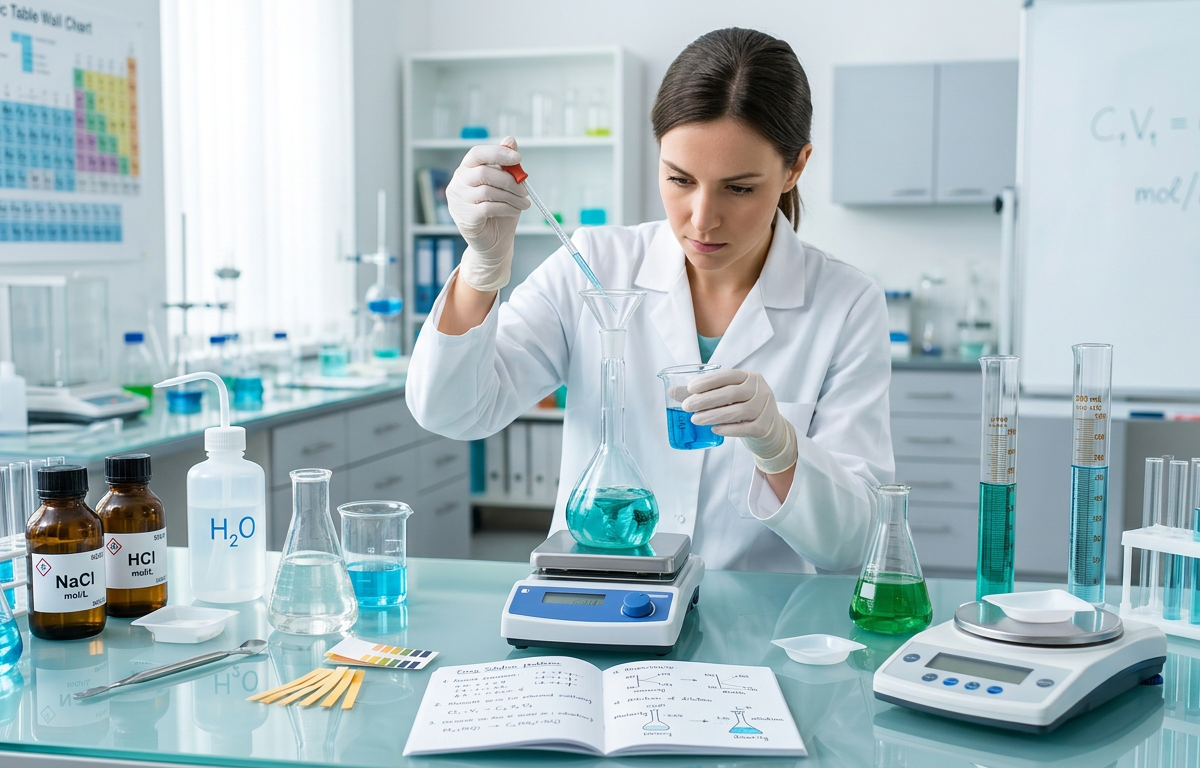
A student weighs out 5.84 grams of sodium chloride, adds it to a flask, and then pours in exactly 500 mL of water. While this seems correct, they have actually failed to create a 0.20 M solution. The most frequent error in the laboratory is forgetting that molarity is based on the total volume of the solution, not the volume of the solvent added. Because the salt itself occupies space, the final mixture will slightly exceed 500 mL, resulting in an inaccurate concentration. Success in solution chemistry requires a precise sequence: converting mass to moles and ensuring the final volume is adjusted only after the solute is dissolved.
Bridging the gap between a dry calculation and a wet lab involves two primary tools: the molarity equation and the dilution formula. Whether you are scaling down a concentrated stock of hydrochloric acid or determining how many grams of glucose to stir into a beaker, you are essentially managing the ratio of particles to space. The following practice set focuses on these core transitions, specifically targeting the unit conversions between milliliters and liters that often lead to decimal point errors in high-pressure exam settings.
The Mechanics of Molar Concentration
Solution preparation is the process of creating a homogeneous mixture by dissolving a specific amount of solute into a solvent to reach a desired concentration. In most introductory chemistry settings, this involves the concept of molarity, which is defined as the number of moles of solute per liter of solution. To succeed with easy solution preparation practice questions, you must be comfortable using the formula: Molarity (M) = Moles of Solute / Liters of Solution. Additionally, you will frequently need to perform grams to moles conversions using the molar mass of the substance, which can be found on a standard periodic table. Another common technique is dilution, where a concentrated "stock" solution is mixed with more solvent to create a less concentrated "working" solution, typically calculated using the formula M1V1 = M2V2.
Solved Examples
Calculating Mass for a Specific Molarity: How many grams of Sodium Chloride (NaCl) are needed to prepare 500 mL of a 0.20 M solution? (Molar mass of NaCl = 58.44 g/mol).
Convert volume from mL to Liters: 500 mL / 1000 = 0.500 L.
Calculate moles needed: Moles = Molarity × Volume = 0.20 mol/L × 0.500 L = 0.10 moles.
Convert moles to grams: Mass = Moles × Molar Mass = 0.10 mol × 58.44 g/mol = 5.844 grams.
Final Answer: 5.84 grams of NaCl.
Simple Dilution: You have a 10.0 M stock solution of HCl. How much of this stock is needed to make 100 mL of a 1.0 M HCl solution?
Identify variables: M1 = 10.0 M, M2 = 1.0 M, V2 = 100 mL.
Use the dilution formula: M1V1 = M2V2.
Rearrange for V1: V1 = (M2 × V2) / M1.
Calculate: V1 = (1.0 M × 100 mL) / 10.0 M = 10 mL.
Final Answer: 10 mL of the stock solution.
Finding Molarity from Mass: If 10 grams of NaOH (Molar mass = 40.00 g/mol) are dissolved in water to make a final volume of 2.0 Liters, what is the molarity?
Convert grams to moles: 10 g / 40.00 g/mol = 0.25 moles.
Use the molarity formula: M = Moles / Liters.
Calculate: M = 0.25 mol / 2.0 L = 0.125 M.
Final Answer: 0.125 M.
Practice Questions
Test your knowledge with these easy solution preparation practice questions. Ensure you have a calculator and a periodic table handy for molar mass values.
1. How many grams of Glucose (C6H12O6, molar mass = 180.16 g/mol) are required to make 250 mL of a 0.5 M solution?
2. A student needs to prepare 2.0 L of a 0.1 M KCl solution. How many moles of KCl are required?
3. What is the final concentration if you dilute 50 mL of 2.0 M NaOH to a total volume of 200 mL?
Want unlimited practice questions like these?
Generate AI-powered questions with step-by-step solutions on any topic.
Try Question Generator Free →4. How many milliliters of water must be added to 100 mL of 1.0 M NaCl to make it 0.5 M? (Careful: find total volume first!)
5. Calculate the molarity of a solution containing 5.0 grams of MgCl2 (molar mass = 95.21 g/mol) in 500 mL of solution.
6. You need to make 1.5 L of a 0.75 M Sucrose solution. How many moles of sucrose do you need?
7. If you have 25 grams of AgNO3 (molar mass = 169.87 g/mol), what is the maximum volume of 0.1 M solution you can prepare?
8. A lab protocol asks for 500 mL of 0.25 M CuSO4. How many grams of CuSO4 (molar mass = 159.61 g/mol) should you weigh out?
9. What volume of 12.0 M HCl stock solution is needed to prepare 250 mL of 1.0 M HCl?
10. If 0.5 moles of NaCl are dissolved in enough water to make 250 mL of solution, what is the molarity?
Answers & Explanations
22.52 grams. Explanation: Moles = 0.5 M × 0.250 L = 0.125 mol. Mass = 0.125 mol × 180.16 g/mol = 22.52 g.
0.2 moles. Explanation: Moles = M × V = 0.1 mol/L × 2.0 L = 0.2 mol.
0.5 M. Explanation: Using M1V1 = M2V2: (2.0 M)(50 mL) = (M2)(200 mL). M2 = 100 / 200 = 0.5 M.
100 mL. Explanation: M1V1 = M2V2 → (1.0)(100) = (0.5)(V2) → V2 = 200 mL. Since you started with 100 mL, you must add 100 mL of water.
0.105 M. Explanation: Moles = 5.0 g / 95.21 g/mol = 0.0525 mol. Molarity = 0.0525 mol / 0.500 L = 0.105 M.
1.125 moles. Explanation: Moles = 0.75 M × 1.5 L = 1.125 mol.
1.47 Liters. Explanation: Moles = 25 g / 169.87 g/mol = 0.147 mol. Volume = Moles / Molarity = 0.147 / 0.1 = 1.47 L.
19.95 grams. Explanation: Moles = 0.25 M × 0.500 L = 0.125 mol. Mass = 0.125 mol × 159.61 g/mol = 19.95 g.
20.83 mL. Explanation: (12.0 M)(V1) = (1.0 M)(250 mL) → V1 = 250 / 12 = 20.83 mL.
2.0 M. Explanation: Molarity = 0.5 mol / 0.250 L = 2.0 M.
1. Which formula is used to calculate the molarity of a solution?
Frequently Asked Questions
What is the difference between a solute and a solvent?
A solute is the substance being dissolved (like salt), while the solvent is the substance doing the dissolving (like water). In most easy solution preparation practice questions, water is the universal solvent used to create aqueous solutions.
Why must volume be in liters when calculating molarity?
Molarity is defined by the International Union of Pure and Applied Chemistry (IUPAC) as moles per cubic decimeter, which is equivalent to moles per liter. Using milliliters would result in a value 1,000 times larger than the standard molar concentration.
How do I find the molar mass of a compound?
To find the molar mass, sum the atomic masses of all atoms present in the chemical formula. For instance, in molecular formula calculations, you multiply the atomic mass of each element by its subscript and add them together.
Can I use any unit of volume in the dilution equation?
Yes, in the formula M1V1 = M2V2, you can use any volume unit (mL, L, drops) as long as it is consistent on both sides of the equation. This is because the units cancel out during the calculation of the ratio.
What is the most common mistake in solution preparation?
A frequent error is forgetting to account for the total final volume; for example, adding 500 mL of water to a solute rather than adding enough water until the total volume reaches 500 mL. You can read more about avoiding these errors in our guide on common molarity mistakes.
Is molarity temperature-dependent?
Yes, molarity is temperature-dependent because liquid volume expands or contracts with temperature changes. For highly precise work, scientists may use molality, which relates moles to the mass of the solvent, as mass does not change with temperature.
Want unlimited practice questions like these?
Generate AI-powered questions with step-by-step solutions on any topic.
Try Question Generator Free →Enjoyed this article?
Share it with others who might find it helpful.
Related Articles

Calculating High-Stakes Meds: BSA Mosteller Formula Practice
Master hard body surface area-based dosage calculations with our comprehensive guide, solved examples, and practice questions for healthcare students.
May 17, 2026
Predicting Radioactive Decay: Solving for Mass and Time Intervals
Master half-life calculations with our comprehensive guide featuring step-by-step solved examples, practice questions, and detailed answers for students.
Apr 2, 2026
Solving Equilibrium Problems Without Losing Your Stoichiometry
Master chemical equilibrium with these easy ICE table practice questions. Learn to calculate concentrations and K values with step-by-step solved examples.
Mar 30, 2026
Calculating Kc: Mastering the Ratio of Equilibrium Concentrations
Master the Equilibrium Constant (Kc) with our comprehensive guide featuring solved examples, practice questions, and detailed explanations for chemistry students.
Mar 30, 2026
Calculating Enthalpy Changes Using Bond Enthalpy Data
Master bond energy calculations with our comprehensive guide. Includes solved examples, practice questions, and detailed explanations for chemistry students.
Mar 29, 2026
Calculating Enthalpy Changes: Hess’s Law Puzzle Solving Guide
Master Hess’s Law with our comprehensive guide featuring solved examples, step-by-step practice questions, and detailed answers for chemistry students.
Mar 29, 2026
Solving Titration Math: From M1V1 to Polyprotic Stoichiometry
Master the basics of neutralization with our easy acid-base titration practice questions. Includes step-by-step solved examples and a quick quiz.
Mar 29, 2026
Mastering M1V1 = M2V2: Solving Complex Solution Dilutions
Master dilution calculations with our comprehensive guide. Includes the M1V1=M2V2 formula, solved examples, and 10 practice questions with detailed answers.
Mar 27, 2026