Easy ppm and ppb Practice Questions
Concept Explanation
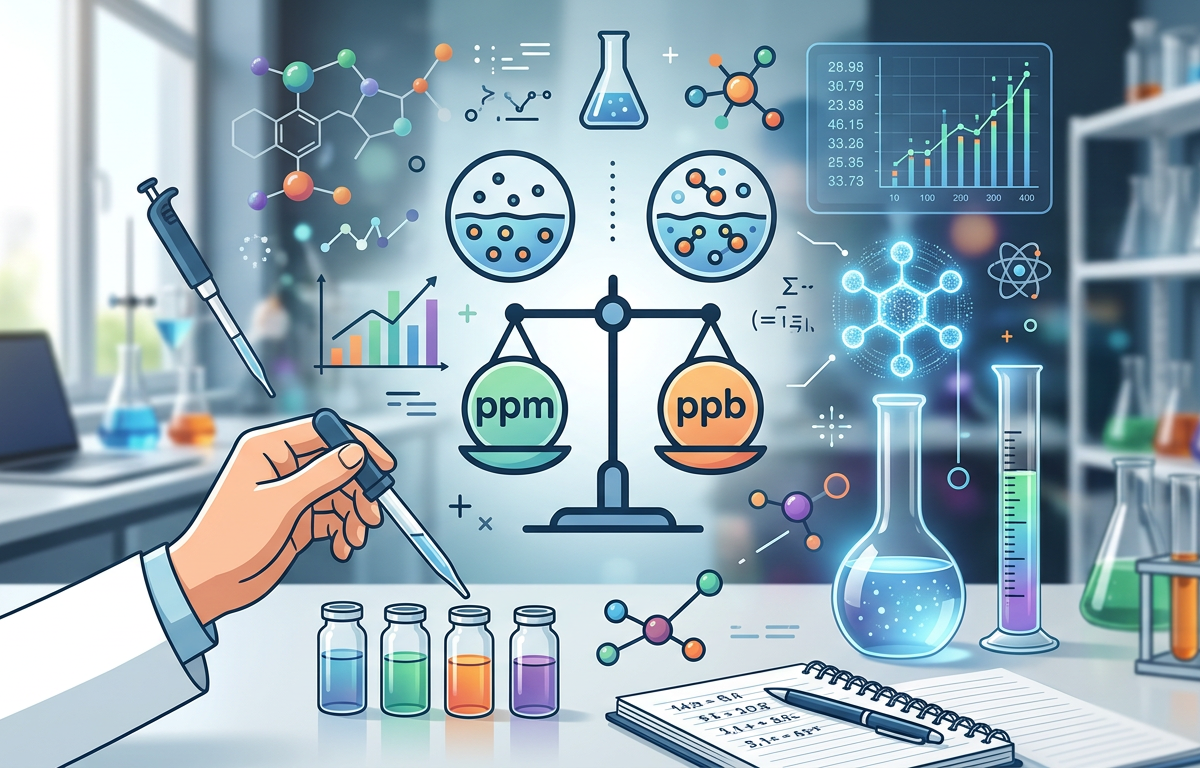
Parts per million (ppm) and parts per billion (ppb) are units of concentration used to express very small amounts of a solute within a large volume of solution or mixture. These measurements are essential in fields like environmental science, toxicology, and analytical chemistry where trace amounts of substances, such as lead in drinking water or CO2 in the atmosphere, must be monitored precisely. While molarity is common for laboratory concentrations, ppm and ppb are more practical for describing highly dilute systems.
To calculate these values, you compare the mass of the solute to the total mass of the solution and multiply by a factor of 106 for ppm or 109 for ppb. Because 1 liter of water has a mass of approximately 1,000,000 milligrams, 1 ppm is equivalent to 1 milligram of solute per liter of water (mg/L). Similarly, 1 ppb is equivalent to 1 microgram per liter (μg/L). These units are dimensionless ratios, similar to percentages, but on a much smaller scale. For instance, 1% is 1 part per hundred, whereas 1 ppm is 1 part per million.
Key Formulas
UnitFormulaCommon Equivalent (Aqueous)ppm(Mass of Solute / Total Mass) × 106mg/L or mg/kgppb(Mass of Solute / Total Mass) × 109μg/L or μg/kg
Understanding these units is a critical step in mastering percentage composition and other concentration metrics. Regulatory bodies like the Environmental Protection Agency (EPA) use these units to set safety standards for public health.
Solved Examples
Solving ppm and ppb problems requires careful attention to units to ensure the solute and solution masses are in the same scale before multiplying by the power of ten.
Calculating ppm from Mass: A 500-gram sample of well water contains 0.002 grams of fluoride. What is the concentration in ppm?
1. Identify the mass of solute (0.002 g) and total mass (500 g).
2. Use the formula: (0.002 / 500) × 1,000,000.
3. 0.000004 × 1,000,000 = 4 ppm.Converting ppm to ppb: A soil sample has a lead concentration of 1.5 ppm. Express this in ppb.
1. Recognize that 1 ppm = 1,000 ppb (since 109 is 1,000 times larger than 106).
2. Multiply the ppm value by 1,000.
3. 1.5 × 1,000 = 1,500 ppb.Finding Solute Mass: How many milligrams of salt are in 2 liters of a 15 ppm solution?
1. Recall that 1 ppm = 1 mg/L for aqueous solutions.
2. Multiply the concentration (15 mg/L) by the volume (2 L).
3. 15 mg/L × 2 L = 30 mg of salt.
Practice Questions
Test your knowledge with these easy ppm and ppb practice questions. Ensure you convert all masses to the same units (e.g., grams) before performing the final calculation.
A 2,000 g sample of river water contains 0.01 g of nitrates. Calculate the concentration in ppm.
An atmospheric gas sample contains 0.0005 g of methane in every 1,000 g of air. What is the methane concentration in ppm?
Convert a concentration of 0.08 ppm of mercury into ppb.
Want unlimited practice questions like these?
Generate AI-powered questions with step-by-step solutions on any topic.
Try Question Generator Free →A bottle of mineral water contains 45 mg of calcium in 0.5 liters. What is the calcium concentration in ppm? (Assume 1 L = 1 kg).
A laboratory test detects 5 ppb of a certain pesticide in a 2 kg fruit sample. How many micrograms of pesticide are present?
If a solution is 250 ppb, what is its concentration in ppm?
A 1.5 kg sample of soil contains 0.000003 kg of arsenic. Calculate the concentration in ppm.
A technician dissolves 0.025 g of a dye in 250,000 g of water. What is the concentration in ppb?
The legal limit for a certain toxin is 15 ppb. If a 100 g sample contains 0.000002 g of the toxin, is it within the legal limit?
How many grams of solute are needed to prepare 5,000 g of a 10 ppm solution?
Answers & Explanations
5 ppm. Calculation: (0.01 g / 2,000 g) × 1,000,000 = 0.000005 × 1,000,000 = 5.
0.5 ppm. Calculation: (0.0005 g / 1,000 g) × 1,000,000 = 0.0000005 × 1,000,000 = 0.5.
80 ppb. To convert ppm to ppb, multiply by 1,000. 0.08 × 1,000 = 80.
90 ppm. First, convert 0.5 L to 500,000 mg (since 1 L = 1,000,000 mg). (45 mg / 500,000 mg) × 1,000,000 = 90. Alternately, use mg/L: 45 mg / 0.5 L = 90 mg/L.
10 μg. Since 1 ppb = 1 μg/kg, then 5 ppb = 5 μg/kg. For 2 kg: 5 μg/kg × 2 kg = 10 μg.
0.25 ppm. To convert ppb to ppm, divide by 1,000. 250 / 1,000 = 0.25.
2 ppm. Calculation: (0.000003 kg / 1.5 kg) × 1,000,000 = 0.000002 × 1,000,000 = 2.
100 ppb. Calculation: (0.025 g / 250,000 g) × 1,000,000,000 = 0.0000001 × 1,000,000,000 = 100.
Yes (20 ppb). Calculation: (0.000002 g / 100 g) × 1,000,000,000 = 20 ppb. Since 20 ppb is greater than 15 ppb, it is actually above the legal limit.
0.05 g. Rearrange the formula: Solute = (ppm × Total Mass) / 106. (10 × 5,000) / 1,000,000 = 50,000 / 1,000,000 = 0.05 g.
1. Which of the following is equivalent to 1 ppm in an aqueous solution?
Frequently Asked Questions
What is the difference between ppm and ppb?
Parts per million (ppm) measures one unit of solute in one million units of total solution, while parts per billion (ppb) measures one unit in one billion. In practical terms, ppb is 1,000 times more dilute than ppm, meaning 1 ppm equals 1,000 ppb.
How do you convert ppm to a percentage?
To convert ppm to a percentage, divide the ppm value by 10,000. For example, a concentration of 5,000 ppm is equal to 0.5%, because 1% is equivalent to 10,000 parts per million.
When should I use ppm instead of molarity?
You should use ppm when dealing with trace amounts of substances where the molar concentration would be an inconveniently small decimal. It is standard for reporting water quality, air pollutants, and safety thresholds in the World Health Organization (WHO) guidelines.
Is 1 ppm always equal to 1 mg/L?
This equality only holds true for dilute aqueous solutions where the density of the solution is approximately 1.00 g/mL. In these cases, 1 liter of water weighs 1 kilogram (1,000,000 mg), making 1 mg/L exactly 1 part per million by mass.
What are some real-world examples of ppb?
Real-world examples of ppb include the concentration of arsenic allowed in drinking water (10 ppb) or the detection of specific hormones in the human bloodstream. These levels are so small they are comparable to a few drops of ink in an Olympic-sized swimming pool.
Can ppm be used for gases?
Yes, ppm is frequently used for gases, but it usually refers to parts per million by volume (ppmv) rather than mass. For example, the NASA Global Climate Change resources track CO2 levels in the atmosphere using ppm units.
Want unlimited practice questions like these?
Generate AI-powered questions with step-by-step solutions on any topic.
Try Question Generator Free →
Want unlimited practice questions like these?
Generate AI-powered questions with step-by-step solutions on any topic.
Try Question Generator Free →Enjoyed this article?
Share it with others who might find it helpful.
Related Articles
Hard Le Chatelier’s Principle Practice Questions
Master Hard Le Chatelier’s Principle Practice Questions with our comprehensive guide featuring solved examples, practice problems, and detailed explanations.
Mar 30, 2026
Hard Reaction Quotient (Q) Practice Questions
Hard Reaction Quotient (Q) Practice Questions
Mar 30, 2026
Grams to Moles Practice Questions with Answers
Master grams to moles conversions with our comprehensive guide. Includes step-by-step examples, practice questions, and detailed answers for chemistry students.
Mar 26, 2026
Avogadro’s Number Practice Questions with Answers
Master the mole concept with our Avogadro’s Number practice questions. Includes step-by-step solved examples, a quick quiz, and detailed explanations.
Mar 26, 2026
Empirical Formulas: Solving Ratios from Mass and Percent Data
Master empirical formula calculations with 10 practice questions, worked answers, and a free step-by-step calculator for mass, percentage, and combustion problems.
Mar 26, 2026