Easy Organ System Questions Practice Questions
Concept Explanation
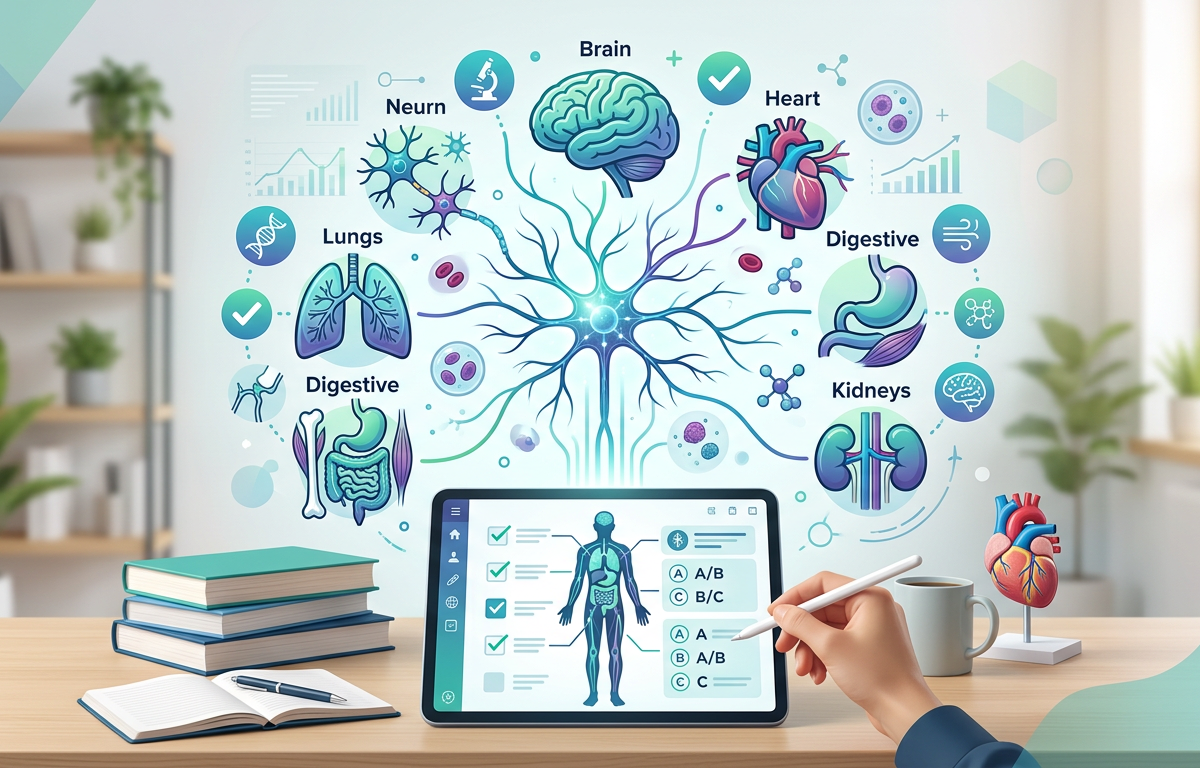
An organ system is a group of organs that work together to perform one or more complex physiological functions within the body. In the human body, there are 11 major organ systems, including the circulatory, respiratory, digestive, and nervous systems, each playing a critical role in maintaining homeostasis. Understanding how these systems interact is a fundamental part of mastering anatomy practice questions. For example, the skeletal system provides the structural framework, while the muscular system allows for movement by pulling on those bones. According to the National Cancer Institute, biological organization follows a hierarchy from cells to tissues, then to organs, and finally to organ systems. By studying Easy Organ System Questions Practice Questions, students can build a solid foundation for more advanced medical and biological studies.
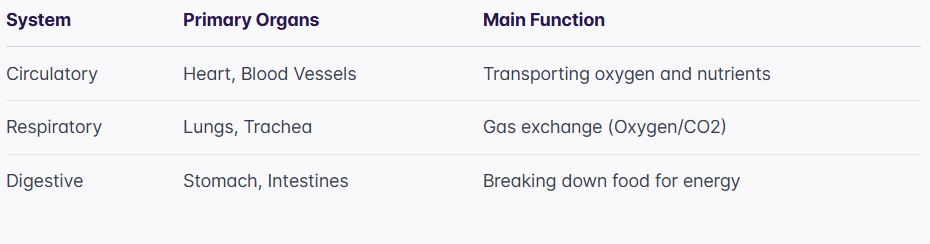
Key Human Organ Systems
Solved Examples
These examples demonstrate how to identify the correct organ system based on its primary function or the organs involved.
Example 1: Identifying the Respiratory System
Which organ system is primarily responsible for taking in oxygen and removing carbon dioxide from the body?
Identify the main organs involved in gas exchange (the lungs).
Recall which system houses the lungs.
The solution is the Respiratory System.
Example 2: Linking Organs to Systems
The heart and blood vessels belong to which organ system?
Recognize the heart's function as a pump.
Identify that blood vessels act as transport "pipes."
The solution is the Circulatory (or Cardiovascular) System.
Example 3: System Interactions
When you eat a piece of fruit, which system is responsible for breaking it down into nutrients?
Think about the path of food (mouth, esophagus, stomach).
Determine the process name (digestion).
The solution is the Digestive System.
Practice Questions
Test your knowledge with these Easy Organ System Questions Practice Questions. Work through them sequentially to build your confidence.
Which organ system includes the brain, spinal cord, and peripheral nerves?
What is the primary function of the skeletal system?
Which system is responsible for producing hormones that regulate metabolism and growth?
Start Learning Smarter Today
Join thousands of students using AI-powered study tools to achieve better results.
Get Started Free
Start Learning Smarter Today
Join thousands of students using AI-powered study tools to achieve better results.
Get Started FreeThe kidneys and bladder are the main components of which system?
Which organ system acts as the body's first line of defense against infection through the skin?
Which system allows for bodily movement and maintains posture?
The trachea and bronchi are parts of which system?
Which system is responsible for transporting white blood cells to fight infection?
Which organ system breaks down nutrients so they can be absorbed into the blood?
What system includes the pituitary gland and thyroid gland?
Answers & Explanations
Nervous System: The brain and spinal cord form the central nervous system, while nerves carry signals throughout the body. You can learn more in our nervous system questions guide.
Support and Protection: The skeletal system provides a structural frame for the body and protects internal organs like the heart and lungs.
Endocrine System: This system uses glands to secrete hormones directly into the bloodstream to regulate various body functions.
Excretory (or Urinary) System: The kidneys filter waste from the blood to produce urine, which is stored in the bladder.
Integumentary System: This system consists of the skin, hair, and nails, providing a physical barrier against the external environment.
Muscular System: Muscles contract to pull on bones and move the body.
Respiratory System: The trachea (windpipe) and bronchi are tubes that conduct air into the lungs.
Circulatory (or Lymphatic) System: While the lymphatic system is specific to immunity, the circulatory system transports these cells through the blood. See our cardiovascular system questions for more detail.
Digestive System: It processes food mechanically and chemically to extract glucose, amino acids, and fats.
Endocrine System: Glands like the pituitary and thyroid are key regulators of hormonal balance.
1. Which organ system is responsible for the exchange of oxygen and carbon dioxide?
Frequently Asked Questions
What is the largest organ system in the human body?
The integumentary system is considered the largest organ system because the skin covers the entire external surface of the body. It accounts for about 15% of total body weight in adults.
How do organ systems work together?
Organ systems interact through chemical and electrical signals to maintain homeostasis. For example, the respiratory system provides oxygen that the circulatory system then carries to the muscular system for energy.
Can a person survive if one organ system fails?
Survival depends on which system fails; while modern medicine can support some failures (like dialysis for the excretory system), the total failure of the circulatory or nervous system is typically fatal. Medical interventions aim to restore function or provide mechanical support to the affected system.
What is the difference between an organ and an organ system?
An organ is a single structure made of tissues, like the heart, whereas an organ system is a collection of multiple organs working toward a common goal. This hierarchy ensures complex life forms can manage multiple biological processes simultaneously.
Which system is responsible for fighting off diseases?
The immune and lymphatic systems are primarily responsible for identifying and destroying pathogens like bacteria and viruses. They work closely with the circulatory system to transport protective cells throughout the body.
Start Learning Smarter Today
Join thousands of students using AI-powered study tools to achieve better results.
Get Started FreeEnjoyed this article?
Share it with others who might find it helpful.
Related Articles
Hard Le Chatelier’s Principle Practice Questions
Master Hard Le Chatelier’s Principle Practice Questions with our comprehensive guide featuring solved examples, practice problems, and detailed explanations.
Mar 30, 2026

Hard Reaction Quotient (Q) Practice Questions
Hard Reaction Quotient (Q) Practice Questions
Mar 30, 2026
Grams to Moles Practice Questions with Answers
Master grams to moles conversions with our comprehensive guide. Includes step-by-step examples, practice questions, and detailed answers for chemistry students.
Mar 26, 2026
Avogadro’s Number Practice Questions with Answers
Master the mole concept with our Avogadro’s Number practice questions. Includes step-by-step solved examples, a quick quiz, and detailed explanations.
Mar 26, 2026
Empirical Formulas: Solving Ratios from Mass and Percent Data
Master empirical formula calculations with 10 practice questions, worked answers, and a free step-by-step calculator for mass, percentage, and combustion problems.
Mar 26, 2026