Easy Normality Practice Questions
Concept Explanation
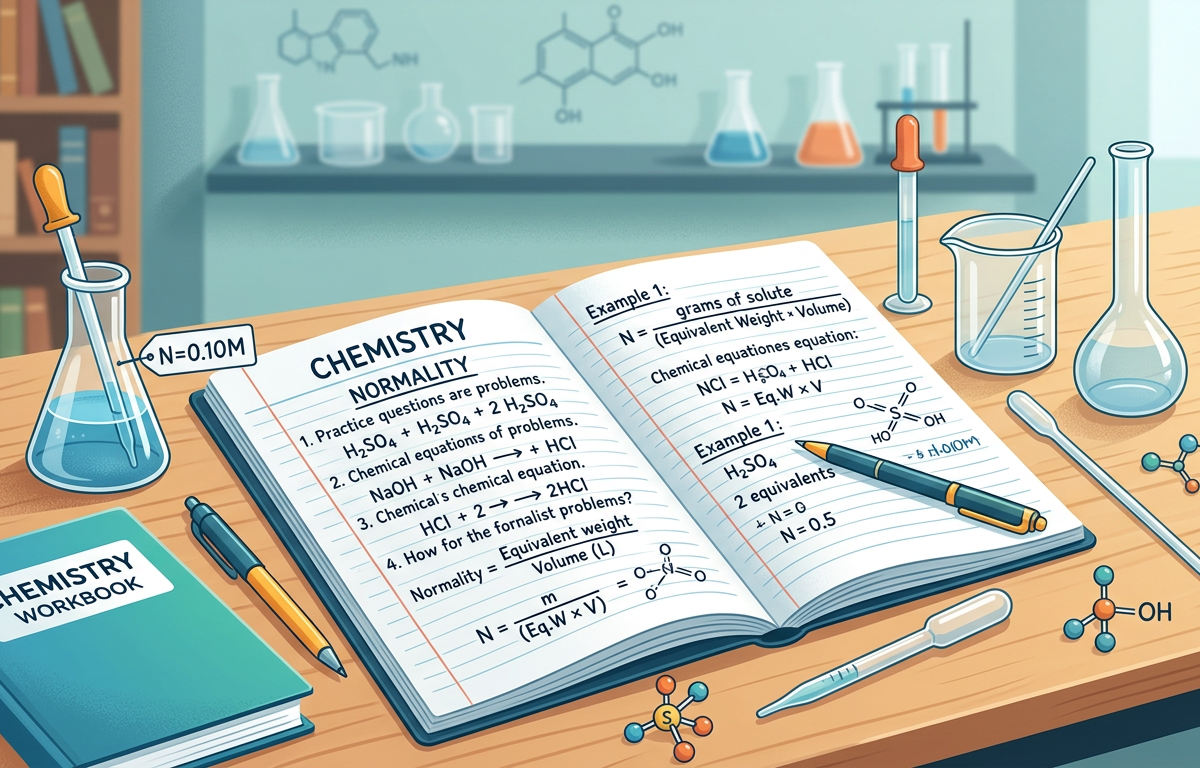
Normality is a measure of concentration that expresses the number of gram equivalents of solute present in one liter of solution. While molarity measures the number of moles of solute per liter, normality focuses on the reactive capacity of the molecule, such as the number of hydrogen ions (H+) or hydroxide ions (OH-) it can provide in a reaction. To calculate normality, you multiply the molarity of the solution by the 'n-factor' or equivalence factor, which represents the number of reactive species per molecule. This unit is particularly useful in acid-base titration practice questions because it allows for a direct 1:1 ratio comparison between reactants at the equivalence point.
The Normality Formula
The mathematical representation of normality (N) is:
N = n × M
Where:
N: Normality (equivalents/L)
n: Equivalence factor (n-factor)
M: Molarity (moles/L)
Alternatively, if you are starting from mass:
N = (Weight of Solute in grams) / (Equivalent Weight × Volume of Solution in Liters)
The Equivalent Weight is calculated as the Molecular Weight divided by the n-factor. For example, in sulfuric acid (H₂SO₄), the n-factor is 2 because it releases two protons. Therefore, its equivalent weight is 98.08 g/mol divided by 2, which equals 49.04 g/eq. Understanding this relationship is easier if you have already mastered grams to moles practice questions.
Solved Examples
Reviewing these worked examples will help you understand how to apply the normality formula to various chemical scenarios.
Example 1: Calculating Normality from Molarity
Calculate the normality of a 0.5 M solution of H₃PO₄ (Phosphoric acid), assuming all three hydrogens are replaceable.
Identify the molarity: M = 0.5 M.
Identify the n-factor: Since H₃PO₄ has 3 replaceable hydrogen ions, n = 3.
Apply the formula: N = n × M.
Calculate: N = 3 × 0.5 = 1.5 N.
The normality of the solution is 1.5 N.
Example 2: Calculating Normality from Mass
What is the normality of a solution containing 4.0 grams of NaOH (Sodium Hydroxide) dissolved in 500 mL of water? (Molar mass of NaOH = 40 g/mol)
Calculate moles of NaOH: 4.0 g / 40 g/mol = 0.1 moles.
Calculate molarity: 0.1 moles / 0.5 L = 0.2 M.
Identify the n-factor: NaOH provides 1 OH- ion, so n = 1.
Apply the formula: N = 1 × 0.2 M = 0.2 N.
The normality of the solution is 0.2 N.
Example 3: Finding Mass from Normality
How many grams of HCl (Molar mass = 36.5 g/mol) are needed to prepare 2 liters of a 0.1 N solution?
Identify target normality: N = 0.1 N.
Identify n-factor for HCl: n = 1.
Calculate required molarity: M = N / n = 0.1 / 1 = 0.1 M.
Calculate moles needed: Moles = M × Volume = 0.1 M × 2 L = 0.2 moles.
Convert moles to grams: 0.2 moles × 36.5 g/mol = 7.3 grams.
You need 7.3 grams of HCl.
Practice Questions
Test your knowledge with these easy normality practice questions. Start with basic conversions and progress to mass-based calculations.
What is the normality of a 2.0 M HCl solution?
Calculate the normality of a 0.75 M H₂SO₄ solution.
A solution is prepared by dissolving 0.5 moles of Ca(OH)₂ in 1 liter of water. What is its normality?
Want unlimited practice questions like these?
Generate AI-powered questions with step-by-step solutions on any topic.
Try Question Generator Free →Calculate the normality of a 0.1 M Al(OH)₃ solution.
If 10 grams of NaOH (Molar mass = 40 g/mol) are dissolved in 250 mL of solution, what is the normality?
What is the normality of a solution containing 49 grams of H₂SO₄ (Molar mass = 98 g/mol) in 1 liter of solution?
Convert 0.5 N Ba(OH)₂ to its molarity.
How many equivalents are present in 500 mL of a 2 N solution?
Determine the normality of 0.25 M H₃PO₄ when used in a reaction where all three protons are neutralized.
A 250 mL solution contains 0.05 equivalents of a solute. Calculate the normality.
Answers & Explanations
Compare your answers with the detailed solutions below to ensure you have mastered the concept of normality.
Answer: 2.0 N. Since HCl has one replaceable hydrogen (n=1), N = M × 1. Thus, 2.0 M × 1 = 2.0 N.
Answer: 1.5 N. H₂SO₄ has two replaceable hydrogens (n=2). N = 0.75 M × 2 = 1.5 N.
Answer: 1.0 N. First, find molarity: 0.5 mol / 1 L = 0.5 M. Ca(OH)₂ has two hydroxide ions (n=2). N = 0.5 M × 2 = 1.0 N.
Answer: 0.3 N. Al(OH)₃ provides three hydroxide ions (n=3). N = 0.1 M × 3 = 0.3 N.
Answer: 1.0 N. Moles = 10g / 40g/mol = 0.25 mol. Molarity = 0.25 mol / 0.25 L = 1.0 M. Since NaOH has n=1, N = 1.0 N.
Answer: 1.0 N. Moles = 49g / 98g/mol = 0.5 mol. Molarity = 0.5 mol / 1 L = 0.5 M. For H₂SO₄, n=2. N = 0.5 × 2 = 1.0 N.
Answer: 0.25 M. For Ba(OH)₂, n=2. Since N = M × n, then M = N / n. M = 0.5 / 2 = 0.25 M.
Answer: 1.0 equivalent. Normality = Equivalents / Volume (L). Equivalents = N × V = 2 N × 0.5 L = 1.0 equivalent.
Answer: 0.75 N. H₃PO₄ has n=3. N = 0.25 M × 3 = 0.75 N.
Answer: 0.2 N. Normality = Equivalents / Volume (L). N = 0.05 eq / 0.25 L = 0.2 N.
1. Which formula correctly represents the relationship between Normality (N) and Molarity (M)?
Frequently Asked Questions
What is the difference between normality and molarity?
Molarity measures the concentration of a solute in moles per liter, whereas normality measures the concentration in gram equivalents per liter. Normality accounts for the reactive capacity of the solute, making it dependent on the specific chemical reaction being performed.
When should I use normality instead of molarity?
Normality is primarily used in acid-base titrations and redox reactions where the stoichiometry of the reaction involves multiple protons or electrons. It simplifies calculations by ensuring that one equivalent of an acid always reacts with exactly one equivalent of a base.
Can the normality of a solution change?
Yes, the normality of a solution can change depending on the reaction it is involved in because the n-factor is reaction-dependent. For example, a polyprotic acid might have a different normality if only one of its hydrogen ions reacts versus all of them.
How do you calculate the equivalent weight?
Equivalent weight is calculated by dividing the molar mass of a substance by its valence or n-factor. For an acid, the n-factor is the number of replaceable H+ ions, and for a base, it is the number of replaceable OH- ions.
Is normality still commonly used in modern chemistry?
While molarity is the more standard unit in modern research and IUPAC recommendations, normality remains common in analytical chemistry and industrial standard operating procedures. It is particularly prevalent in water quality testing and clinical laboratories.
Want unlimited practice questions like these?
Generate AI-powered questions with step-by-step solutions on any topic.
Try Question Generator Free →
Want unlimited practice questions like these?
Generate AI-powered questions with step-by-step solutions on any topic.
Try Question Generator Free →Enjoyed this article?
Share it with others who might find it helpful.
Related Articles

Hard Le Chatelier’s Principle Practice Questions
Master Hard Le Chatelier’s Principle Practice Questions with our comprehensive guide featuring solved examples, practice problems, and detailed explanations.
Mar 30, 2026

Hard Reaction Quotient (Q) Practice Questions
Hard Reaction Quotient (Q) Practice Questions
Mar 30, 2026

Grams to Moles Practice Questions with Answers
Master grams to moles conversions with our comprehensive guide. Includes step-by-step examples, practice questions, and detailed answers for chemistry students.
Mar 26, 2026
Avogadro’s Number Practice Questions with Answers
Master the mole concept with our Avogadro’s Number practice questions. Includes step-by-step solved examples, a quick quiz, and detailed explanations.
Mar 26, 2026

Empirical Formulas: Solving Ratios from Mass and Percent Data
Master empirical formula calculations with 10 practice questions, worked answers, and a free step-by-step calculator for mass, percentage, and combustion problems.
Mar 26, 2026