Variance Calculation Practice Questions with Answers

Concept Explanation
Variance calculation is a statistical process used to measure the spread or dispersion of a set of data points around their arithmetic mean. In essence, it tells you how much the numbers in a data set vary from the average value. A variance of zero indicates that all values are identical, while a higher variance suggests that the data points are spread widely across a larger range. When performing a variance calculation, you are essentially finding the average of the squared differences from the Mean.
There are two primary types of variance: population variance and sample variance. Population variance (denoted as σ²) is used when you have data for every member of a group. Sample variance (denoted as s²) is used when you are estimating the variance of a population based on a smaller subset of that group. The key difference lies in the denominator of the formula: population variance divides by the total number of observations (N), while sample variance divides by N-1, a correction known as Bessel's correction which helps provide an unbiased estimate. For more practice with mathematical and scientific concepts, you might also be interested in our easy hybridization practice questions.
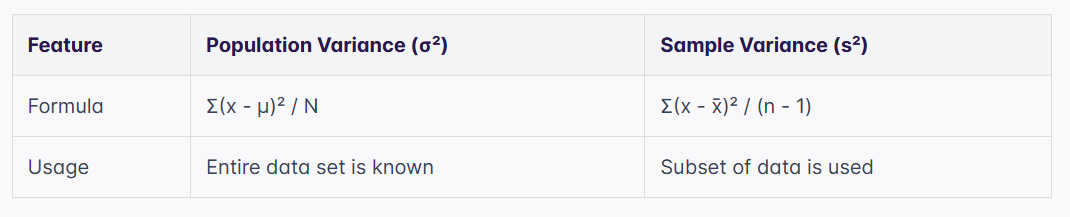
The steps for a standard variance calculation involve finding the mean, subtracting the mean from each data point, squaring those results, and then averaging those squares. This methodology is foundational in fields ranging from finance to statistical analysis and even chemistry, where precision in measurements is vital. For instance, understanding data spread is as critical as mastering naming organic compounds when evaluating experimental results.
Solved Examples
Review these step-by-step solutions to master the mechanics of variance calculation before attempting the practice set.
Example 1: Calculating Population Variance
Find the population variance for the data set: 4, 8, 6, 10.
Calculate the mean (μ): (4 + 8 + 6 + 10) / 4 = 28 / 4 = 7.
Subtract the mean from each value and square the result:
(4-7)² = 9
(8-7)² = 1
(6-7)² = 1
(10-7)² = 9Sum the squared differences: 9 + 1 + 1 + 9 = 20.
Divide by N (4): 20 / 4 = 5. The population variance is 5.
Example 2: Calculating Sample Variance
A scientist takes a sample of 5 chemical reaction times (in seconds): 12, 15, 13, 14, 11. Calculate the sample variance.
Calculate the sample mean (x̄): (12 + 15 + 13 + 14 + 11) / 5 = 65 / 5 = 13.
Subtract the mean from each value and square the result:
(12-13)² = 1
(15-13)² = 4
(13-13)² = 0
(14-13)² = 1
(11-13)² = 4Sum the squared differences: 1 + 4 + 0 + 1 + 4 = 10.
Divide by n-1 (5-1 = 4): 10 / 4 = 2.5. The sample variance is 2.5.
Example 3: Variance with Negative Numbers
Calculate the population variance for the values: -2, 0, 2.
Calculate the mean: (-2 + 0 + 2) / 3 = 0.
Square the deviations: (-2-0)² = 4; (0-0)² = 0; (2-0)² = 4.
Sum the squares: 4 + 0 + 4 = 8.
Divide by N (3): 8 / 3 ≈ 2.67.
Practice Questions
1. A small business tracks the number of daily sales over five days: 10, 12, 10, 14, 9. Calculate the population variance for this data set.
2. A biology student measures the heights of 4 plants in a sample: 5cm, 7cm, 3cm, and 5cm. What is the sample variance of their heights?
3. Calculate the population variance for the following set of exam scores: 85, 90, 95.
Want unlimited practice questions like these?
Generate AI-powered questions with step-by-step solutions on any topic.
Try Question Generator Free →4. A sample of 6 test tubes contains the following volumes (mL): 20, 22, 21, 19, 20, 18. Determine the sample variance.
5. Find the population variance for the set of values: 100, 200, 300, 400, 500.
6. If a data set consists of the values {5, 5, 5, 5, 5}, what is its population variance?
7. A sample of 3 items has values of 10, 20, and 30. Calculate the sample variance.
8. Calculate the population variance for the following four temperatures: -5, -1, 1, 5.
9. A dataset has a mean of 50 and a sum of squared deviations from the mean equal to 200. If there are 10 observations in the population, what is the variance?
10. You are given a sample of 4 values: 2, 4, 6, 8. What is the sample variance? (Hint: See medium polarity determination for logic-based problem solving).
Answers & Explanations
1. Answer: 3.2
Mean = (10+12+10+14+9)/5 = 11. Squared deviations: (10-11)²=1, (12-11)²=1, (10-11)²=1, (14-11)²=9, (9-11)²=4. Sum = 16. Population variance = 16/5 = 3.2.
2. Answer: 2.67
Mean = (5+7+3+5)/4 = 5. Squared deviations: (5-5)²=0, (7-5)²=4, (3-5)²=4, (5-5)²=0. Sum = 8. Sample variance = 8/(4-1) = 8/3 ≈ 2.67.
3. Answer: 16.67
Mean = (85+90+95)/3 = 90. Squared deviations: (85-90)²=25, (90-90)²=0, (95-90)²=25. Sum = 50. Population variance = 50/3 ≈ 16.67.
4. Answer: 2.0
Mean = (20+22+21+19+20+18)/6 = 20. Squared deviations: 0, 4, 1, 1, 0, 4. Sum = 10. Sample variance = 10/(6-1) = 10/5 = 2.0.
5. Answer: 20,000
Mean = 300. Squared deviations: (100-300)²=40000, (200-300)²=10000, (300-300)²=0, (400-300)²=10000, (500-300)²=40000. Sum = 100,000. Population variance = 100,000/5 = 20,000.
6. Answer: 0
If all values are identical, the mean is equal to every value. Each deviation is 0, so the sum of squares is 0, and the variance is 0.
7. Answer: 100
Mean = (10+20+30)/3 = 20. Squared deviations: (10-20)²=100, (20-20)²=0, (30-20)²=100. Sum = 200. Sample variance = 200/(3-1) = 100.
8. Answer: 13
Mean = (-5-1+1+5)/4 = 0. Squared deviations: (-5)²=25, (-1)²=1, (1)²=1, (5)²=25. Sum = 52. Population variance = 52/4 = 13.
9. Answer: 20
The sum of squared deviations is given as 200. For a population of 10, variance = 200 / 10 = 20.
10. Answer: 6.67
Mean = (2+4+6+8)/4 = 5. Squared deviations: (2-5)²=9, (4-5)²=1, (6-5)²=1, (8-5)²=9. Sum = 20. Sample variance = 20/(4-1) = 20/3 ≈ 6.67.
1. Which formula is used to calculate sample variance?
Frequently Asked Questions
What is the difference between variance and standard deviation?
Variance measures the average squared distance from the mean, while standard deviation is the square root of the variance. Standard deviation is often preferred because it is expressed in the same units as the original data.
Can variance ever be a negative number?
No, variance cannot be negative because it is calculated by summing squared differences, which are always non-negative. A variance of zero is the lowest possible value, indicating no spread.
When should I use sample variance instead of population variance?
Use sample variance when you are analyzing a small group to make inferences about a larger population. Use population variance only when you have collected data for every single member of the group you are studying.
How does an outlier affect the variance calculation?
Outliers significantly increase the variance because the distance from the mean is squared in the calculation. This makes variance highly sensitive to extreme values compared to other measures like the interquartile range.
What are the units of variance?
The units of variance are the square of the units of the original data. For example, if the data is measured in meters, the variance is expressed in square meters (m²).
Why is variance important in finance?
In finance, variance is a primary measure of risk, representing the volatility of an asset's returns. Investors use it to understand the likelihood of an investment's actual return differing from its expected return, as explained by resources like Investopedia.
Want unlimited practice questions like these?
Generate AI-powered questions with step-by-step solutions on any topic.
Try Question Generator Free →
Want unlimited practice questions like these?
Generate AI-powered questions with step-by-step solutions on any topic.
Try Question Generator Free →Enjoyed this article?
Share it with others who might find it helpful.
Related Articles

Hard Le Chatelier’s Principle Practice Questions
Master Hard Le Chatelier’s Principle Practice Questions with our comprehensive guide featuring solved examples, practice problems, and detailed explanations.
Mar 30, 2026

Hard Reaction Quotient (Q) Practice Questions
Hard Reaction Quotient (Q) Practice Questions
Mar 30, 2026

Grams to Moles Practice Questions with Answers
Master grams to moles conversions with our comprehensive guide. Includes step-by-step examples, practice questions, and detailed answers for chemistry students.
Mar 26, 2026
Avogadro’s Number Practice Questions with Answers
Master the mole concept with our Avogadro’s Number practice questions. Includes step-by-step solved examples, a quick quiz, and detailed explanations.
Mar 26, 2026

Empirical Formulas: Solving Ratios from Mass and Percent Data
Master empirical formula calculations with 10 practice questions, worked answers, and a free step-by-step calculator for mass, percentage, and combustion problems.
Mar 26, 2026