Medium Polarity Determination Practice Questions
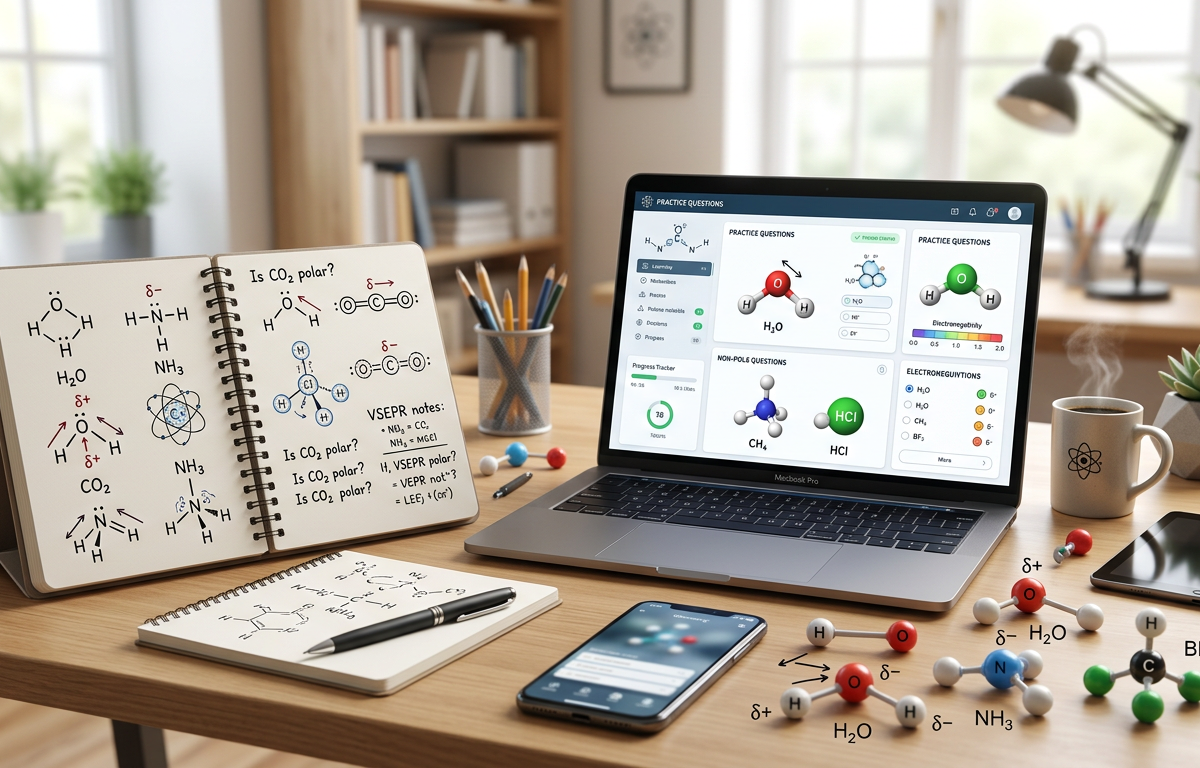
Concept Explanation
Polarity determination is the process of identifying whether a molecule has a net dipole moment by analyzing the electronegativity differences between atoms and the overall 3D geometric symmetry of the molecule.
To master this concept, you must look beyond simple chemical formulas. A molecule's polarity depends on two primary factors: bond polarity and molecular geometry. Bond polarity arises when two atoms share electrons unequally due to differences in their electronegativity. However, even if a molecule contains polar bonds, it can be nonpolar overall if the bond dipoles cancel each other out due to a highly symmetrical shape. This is why understanding VSEPR geometry is essential for predicting physical properties like boiling points and solubility.
In medium-level polarity determination, we often encounter molecules with lone pairs or different types of terminal atoms. For example, while Carbon Dioxide (CO₂) is nonpolar because its linear shape allows the two C=O dipoles to cancel, Water (H₂O) is polar because its bent shape prevents the O-H dipoles from neutralizing. When evaluating a molecule, follow these steps:
Draw the Lewis structure to visualize valence electrons.
Determine the electron and molecular geometry using VSEPR theory.
Identify individual bond dipoles based on electronegativity (vectors pointing toward the more electronegative atom).
Sum the vectors: if they sum to zero, the molecule is nonpolar; if there is a net vector, it is polar.
Solved Examples
Below are three worked examples illustrating the logic used in medium-level polarity determination.
Example 1: Sulfur Dioxide (SO₂)
Lewis Structure: Sulfur is the central atom with two double bonds to oxygen and one lone pair.
Geometry: The electron geometry is trigonal planar, but the molecular geometry is bent (approx. 120°).
Bond Dipoles: Oxygen is more electronegative than sulfur, so dipoles point toward the oxygens.
Determination: Because the molecule is bent, the dipoles do not cancel each other out. SO₂ is polar.
Example 2: Boron Trifluoride (BF₃)
Lewis Structure: Boron is the central atom with three single bonds to fluorine atoms and no lone pairs.
Geometry: The molecular geometry is trigonal planar with 120° angles.
Bond Dipoles: Fluorine is the most electronegative element, creating three strong B-F dipoles.
Determination: In a perfect trigonal planar arrangement, the three dipoles cancel out perfectly. BF₃ is nonpolar.
Example 3: Chloroform (CHCl₃)
Lewis Structure: Carbon is the central atom bonded to one hydrogen and three chlorine atoms.
Geometry: The molecular geometry is tetrahedral.
Bond Dipoles: There are C-Cl dipoles and a C-H dipole. Chlorine is much more electronegative than Carbon.
Determination: Because the four surrounding atoms are not identical, the dipoles do not cancel. The net dipole points toward the chlorine side. CHCl₃ is polar.
Practice Questions
1. Determine the polarity of Nitrogen Trifluoride (NF₃) by considering its molecular geometry and lone pairs.
2. Ammonia (NH₃) and Boron Trifluoride (BF₃) both have three terminal atoms. Why is NH₃ polar while BF₃ is nonpolar?
3. Carbon Tetrachloride (CCl₄) is a common solvent. Based on its symmetry, is it polar or nonpolar?
Want unlimited practice questions like these?
Generate AI-powered questions with step-by-step solutions on any topic.
Try Question Generator Free →4. Predict the polarity of Xenon Tetrafluoride (XeF₄). Note that Xenon has two lone pairs in this molecule.
5. Is Phosphorus Pentachloride (PCl₅) a polar or nonpolar molecule? Explain using its 3D spatial arrangement.
6. Compare the polarity of H₂O and H₂S. Which molecule has a larger net dipole moment and why?
7. Determine if Sulfur Hexafluoride (SF₆) is polar or nonpolar by analyzing its hybridization and octahedral shape.
8. Ozone (O₃) consists of three oxygen atoms. Despite being made of the same element, is the molecule polar or nonpolar?
9. Formaldehyde (CH₂O) has a trigonal planar shape. Analyze the dipoles to determine its polarity.
10. Explain the polarity of Carbonyl Sulfide (OCS), which has a linear geometry similar to CO₂.
Answers & Explanations
NF₃: Polar. Nitrogen has one lone pair and three N-F bonds, resulting in a trigonal pyramidal shape. The dipoles do not cancel because of the asymmetrical shape caused by the lone pair.
NH₃ vs BF₃: NH₃ is polar because it is trigonal pyramidal with a lone pair that disrupts symmetry. BF₃ is nonpolar because it is trigonal planar and perfectly symmetrical, allowing the B-F dipoles to cancel.
CCl₄: Nonpolar. It has a tetrahedral geometry with four identical C-Cl bonds. The symmetrical arrangement ensures all dipoles cancel out.
XeF₄: Nonpolar. XeF₄ has a square planar geometry. The two lone pairs are opposite each other (180°), and the four Xe-F bonds are in a plane, canceling each other out.
PCl₅: Nonpolar. It has a trigonal bipyramidal geometry. The three equatorial P-Cl bonds cancel each other, and the two axial P-Cl bonds cancel each other.
H₂O vs H₂S: Both are polar (bent shape). However, H₂O is more polar because Oxygen is more electronegative than Sulfur, creating a larger electronegativity difference (ΔEN) with Hydrogen.
SF₆: Nonpolar. It has an octahedral geometry. Every S-F bond dipole is opposed by another S-F bond dipole exactly 180° away, leading to a net dipole of zero.
O₃: Polar. The central oxygen is bonded to two other oxygens and has one lone pair, giving it a bent molecular geometry. The formal charges and the bent shape result in a permanent dipole.
CH₂O: Polar. While the shape is trigonal planar, the C=O bond is much more polar than the C-H bonds. The uneven distribution of charge makes the molecule polar.
OCS: Polar. Unlike CO₂, the two ends of the molecule are different (Oxygen vs. Sulfur). Even though it is linear, the C=O dipole is stronger than the C=S dipole, so they do not cancel.
1. Which of the following molecules is nonpolar despite having polar bonds?
Frequently Asked Questions
Can a molecule with polar bonds be nonpolar?
Yes, a molecule with polar bonds is nonpolar if its molecular geometry is highly symmetrical, causing the individual bond dipoles to cancel each other out. Common examples include CO₂, BF₃, and CCl₄.
How do lone pairs affect molecular polarity?
Lone pairs on a central atom often create asymmetrical molecular geometries, such as bent or trigonal pyramidal shapes. This lack of symmetry usually prevents bond dipoles from canceling, making the molecule polar.
What is the difference between bond polarity and molecular polarity?
Bond polarity refers to the unequal sharing of electrons between two specific atoms, while molecular polarity refers to the net dipole moment of the entire molecule. A molecule can have polar bonds but remain nonpolar overall due to symmetry.
Which is more polar, H2O or NH3?
H₂O is more polar than NH₃ because oxygen is more electronegative than nitrogen, leading to a greater electronegativity difference in the O-H bonds compared to N-H bonds. Additionally, the bent shape of water creates a more distinct dipole than the trigonal pyramidal shape of ammonia.
Is every bent molecule polar?
Yes, molecules with a bent geometry are generally polar because the bond dipoles are oriented at an angle and cannot cancel each other out. This holds true even if the terminal atoms are identical, as seen in H₂O and SO₂.
Want unlimited practice questions like these?
Generate AI-powered questions with step-by-step solutions on any topic.
Try Question Generator Free →
Want unlimited practice questions like these?
Generate AI-powered questions with step-by-step solutions on any topic.
Try Question Generator Free →Enjoyed this article?
Share it with others who might find it helpful.
Related Articles
Hard Le Chatelier’s Principle Practice Questions
Master Hard Le Chatelier’s Principle Practice Questions with our comprehensive guide featuring solved examples, practice problems, and detailed explanations.
Mar 30, 2026

Hard Reaction Quotient (Q) Practice Questions
Hard Reaction Quotient (Q) Practice Questions
Mar 30, 2026

Grams to Moles Practice Questions with Answers
Master grams to moles conversions with our comprehensive guide. Includes step-by-step examples, practice questions, and detailed answers for chemistry students.
Mar 26, 2026
Avogadro’s Number Practice Questions with Answers
Master the mole concept with our Avogadro’s Number practice questions. Includes step-by-step solved examples, a quick quiz, and detailed explanations.
Mar 26, 2026

Empirical Formulas: Solving Ratios from Mass and Percent Data
Master empirical formula calculations with 10 practice questions, worked answers, and a free step-by-step calculator for mass, percentage, and combustion problems.
Mar 26, 2026