Easy Naming Organic Compounds (IUPAC) Practice Questions
Concept Explanation
Easy Naming Organic Compounds (IUPAC) involves applying a standardized set of rules developed by the International Union of Pure and Applied Chemistry to provide a unique and systematic name for every chemical structure.
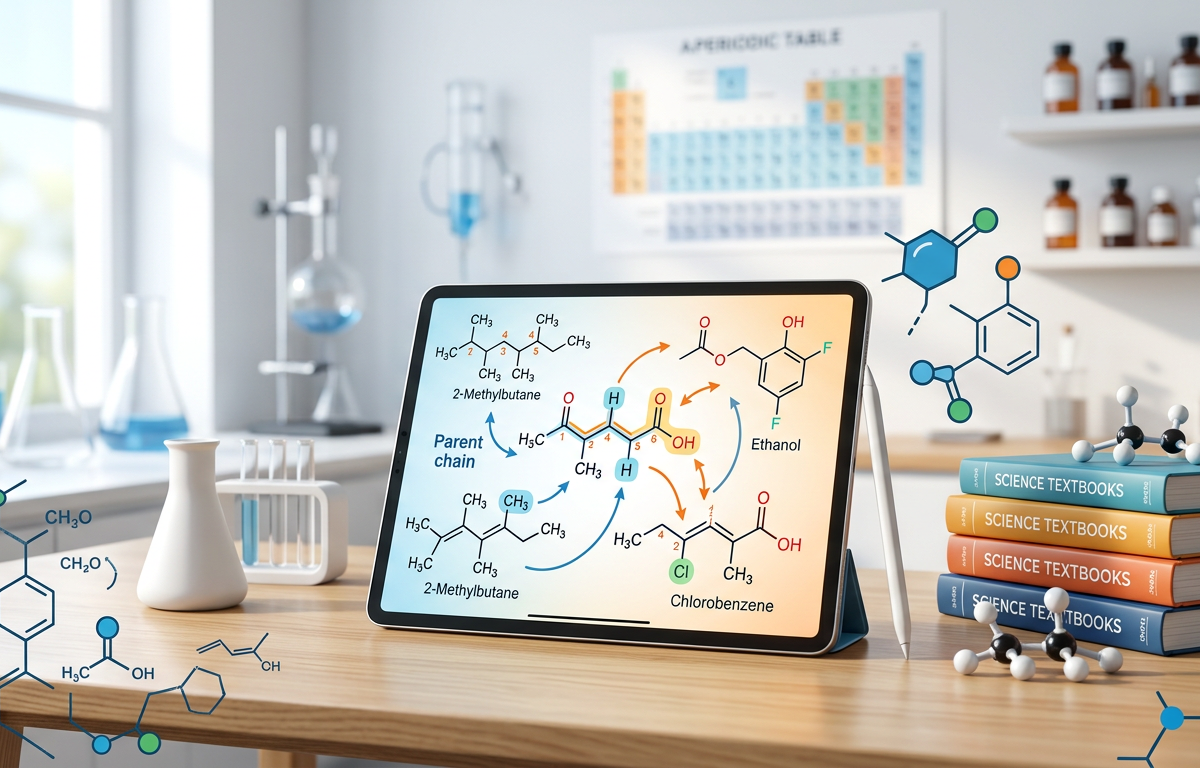
The IUPAC system ensures that every chemist, regardless of location, can communicate complex structures without ambiguity. For beginners, the process focuses on alkanes, alkenes, and simple functional groups. According to IUPAC standards, the name of an organic molecule is built from four primary components: the locants (numbers showing position), the prefixes (substituents), the parent chain (the longest carbon chain), and the suffix (the primary functional group).
To master easy naming organic compounds (IUPAC), follow these fundamental steps:
Identify the Parent Chain: Find the longest continuous chain of carbon atoms. If a double or triple bond is present, it must be part of this chain.
Number the Chain: Number the carbons starting from the end closest to a substituent or a multiple bond. The goal is to give the lowest possible numbers to these features.
Identify Substituents: Name any branches (like methyl or ethyl groups) or halogens attached to the parent chain.
Assemble the Name: List substituents in alphabetical order (ignoring prefixes like di-, tri-), followed by the parent name and the appropriate suffix (e.g., -ane for alkanes, -ene for alkenes).
Understanding these basics is essential before moving on to more complex topics like Functional Group Identification or advanced stereochemistry.
Solved Examples
Reviewing worked examples is the most effective way to learn the nuances of nomenclature rules.
Name the molecule: CH₃-CH(CH₃)-CH₂-CH₃
Find the longest chain: The longest chain has 4 carbons, so the parent name is "butane."
Number the chain: Numbering from left to right puts the branch at carbon 2. Numbering from right to left puts it at carbon 3. We choose the lower number: 2.
Identify the substituent: A one-carbon branch is called a "methyl" group.
Combine: The name is 2-methylbutane.
Name the molecule: CH₂=CH-CH₂-CH₃
Identify the parent: A 4-carbon chain with a double bond is "butene."
Number the chain: Start from the end closest to the double bond. The double bond starts at carbon 1.
Combine: The name is but-1-ene (or 1-butene).
Name the molecule: CH₃-CH(Cl)-CH₃
Identify the parent: 3 carbons in a row is "propane."
Identify the substituent: A chlorine atom is named as "chloro."
Locate the substituent: It is on the second carbon.
Combine: The name is 2-chloropropane.
Practice Questions
Test your skills with these easy naming organic compounds (IUPAC) practice questions. Start with the basics and work your way up.
1. What is the IUPAC name for a straight-chain alkane with five carbon atoms?
2. Name the following structure: CH₃-CH₂-CH(CH₃)-CH₂-CH₂-CH₃
3. Provide the name for: CH₃-CH₂-CH₂-OH
Want unlimited practice questions like these?
Generate AI-powered questions with step-by-step solutions on any topic.
Try Question Generator Free →4. What is the IUPAC name for CH₃-C≡C-CH₃?
5. Name this halogenated compound: CH₃-CH₂-Br
6. Assign the name for: CH₃-CH(CH₃)-CH(CH₃)-CH₃
7. Name the following alkene: CH₃-CH=CH-CH₃
8. What is the IUPAC name for a cyclic alkane with four carbon atoms?
Answers & Explanations
Pentane: A five-carbon alkane uses the prefix "pent-" and the suffix "-ane." Since there are no branches, no locants are needed.
3-methylhexane: The longest chain has 6 carbons (hexane). Numbering from the left places the methyl group at carbon 3. Numbering from the right would place it at carbon 4. We use 3.
Propan-1-ol: The 3-carbon chain is "propane." The -OH group indicates an alcohol (suffix -ol). It is attached to the first carbon.
But-2-yne: The 4-carbon chain has a triple bond (suffix -yne). The bond starts at carbon 2 whether you count from left or right.
Bromoethane: The 2-carbon chain is "ethane." The bromine substituent is "bromo." Since there is only one possible position for the bromine on a 2-carbon chain that wouldn't be carbon 1, the locant "1" is often omitted in simple cases.
2,3-dimethylbutane: The longest chain is 4 carbons (butane). There are two methyl groups at positions 2 and 3. We use the prefix "di-" to indicate two identical groups.
But-2-ene: A 4-carbon chain with a double bond starting at the second carbon. For more on double bond geometry, see our guide on Isomer Identification.
Cyclobutane: Cyclic molecules use the prefix "cyclo-" followed by the alkane name corresponding to the number of carbons in the ring.
1. Which suffix is used for an organic molecule containing only single C-C bonds?
Frequently Asked Questions
What does IUPAC stand for in chemistry?
IUPAC stands for the International Union of Pure and Applied Chemistry. It is the global authority that develops standardized nomenclature for chemical elements and compounds to ensure clear scientific communication.
How do I choose the parent chain if two chains have the same length?
If two chains have the same length, choose the one with the greatest number of substituents. This rule simplifies the naming of the branches and follows standard PubChem and IUPAC conventions.
What is the difference between a common name and an IUPAC name?
Common names are traditional or historical names like "acetone," while IUPAC names are systematic and based on the structure, such as "propan-2-one." IUPAC names allow anyone to draw the exact structure just by reading the name.
When do I need to use numbers (locants) in a name?
Locants are required whenever there is more than one possible position for a substituent or functional group on the parent chain. If the position is unambiguous, such as in "ethanol," the number is often omitted.
How are halogen substituents named in the IUPAC system?
Halogens are treated as substituents and named by changing their ending to "-o." For example, fluorine becomes fluoro, chlorine becomes chloro, bromine becomes bromo, and iodine becomes iodo.
Want unlimited practice questions like these?
Generate AI-powered questions with step-by-step solutions on any topic.
Try Question Generator Free →
Want unlimited practice questions like these?
Generate AI-powered questions with step-by-step solutions on any topic.
Try Question Generator Free →Enjoyed this article?
Share it with others who might find it helpful.
Related Articles
Hard Le Chatelier’s Principle Practice Questions
Master Hard Le Chatelier’s Principle Practice Questions with our comprehensive guide featuring solved examples, practice problems, and detailed explanations.
Mar 30, 2026
Hard Reaction Quotient (Q) Practice Questions
Hard Reaction Quotient (Q) Practice Questions
Mar 30, 2026

Grams to Moles Practice Questions with Answers
Master grams to moles conversions with our comprehensive guide. Includes step-by-step examples, practice questions, and detailed answers for chemistry students.
Mar 26, 2026
Avogadro’s Number Practice Questions with Answers
Master the mole concept with our Avogadro’s Number practice questions. Includes step-by-step solved examples, a quick quiz, and detailed explanations.
Mar 26, 2026

Empirical Formulas: Solving Ratios from Mass and Percent Data
Master empirical formula calculations with 10 practice questions, worked answers, and a free step-by-step calculator for mass, percentage, and combustion problems.
Mar 26, 2026