Easy Hybridization Practice Questions
Concept Explanation
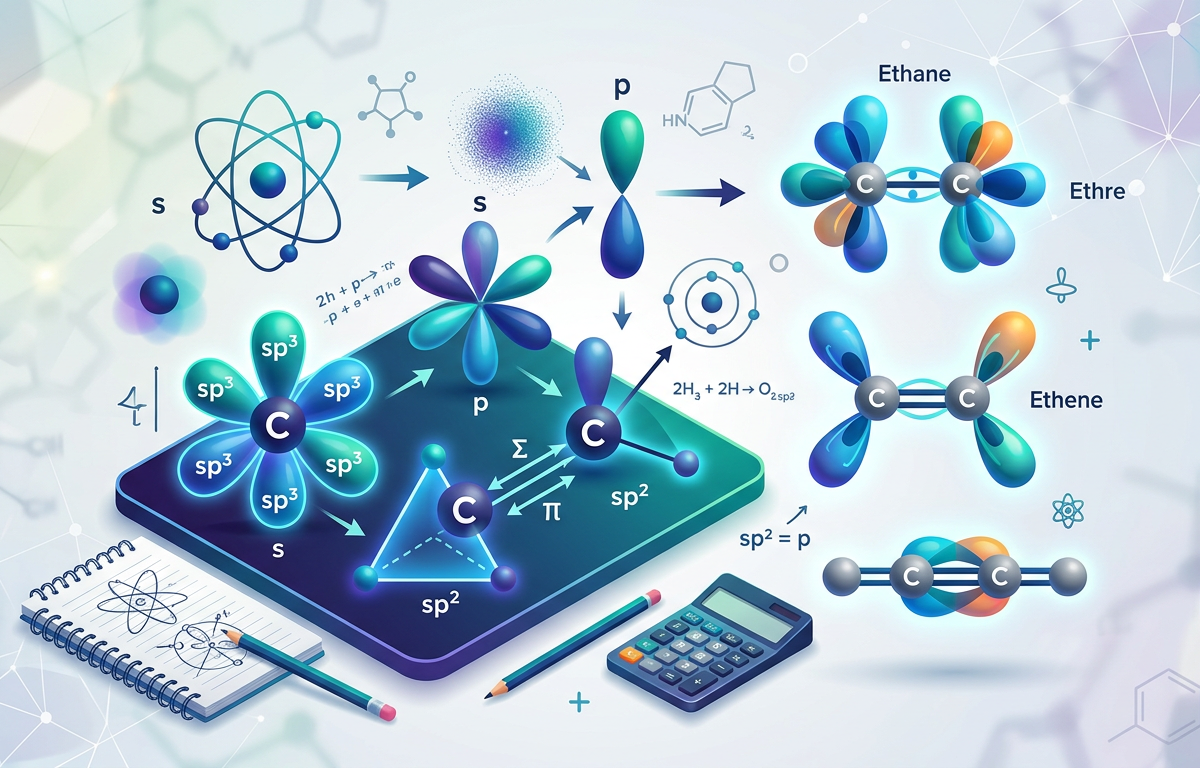
Hybridization is the mathematical process of mixing atomic orbitals within an atom to create new, identical hybrid orbitals that facilitate chemical bonding and determine molecular geometry. In valence bond theory, central atoms often combine their standard s, p, and sometimes d orbitals to form a set of hybrid orbitals that are equivalent in energy and shape. This concept explains why molecules like methane (CH₄) have uniform bond lengths and angles that standard atomic orbitals cannot account for. By understanding the number of electron domains (bonding pairs and lone pairs) surrounding a central atom, students can predict whether an atom is sp, sp², or sp³ hybridized.
To determine hybridization, you must first draw the Lewis structure of the molecule. Once the structure is clear, count the "electron domains" around the central atom. An electron domain is either a single bond, a double bond, a triple bond, or a lone pair of electrons. The sum of these domains is often called the steric number. For instance, a steric number of 2 corresponds to sp hybridization (linear), a steric number of 3 corresponds to sp² (trigonal planar), and a steric number of 4 corresponds to sp³ (tetrahedral). This foundational knowledge is essential for mastering VSEPR geometry practice questions and understanding how molecules interact in three-dimensional space.
Solved Examples
Review these step-by-step examples to master the process of identifying hybridization in simple molecules.
Determine the hybridization of the carbon atom in Methane (CH₄).
Draw the Lewis structure: Carbon is the central atom with four single bonds to hydrogen atoms.
Count the electron domains: There are 4 bonding pairs and 0 lone pairs. Total domains = 4.
Match the domain count to the hybridization type: 4 domains = sp³ hybridization.
Result: The carbon in methane uses four sp³ hybrid orbitals to form four sigma bonds.
Determine the hybridization of the boron atom in Boron Trifluoride (BF₃).
Draw the Lewis structure: Boron is the central atom with three single bonds to fluorine atoms.
Count the electron domains: There are 3 bonding pairs and 0 lone pairs (Boron is an exception to the octet rule). Total domains = 3.
Match the domain count to the hybridization type: 3 domains = sp² hybridization.
Result: The boron atom is sp² hybridized, resulting in a trigonal planar geometry.
Determine the hybridization of the carbon atoms in Ethyne (C₂H₂).
Draw the Lewis structure: The two carbons are connected by a triple bond, and each is bonded to one hydrogen.
Count the electron domains for one carbon: There is 1 triple bond (counts as 1 domain) and 1 single bond. Total domains = 2.
Match the domain count to the hybridization type: 2 domains = sp hybridization.
Result: Each carbon atom is sp hybridized, allowing for the linear shape of the molecule.
Practice Questions
Test your knowledge with these easy hybridization practice questions. Use the steric number method to find the answers.
1. What is the hybridization of the central oxygen atom in a water molecule (H₂O)?
2. Identify the hybridization of the nitrogen atom in ammonia (NH₃).
3. Determine the hybridization of the carbon atom in carbon dioxide (CO₂).
Want unlimited practice questions like these?
Generate AI-powered questions with step-by-step solutions on any topic.
Try Question Generator Free →4. In the molecule BeCl₂, what is the hybridization of the Beryllium atom?
5. What is the hybridization of the central carbon in formaldehyde (CH₂O)?
6. Identify the hybridization of the phosphorus atom in PCl₅.
7. Determine the hybridization of the sulfur atom in sulfur hexafluoride (SF₆).
8. What is the hybridization of the central carbon in the carbonate ion (CO₃²⁻)?
9. Identify the hybridization of the oxygen atom in the hydronium ion (H₃O⁺).
10. Determine the hybridization of the central iodine atom in IF₃.
Answers & Explanations
1. sp³: Oxygen in H₂O has two single bonds and two lone pairs. Total domains = 4 (sp³). Even though the shape is bent, the orbital arrangement is based on four domains.
2. sp³: Nitrogen in NH₃ has three single bonds and one lone pair. Total domains = 4 (sp³). This results in a trigonal pyramidal molecular geometry.
3. sp: Carbon in CO₂ has two double bonds. Each double bond counts as one domain. Total domains = 2 (sp). This is why CO₂ is a linear molecule.
4. sp: Beryllium in BeCl₂ has two single bonds and no lone pairs. Total domains = 2 (sp). Beryllium is often electron-deficient in these simple covalent compounds.
5. sp²: The carbon in CH₂O has two single bonds (to H) and one double bond (to O). Total domains = 3 (sp²).
6. sp³d: Phosphorus in PCl₅ has five single bonds and no lone pairs. Total domains = 5. According to Wikipedia's guide on hybridization, five domains require the use of one d orbital, resulting in sp³d.
7. sp³d²: Sulfur in SF₆ has six single bonds and no lone pairs. Total domains = 6 (sp³d²). This corresponds to an octahedral geometry.
8. sp²: The carbon in CO₃²⁻ has three electron domains (one double bond and two single bonds, distributed via resonance). Total domains = 3 (sp²).
9. sp³: Oxygen in H₃O⁺ has three single bonds and one lone pair. Total domains = 4 (sp³).
10. sp³d: Iodine in IF₃ has three single bonds and two lone pairs. Total domains = 5 (sp³d). For more on electron distributions, check out electron configuration practice questions.
1. Which hybridization corresponds to a linear molecular geometry?
Frequently Asked Questions
What is the easiest way to find hybridization?
The easiest method is to count the number of electron domains (lone pairs + atoms bonded) around the central atom. This steric number directly correlates to the hybridization: 2 is sp, 3 is sp², and 4 is sp³.
Does a triple bond change the hybridization count?
No, a triple bond counts as only one electron domain when determining the hybridization of an atom. The extra two bonds in a triple bond are pi bonds, which are formed by unhybridized p orbitals rather than hybrid orbitals.
Can lone pairs affect hybridization?
Yes, lone pairs are considered electron domains and must be included in the total count when determining hybridization. For example, water has two bonds and two lone pairs, totaling four domains and resulting in sp³ hybridization.
Why is hybridization important in chemistry?
Hybridization is crucial because it explains molecular shapes and bond angles that cannot be predicted by simple atomic orbital overlap. It provides a more accurate model of how atoms share electrons to reach stable energy states, as noted by resources like LibreTexts Chemistry.
What is the difference between sp² and sp³ hybridization?
The difference lies in the number of p orbitals mixed with the s orbital; sp² mixes one s and two p orbitals (3 domains), while sp³ mixes one s and three p orbitals (4 domains). This results in different geometries, specifically trigonal planar for sp² and tetrahedral for sp³.
How do I identify hybridization in ions?
You identify hybridization in ions the same way as in neutral molecules by drawing the Lewis structure and counting the electron domains. For more practice with charged species, you might look into periodic trends practice questions to see how electronegativity affects bonding.
Want unlimited practice questions like these?
Generate AI-powered questions with step-by-step solutions on any topic.
Try Question Generator Free →
Want unlimited practice questions like these?
Generate AI-powered questions with step-by-step solutions on any topic.
Try Question Generator Free →Enjoyed this article?
Share it with others who might find it helpful.
Related Articles
Hard Le Chatelier’s Principle Practice Questions
Master Hard Le Chatelier’s Principle Practice Questions with our comprehensive guide featuring solved examples, practice problems, and detailed explanations.
Mar 30, 2026

Hard Reaction Quotient (Q) Practice Questions
Hard Reaction Quotient (Q) Practice Questions
Mar 30, 2026

Grams to Moles Practice Questions with Answers
Master grams to moles conversions with our comprehensive guide. Includes step-by-step examples, practice questions, and detailed answers for chemistry students.
Mar 26, 2026
Avogadro’s Number Practice Questions with Answers
Master the mole concept with our Avogadro’s Number practice questions. Includes step-by-step solved examples, a quick quiz, and detailed explanations.
Mar 26, 2026

Empirical Formulas: Solving Ratios from Mass and Percent Data
Master empirical formula calculations with 10 practice questions, worked answers, and a free step-by-step calculator for mass, percentage, and combustion problems.
Mar 26, 2026