Why Students Get SAT Math Questions Wrong: 7 Critical Errors
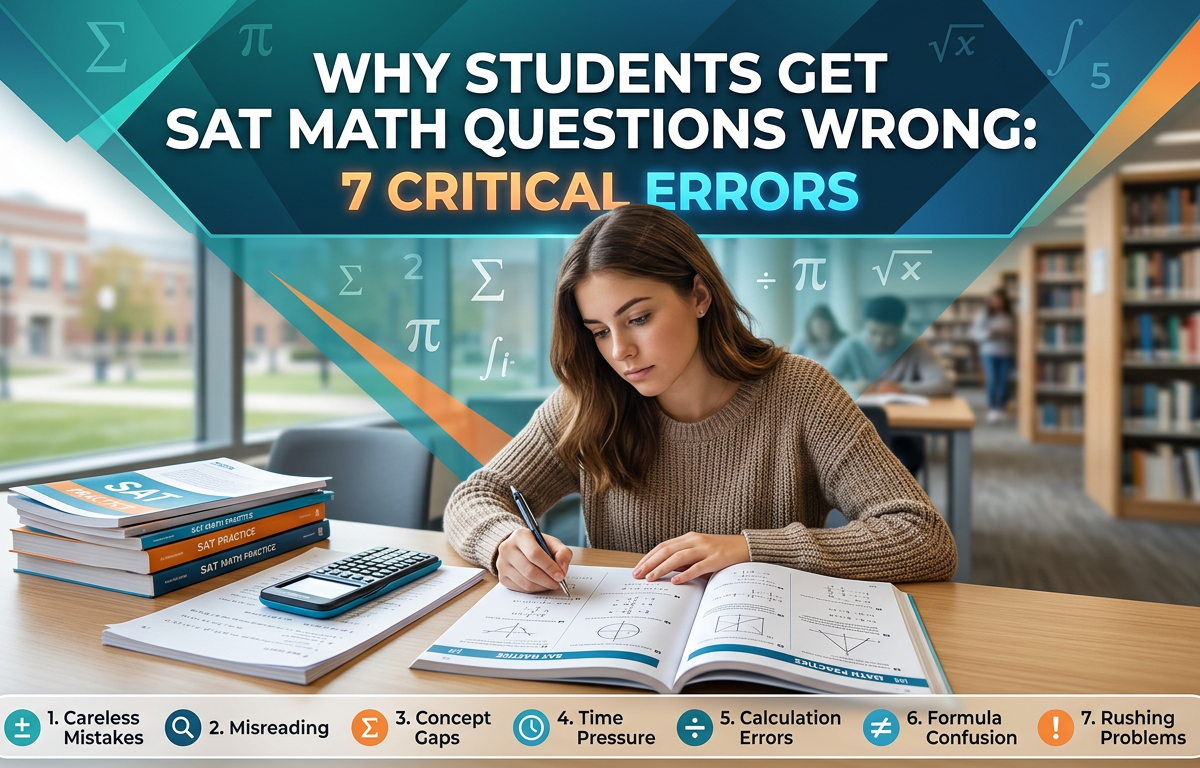
The Psychology of the SAT: Why High Achievers Struggle
Success in a high school Honors Algebra II or Pre-Calculus class does not automatically translate to a 750+ on the SAT. Many students find themselves frustrated when their report card says "A" but their practice test says "580." Understanding Why Students Get SAT Math Questions Wrong often begins with realizing that the College Board does not just test your ability to solve for X; it tests your ability to think under duress while avoiding sophisticated traps.
The SAT is a "clever" test by design. Unlike a typical classroom quiz that rewards you for showing your work and following a linear path, the SAT rewards efficiency and skepticism. High achievers often struggle because they try to "muscle through" problems using complex Academic math when the test is looking for a logical shortcut. According to College Board research, the assessment aims to measure college readiness through problem-solving, which is a different cognitive skill set than rote memorization.
Straight-A students frequently underperform because they treat the SAT like a school exam. In school, if you do the steps correctly, you get the right answer; on the SAT, the test designers deliberately trigger intuition-based errors. They know exactly where a student is likely to trip—such as forgetting to distribute a negative sign or failing to flip an inequality symbol. This creates a psychological gap where high-stakes pressure causes a "brain freeze," leading to a breakdown in memory recall for even the most basic Easy SAT Integers Practice Questions.
Foundational Gaps: The Content Knowledge Hurdle
Gaps in core knowledge act as a ceiling for your score regardless of how many "tips and tricks" you learn. Why Students Get SAT Math Questions Wrong often boils down to a shaky understanding of "The Heart of Algebra" or "Passport to Advanced Math." If you cannot look at a function and immediately understand the relationship between its input and output, you will lose time—and points—on higher-level questions.
Many students have "forgotten" the middle school lessons that form the bedrock of SAT Geometry and Trigonometry. While you might be able to handle complex calculus, you might struggle with a Medium SAT Geometry Practice Question because you haven't thought about supplementary angles or circle theorems in three years. These "easy" misses are rarely bad luck; they are signs that your mental library of geometric properties has gathered dust.
The danger of calculator over-reliance cannot be overstated. When a student uses a calculator for basic arithmetic, they lose their "number sense," making it harder to spot when an answer is logically impossible. Data analysis and statistical misconceptions are also common; students often struggle with standard deviation or margin of error because these topics are briefly covered in school but heavily emphasized on the Digital SAT. For those struggling here, practicing Medium SAT Statistics Practice Questions can help bridge the gap between classroom theory and test-day reality.
Reading Errors: The Hidden Literacy Test in SAT Math
The SAT Math section is as much a reading test as it is a numbers test. Students frequently solve the math perfectly but answer the wrong question because they skimmed the prompt. Are you solving for x, or are you solving for x + 5? The difference between a 700 and a 750 often lies in that final sentence.
Word problems are designed to bury the actual question in "fluff" text. A paragraph might describe a scientist in a lab and the history of her research, but the only relevant numbers are at the very end. This leads to the "Final Sentence Trap," where a student spends three minutes calculating a variable only to realize the question asked for the ratio of two variables. Reading errors also include ignoring critical constraints like "x must be a positive integer." If you find a solution that is -3, and you didn't see the word "positive," you will choose a trap answer every time.
Unit conversions are another silent score killer. A problem might provide speed in miles per hour but ask for the answer in feet per second. If you aren't vigilant, you will find the "correct" wrong answer waiting for you in the choices. Improving your attention to detail on Hard SAT Geometry Word Practice Questions is an excellent way to train your brain to catch these linguistic hurdles before they cost you points.
The Logic of Trap Answers: How the Test Predicts Your Mistakes
The College Board does not choose random numbers for incorrect answer choices. Every "wrong" answer is the result of a specific, predictable mistake. This is a primary reason Why Students Get SAT Math Questions Wrong; they see their calculated result in the options and assume it must be correct, unaware they fell into a "honeypot."
One common trap is the "Partial Completion" error. This occurs when a multi-step problem has an intermediate value that looks like a final answer. For example, if a question asks for the area of a circle but you stop after finding the radius, the value of the radius will almost certainly be answer choice (A). Students who are impulsive or rushing will see that number, feel a rush of relief, and bubble it in without finishing the calculation.
Reverse logic and sign errors are also highly exploited. Test designers know that students often forget to switch the sign when dividing by a negative in an inequality. They also know that students gravitate toward "nice numbers"—whole integers like 5 or 10—even when the actual answer is a messy fraction. This is particularly prevalent in Medium SAT Number Properties Practice Questions, where logic often trumps calculation. Identifying these distractors is a skill that separates the top 1% from the rest of the pack.
Master the SAT Math Section with Bevinzey
Stop falling for trap answers and start thinking like a test designer. Access thousands of practice questions and expert strategies designed to boost your score.
Get Started FreeStrategic and Procedural Failures
The Digital SAT requires a different strategic approach than the old paper version. Many Why Students Get SAT Math Questions Wrong issues stem from poor time management and the failure to use modern tools effectively. With the adaptive nature of Module 2, the stakes for being efficient in Module 1 have never been higher.
A major procedural failure is the refusal to use the built-in Desmos graphing calculator. Desmos is a "force multiplier" that can solve complex systems of equations, find intercepts, and visualize functions in seconds. Students who insist on doing everything by hand often run out of time on the final, more difficult questions. Conversely, "scratchpad negligence"—trying to do everything mentally—leads to simple arithmetic errors that are entirely avoidable. Even National Center for Education Statistics data suggests that structured problem-solving leads to higher accuracy in standardized environments.
Inefficient pathways also drain your mental energy. If you are using a long algebraic method for a problem that could be solved by "plugging in" answer choices, you are wasting valuable cognitive resources. This fatigue accumulates. By the time you reach the Hard SAT Geometry Practice Questions at the end of the module, your brain is too tired to think critically, leading to a cascade of errors in the home stretch.
The Role of Testing Anxiety and Mental Fatigue
Mental stamina is just as important as mathematical knowledge. The transition from the relatively straightforward Module 1 to the adaptive (and often much harder) Module 2 can trigger a spike in anxiety. When a student encounters three difficult questions in a row, their "fight or flight" response may kick in, leading to decreased performance on the rest of the test.
Physical factors like dehydration and lack of sleep significantly impact your ability to sustain peak performance for over two hours. According to the Mayo Clinic, even mild dehydration can impair cognitive functions like concentration and short-term memory. This "brain fog" usually hits during the final 15 minutes of the math section—exactly when you are facing the most challenging problems on the test.
To combat this, you must learn to "reset" your brain. If you spend two minutes on a question and are no closer to the answer, you must have the discipline to mark it, move on, and return later. Refusing to let go of a single hard question is a recipe for a time-management disaster. Think of your mental energy as a battery; don't drain it all on one difficult Hard SAT Circle Practice Question at the expense of five easier ones.
How to Diagnose and Fix Your Specific Errors
Fixing your mistakes requires more than just doing more practice problems; it requires a systematic diagnosis of why you missed them. Every student should maintain an "Error Log." This log shouldn't just list the correct answer; it should categorize the mistake into one of three buckets: Conceptual (I didn't know how to do it), Careless (I knew how, but I messed up), or Strategic (I took too long or misread the prompt).
The "20-minute review rule" is essential: for every practice set you complete, spend at least 20 minutes analyzing your errors. If you missed a Hard SAT Percent Practice Question, don't just look at the solution. Redo the problem from scratch without help. This reinforces the neural pathways needed to recognize the pattern next time. If you keep making "careless" errors, your problem isn't math; it's your "pre-flight checklist."
Develop a habitual checklist for every question: 1. What is the question asking? 2. What are the units/constraints? 3. Does my answer make sense logically? By slowing down to speed up, you eliminate the simple errors that prevent you from reaching your target score. Consistent, timed practice is the only way to build the "test-taking callouses" necessary to remain calm and accurate when the clock is ticking.
Frequently Asked Questions
Is SAT Math getting harder?
The Digital SAT Math section isn't necessarily harder in terms of content, but it is more efficient. The adaptive nature means that if you do well in Module 1, Module 2 will present more challenging questions, making it feel harder than the old paper version.
How can I stop making 'careless' mistakes on the SAT?
The best way to stop careless mistakes is to use an Error Log to identify patterns. Most students realize they make the same 2-3 types of errors (like sign errors or misreading the final question). Once you identify these, you can create a mental "checklist" to run before bubbling in any answer.
Do I need to memorize formulas for the SAT Math section?
While the SAT provides a reference sheet with basic geometry formulas, you should memorize common ones like the quadratic formula, slope-intercept form, and circle equations. Relying on the reference sheet wastes time and disrupts your flow.
Is the Digital SAT Math different from the old paper version?
Yes. The Digital SAT is shorter, allows a calculator (Desmos) on all sections, and uses "multistage adaptive testing." This means the difficulty of the second module depends on your performance in the first.
How much time should I spend on each SAT Math question?
On average, you have about 70-80 seconds per question. However, you should aim to finish "Easy" questions in 30 seconds to bank time for the "Hard" questions at the end of the module that may take 2-3 minutes.
Enjoyed this article?
Share it with others who might find it helpful.
Related Articles
Stop Falling for SAT Math Traps: 25 Errors That Cost Points
Stop losing points to avoidable errors. Learn the most common SAT Math mistakes students make and expert strategies to boost your score on test day.
Apr 27, 2026
How to Improve SAT Math Score: The Ultimate Expert Strategy Guide
Stuck on SAT Math? Learn the proven strategies to boost your score, master the Digital SAT interface, and eliminate careless errors with our expert guide.
Apr 27, 2026
SAT Decimals: Avoiding Precision Traps and Grid-in Errors
SAT Decimals Practice Questions with Answers
Apr 27, 2026
SAT Math Practice Questions Set 3
SAT Math Practice Questions Set 3
Apr 26, 2026

SAT Math Practice Questions Set 1
SAT Math Practice Questions Set 1
Apr 26, 2026
SAT Math Practice Questions Set 2
SAT Math Practice Questions Set 2
Apr 26, 2026
Hard SAT Math Practice Questions
Hard SAT Math Practice Questions
Apr 26, 2026

Medium SAT Math Practice Questions
Medium SAT Math Practice Questions
Apr 26, 2026