Physiology Practice Questions Practice Questions with Answers
Concept Explanation
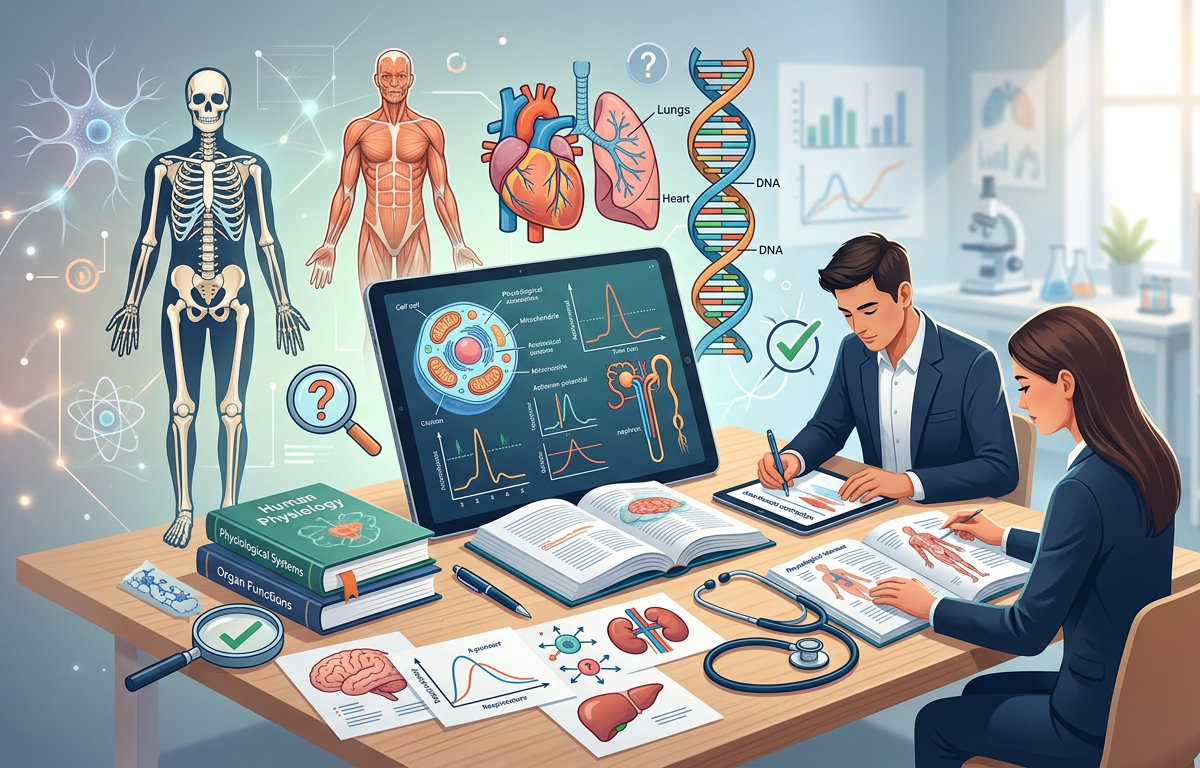
Physiology is the scientific study of the functions and mechanisms that work within a living system, encompassing how organisms, organ systems, organs, cells, and biomolecules carry out the chemical and physical functions that exist in a living system.
It explores the intricate processes that maintain homeostasis, the dynamic equilibrium necessary for life, and how various systems interact to ensure survival and adaptation. Key concepts in physiology include:
- Homeostasis: The maintenance of a stable internal environment despite external fluctuations. This involves feedback loops (negative and positive) that regulate variables like body temperature, blood glucose, and pH.
- Cellular Physiology: The study of how individual cells function, including membrane transport, energy production (metabolism), and cellular communication.
- Organ System Integration: How different organ systems, such as the cardiovascular, respiratory, nervous, and endocrine systems, coordinate their activities. For instance, the nervous system and endocrine system work together to regulate many bodily functions. For more on the nervous system, see our Nervous System Questions Practice Questions.
- Adaptation: The physiological changes that allow an organism to adjust to its environment over time.
- Pathophysiology: The study of how disease processes affect normal physiological functions.
Understanding physiology is fundamental to healthcare, sports science, and biological research, providing insight into the complexities of life itself. It often builds upon a strong foundation in anatomy, which focuses on the structure of living organisms. You can explore more about structure in our Anatomy Practice Questions.
Solved Examples
Example 1: Homeostatic Regulation of Blood Glucose
Question: Describe the homeostatic mechanism that regulates blood glucose levels after a meal.
- Identify the Stimulus: After a meal, carbohydrates are digested into glucose, leading to an increase in blood glucose levels.
- Identify the Receptor: Beta cells in the islets of Langerhans within the pancreas detect the elevated blood glucose.
- Identify the Control Center: The beta cells themselves act as the control center, responding to the stimulus.
- Identify the Effector: The beta cells release insulin into the bloodstream.
- Describe the Response: Insulin acts on target cells (e.g., muscle, liver, adipose tissue) to increase glucose uptake from the blood and promote its conversion into glycogen for storage (glycogenesis) or fat. This lowers blood glucose levels.
- Negative Feedback: As blood glucose levels return to the normal range, the stimulus for insulin release diminishes, illustrating a negative feedback loop.
Example 2: Oxygen Transport in Blood
Question: Explain how oxygen is primarily transported in the blood from the lungs to the body tissues.
- Oxygen Entry into Blood: In the lungs, oxygen diffuses from the alveoli into the pulmonary capillaries due to a higher partial pressure of oxygen in the alveoli.
- Binding to Hemoglobin: Once in the blood, the vast majority of oxygen (about 98.5%) binds reversibly to hemoglobin, a protein found in red blood cells. Each hemoglobin molecule can bind up to four oxygen molecules, forming oxyhemoglobin.
- Transport through Circulation: The oxygen-rich blood is then pumped by the heart through the systemic circulation to various body tissues.
- Oxygen Release at Tissues: At the tissues, where the partial pressure of oxygen is lower and conditions like lower pH, higher temperature, and higher CO2 concentration (Bohr effect) exist, hemoglobin's affinity for oxygen decreases.
- Diffusion into Cells: Oxygen dissociates from hemoglobin and diffuses out of the capillaries and into the interstitial fluid, and then into the tissue cells, where it is used for cellular respiration.
Example 3: Role of the Kidney in Fluid Balance
Question: How do the kidneys contribute to maintaining the body's fluid balance?
- Filtration: The kidneys filter about 180 liters of plasma per day through the glomeruli, forming a filtrate that contains water, ions, glucose, amino acids, and waste products.
- Selective Reabsorption: As the filtrate passes through the renal tubules, most of the water (approximately 99%), essential nutrients, and ions are selectively reabsorbed back into the bloodstream. This process is regulated by hormones.
- Hormonal Regulation (ADH): Antidiuretic hormone (ADH), released from the posterior pituitary, increases the permeability of the collecting ducts and distal convoluted tubules to water, leading to increased water reabsorption and concentrated urine. This helps conserve water when the body is dehydrated.
- Hormonal Regulation (Aldosterone): Aldosterone, from the adrenal cortex, promotes sodium reabsorption (and thus water follows) in the distal tubules and collecting ducts, contributing to blood volume and pressure regulation.
- Waste Excretion: Excess water, electrolytes, and metabolic waste products (like urea and creatinine) are excreted in the urine, ensuring their removal while preserving necessary fluid volume.
Practice Questions
1. Which of the following is a primary function of the lymphatic system?
a) Pumping blood throughout the body
b) Producing hormones for metabolic regulation
c) Returning interstitial fluid to the bloodstream and aiding in immune surveillance
d) Digesting food and absorbing nutrients
2. Describe the process of muscle contraction at the sarcomere level, including the role of calcium ions and ATP.
3. A patient presents with abnormally low blood pressure. Which of the following physiological responses would the body likely initiate to restore blood pressure to normal?
a) Vasodilation of arterioles
b) Decreased heart rate
c) Increased release of antidiuretic hormone (ADH)
d) Inhibition of the renin-angiotensin-aldosterone system
4. Explain the difference between afferent and efferent neurons in the nervous system.
5. What is the primary role of surfactant in the respiratory system?
a) To increase the rate of oxygen diffusion into the blood
b) To reduce surface tension in the alveoli, preventing their collapse
c) To filter incoming air of pathogens
d) To facilitate gas exchange by thickening the alveolar-capillary membrane
6. Describe the two main types of feedback loops in homeostasis and provide an example for each.
7. A person experiences severe dehydration. How would the body's osmoreceptors and the endocrine system respond to this condition?
8. Which component of blood is primarily responsible for oxygen transport?
a) Plasma
b) Platelets
c) White blood cells
d) Red blood cells
9. Briefly explain the concept of "threshold potential" in neuron firing.
10. What is the function of the hepatic portal system?
Answers & Explanations
1. Answer: c) Returning interstitial fluid to the bloodstream and aiding in immune surveillance
Explanation: The lymphatic system is a crucial part of both the circulatory and immune systems. It collects excess interstitial fluid (lymph) that leaks from capillaries and returns it to the bloodstream, preventing edema. Lymph nodes, a key component, filter the lymph and house immune cells, providing immune surveillance. Options a, b, and d describe functions of the cardiovascular, endocrine, and digestive systems, respectively.
2. Explanation: Muscle contraction, specifically in skeletal muscle, occurs via the sliding filament model within the sarcomeres. When an action potential reaches the muscle fiber, it triggers the release of calcium ions (Ca2+) from the sarcoplasmic reticulum. These Ca2+ ions bind to troponin, causing a conformational change that moves tropomyosin away from the myosin-binding sites on the actin filaments. This exposes the binding sites, allowing myosin heads to attach to actin, forming cross-bridges. ATP then binds to the myosin head, causing it to detach from actin. The hydrolysis of ATP into ADP and inorganic phosphate (Pi) re-energizes the myosin head, causing it to cock into a high-energy position. The myosin head then re-attaches to a new site on the actin filament, and the release of ADP and Pi triggers the power stroke, pulling the actin filament towards the M-line. This cycle continues as long as Ca2+ and ATP are available, resulting in the shortening of the sarcomere and muscle contraction. For more detailed information on cellular processes, you might find our Cell Structure Practice Questions helpful.
3. Answer: c) Increased release of antidiuretic hormone (ADH)
Explanation: Low blood pressure indicates reduced blood volume or systemic vasodilation. The body's response would aim to increase blood volume and/or vasoconstriction. Increased ADH release promotes water reabsorption in the kidneys, which helps to increase blood volume and thus blood pressure. Vasodilation (a) would further lower blood pressure. Decreased heart rate (b) would reduce cardiac output and blood pressure. Inhibition of the renin-angiotensin-aldosterone system (d) would reduce blood volume and pressure, which is contrary to the needed response.
4. Explanation: Afferent neurons (also known as sensory neurons) transmit sensory information from peripheral receptors towards the central nervous system (CNS). They detect stimuli from the internal or external environment. Efferent neurons (also known as motor neurons) transmit motor commands from the CNS to effector organs, such as muscles or glands, to initiate a response. In essence, afferent neurons carry signals "to" the CNS, while efferent neurons carry signals "away from" the CNS.
5. Answer: b) To reduce surface tension in the alveoli, preventing their collapse
Explanation: Surfactant is a lipoprotein complex produced by Type II alveolar cells. Its primary function is to lower the surface tension of the fluid lining the alveoli. This reduction in surface tension prevents the small, delicate alveoli from collapsing during exhalation, making it easier to inflate them during inhalation and ensuring efficient gas exchange. Without sufficient surfactant, conditions like Infant Respiratory Distress Syndrome can occur.
6. Explanation: The two main types of feedback loops in homeostasis are negative feedback and positive feedback.
- Negative Feedback: This mechanism works to counteract a change from a set point, bringing the variable back to its normal range. It is the most common type of homeostatic regulation.
- Example: Regulation of body temperature. If body temperature rises above the set point, sweat glands are activated, and blood vessels in the skin dilate to release heat, bringing the temperature back down.
- Positive Feedback: This mechanism enhances or amplifies a change, moving the variable further away from the set point. It is less common in physiological regulation but crucial for specific events.
- Example: Childbirth. During labor, contractions of the uterus push the baby towards the cervix. This stretching of the cervix stimulates the release of oxytocin, which intensifies uterine contractions, leading to more stretching and further oxytocin release, until the baby is delivered.
7. Explanation: In severe dehydration, the body's fluid volume decreases, leading to an increase in plasma osmolarity (concentration of solutes). Osmoreceptors, located primarily in the hypothalamus, detect this increase in osmolarity. In response, the hypothalamus stimulates the posterior pituitary gland to release more antidiuretic hormone (ADH), also known as vasopressin. ADH acts on the kidneys, specifically increasing the permeability of the collecting ducts and distal convoluted tubules to water. This leads to increased water reabsorption back into the bloodstream, producing a smaller volume of more concentrated urine, thus conserving body water and helping to restore normal fluid balance and osmolarity. Additionally, the sensation of thirst is triggered, encouraging water intake.
8. Answer: d) Red blood cells
Explanation: Red blood cells (erythrocytes) contain hemoglobin, a protein specifically designed to bind and transport oxygen from the lungs to the body's tissues. While plasma carries a small amount of dissolved oxygen, and white blood cells and platelets have other functions (immune response and clotting, respectively), red blood cells are the primary transporters of oxygen.
9. Explanation: Threshold potential is the critical level of membrane potential that must be reached for an action potential (nerve impulse) to be generated in a neuron. When the membrane potential depolarizes to this threshold (typically around -55 mV from a resting potential of -70 mV), voltage-gated sodium channels open rapidly, leading to a massive influx of Na+ ions and the rapid depolarization characteristic of an action potential. If the threshold is not reached, no action potential will fire (all-or-none principle).
10. Explanation: The hepatic portal system is a specialized part of the circulatory system that collects nutrient-rich blood from the digestive organs (stomach, small intestine, large intestine, pancreas, and spleen) and transports it directly to the liver via the hepatic portal vein. This allows the liver to process, detoxify, and store absorbed nutrients before they enter the general systemic circulation. It ensures that potentially harmful substances absorbed from the gut are first handled by the liver, and that nutrients are metabolized or stored appropriately.
1. Which of the following is the primary mechanism for maintaining stable body temperature in humans?
Frequently Asked Questions
What is homeostasis in physiology?
Homeostasis is the ability of an organism to maintain a stable internal environment despite changes in external conditions. It involves a complex interplay of regulatory mechanisms, primarily negative feedback loops, to keep physiological variables within a narrow, healthy range.
Why is feedback important in physiological regulation?
Feedback mechanisms are crucial for maintaining homeostasis and coordinating bodily functions. Negative feedback loops correct deviations from a set point, while positive feedback loops amplify a response to achieve a specific outcome, like childbirth or blood clotting.
How do the nervous and endocrine systems communicate?
The nervous and endocrine systems are the body's two main communication and control systems. The nervous system uses electrical signals (action potentials) and neurotransmitters for rapid, localized responses, while the endocrine system uses chemical messengers (hormones) transported via the bloodstream for slower, widespread, and prolonged effects.
What is the role of ATP in muscle contraction?
ATP (adenosine triphosphate) is the direct energy source for muscle contraction. It is required for the detachment of myosin heads from actin, the re-cocking of the myosin heads into a high-energy state, and the active transport of calcium ions back into the sarcoplasmic reticulum for muscle relaxation.
How do the kidneys regulate blood pressure?
The kidneys regulate blood pressure through several mechanisms, including controlling blood volume by adjusting water and salt excretion, producing renin (which initiates the renin-angiotensin-aldosterone system to cause vasoconstriction and increase blood volume), and releasing erythropoietin, which affects red blood cell production and thus blood viscosity.
What is the difference between systemic and pulmonary circulation?
Systemic circulation transports oxygenated blood from the heart to the rest of the body's tissues and returns deoxygenated blood to the heart. Pulmonary circulation carries deoxygenated blood from the heart to the lungs to pick up oxygen and release carbon dioxide, then returns oxygenated blood to the heart. You can learn more about the cardiovascular system here.
Enjoyed this article?
Share it with others who might find it helpful.
Related Articles
Hard Physiology Practice Questions Practice Questions
Dive into hard physiology practice questions to master complex bodily functions, regulatory systems, and cellular mechanisms.
Apr 25, 2026

Medium Physiology Practice Questions Practice Questions
Boost your understanding of physiological processes with these medium physiology practice questions covering homeostasis, organ systems, and cellular functions.
Apr 25, 2026
Easy Physiology Practice Questions Practice Questions
These easy physiology practice questions cover fundamental concepts of how the human body functions, including organ systems, cells, and homeostatic mechanisms.
Apr 25, 2026
Hard Microbiology Practice Questions Practice Questions
Hard Microbiology Practice Questions Practice Questions
Apr 26, 2026
Medium Microbiology Practice Questions Practice Questions
Master microbiology with our medium-level practice questions covering bacterial growth, genetics, and metabolism. Includes solved examples and a quick quiz.
Apr 26, 2026
Easy Microbiology Practice Questions Practice Questions
Easy Microbiology Practice Questions Practice Questions
Apr 26, 2026

Hard Enzyme Questions Practice Questions
Master complex biochemistry with these hard enzyme questions. Cover Michaelis-Menten kinetics, inhibition types, and Lineweaver-Burk plots with solved examples.
Apr 26, 2026

Medium Enzyme Questions Practice Questions
Master enzyme kinetics and regulation with our Medium Enzyme Questions Practice Questions. Includes solved examples, detailed explanations, and a quick quiz.
Apr 26, 2026