Cell Structure Practice Questions Practice Questions with Answers

Concept Explanation
Cell structure refers to the individual components, or organelles, that make up a cell and the specific ways these parts are organized to perform life-sustaining functions. Cells are the fundamental building blocks of all living organisms, categorized primarily into prokaryotic cells (lacking a nucleus) and eukaryotic cells (containing a membrane-bound nucleus). Understanding cell structure involves studying the cell membrane, cytoplasm, and various organelles like the mitochondria, ribosomes, and endoplasmic reticulum. According to Nature Education, the complexity of these structures allows for the compartmentalization of chemical reactions, which is essential for multicellular life.
Key Components of Cell Structure
To master Cell Structure Practice Questions, you must distinguish between the various organelles and their roles. Below is a summary of the most critical structures:
Cell Membrane: A phospholipid bilayer that regulates the entry and exit of substances.
Nucleus: The control center containing genetic material (DNA).
Mitochondria: The site of cellular respiration where ATP (energy) is produced.
Ribosomes: Small structures responsible for protein synthesis.
Endoplasmic Reticulum (ER): A network of membranes; 'Rough' ER has ribosomes for protein transport, while 'Smooth' ER synthesizes lipids.
Golgi Apparatus: Modifies, sorts, and packages proteins for secretion.
Lysosomes: Contain digestive enzymes to break down waste materials.
Just as mathematical precision is required for unit conversion practice questions, biological systems rely on precise structural organization to maintain homeostasis. Comparing plant and animal cells is also vital; for instance, plant cells possess a rigid cell wall and chloroplasts for photosynthesis, while animal cells do not.
Solved Examples
Here are several worked examples to help you apply your knowledge of cell biology to specific scenarios.
Example: Identifying Organelles by Function
Question: A cell is observed to have a high concentration of mitochondria. What can you infer about the function of this cell?
Identify the role of mitochondria: They produce ATP through aerobic respiration.
Connect function to cell type: Cells requiring high energy, such as muscle cells or sperm cells, will naturally have more mitochondria.
Conclusion: The cell is likely involved in high-energy activities or active transport.
Example: Distinguishing Prokaryotes from Eukaryotes
Question: A microscopic organism is found to have DNA, ribosomes, and a cell wall, but no nucleus. Is it a prokaryote or a eukaryote?
Analyze the traits: DNA and ribosomes are common to all cells.
Identify the defining absence: The lack of a membrane-bound nucleus is the hallmark of a prokaryote.
Conclusion: The organism is a prokaryote (likely a bacterium).
Example: Plant vs. Animal Cells
Question: If a cell is placed in a hypotonic solution and does not burst, what structure is likely responsible?
Understand the mechanism: In a hypotonic solution, water enters the cell via osmosis.
Identify the protective layer: Animal cells lack a rigid outer layer and may lyse (burst). Plant cells have a cell wall.
Conclusion: The cell wall provides turgor pressure and prevents the cell from bursting.
Practice Questions
Test your knowledge with these Cell Structure Practice Questions. These range from basic identification to complex functional analysis.
Which organelle is known as the \"powerhouse of the cell\" because it generates most of the cell's supply of adenosine triphosphate (ATP)?
What is the primary difference between the Rough Endoplasmic Reticulum and the Smooth Endoplasmic Reticulum?
Which structure is composed of a phospholipid bilayer and acts as a semi-permeable barrier?
Start Learning Smarter Today
Join thousands of students using AI-powered study tools to achieve better results.
Get Started FreeDescribe the function of the Golgi apparatus in terms of protein trafficking.
Which organelle contains digestive enzymes that break down macromolecules, old cell parts, and microorganisms?
Identify two structures found in plant cells that are absent in animal cells.
Explain the role of the nucleolus within the nucleus.
What is the function of the cytoskeleton, and what are its three main components?
How do ribosomes differ in their location within the cell, and how does this affect the proteins they produce?
Why is the membrane described as a \"fluid mosaic model\"?
Answers & Explanations
Mitochondria: They are responsible for cellular respiration, converting nutrients (glucose) into energy (ATP).
Presence of Ribosomes: The Rough ER is studded with ribosomes and is involved in protein synthesis and transport. The Smooth ER lacks ribosomes and is involved in lipid synthesis and detoxification.
Cell Membrane (Plasma Membrane): It consists of phospholipids with hydrophilic heads and hydrophobic tails, regulating what enters and exits the cell.
Modifying and Packaging: The Golgi apparatus receives proteins from the ER, modifies them (e.g., adding sugar chains), and packages them into vesicles for transport to their final destination.
Lysosome: These organelles act as the cell's waste disposal system, utilizing acid hydrolase enzymes to digest materials.
Cell Wall and Chloroplasts: The cell wall provides structural support, and chloroplasts enable photosynthesis. (Large central vacuoles are also a valid answer).
Ribosome Synthesis: The nucleolus is a dense region within the nucleus where ribosomal RNA (rRNA) is synthesized and combined with proteins to form ribosome subunits.
Structural Support: The cytoskeleton maintains cell shape and aids in movement. Its three components are microfilaments, intermediate filaments, and microtubules.
Free vs. Bound: Free ribosomes in the cytoplasm produce proteins used within the cell. Bound ribosomes on the Rough ER produce proteins destined for insertion into membranes or secretion outside the cell.
Dynamic Structure: It is \"fluid\" because molecules can move laterally within the layer and a \"mosaic\" because it is made of various proteins, cholesterol, and carbohydrates embedded in the bilayer.
Understanding these biological systems is as fundamental as mastering linear equations practice questions in mathematics. Both require a grasp of how individual parts contribute to a whole system.
1. Which organelle is responsible for the process of photosynthesis in plant cells?
Frequently Asked Questions
What is the difference between a cell wall and a cell membrane?
The cell membrane is a flexible, semi-permeable lipid bilayer found in all cells that regulates substance traffic. The cell wall is a rigid outer layer found in plants, fungi, and bacteria that provides structural support and protection.
Why are cells so small?
Cells remain small to maintain a high surface area-to-volume ratio, which ensures efficient transport of nutrients and waste across the membrane. As a cell grows larger, its volume increases faster than its surface area, making diffusion less effective.
What is the role of vacuoles in animal vs. plant cells?
In plant cells, a large central vacuole maintains turgor pressure and stores water and nutrients. In animal cells, vacuoles are much smaller and are primarily used for temporary storage or transport of materials.
How do ribosomes participate in the central dogma of biology?
Ribosomes are the site of translation, where the genetic code carried by messenger RNA (mRNA) is read to assemble amino acids into functional proteins. This process follows the transcription of DNA into RNA within the nucleus.
What happens if a cell's lysosomes rupture?
If many lysosomes rupture simultaneously, the released digestive enzymes can digest the cell from the inside out, leading to programmed cell death or autolysis. This mechanism is sometimes used by the body to remove damaged or diseased cells.
Can a cell survive without a nucleus?
Certain specialized cells, such as mature human red blood cells, lack a nucleus to provide more space for hemoglobin, but they cannot divide or repair themselves. In contrast, prokaryotes naturally lack a nucleus but contain their DNA in a nucleoid region, allowing them to function and reproduce normally.
Start Learning Smarter Today
Join thousands of students using AI-powered study tools to achieve better results.
Get Started FreeEnjoyed this article?
Share it with others who might find it helpful.
Related Articles
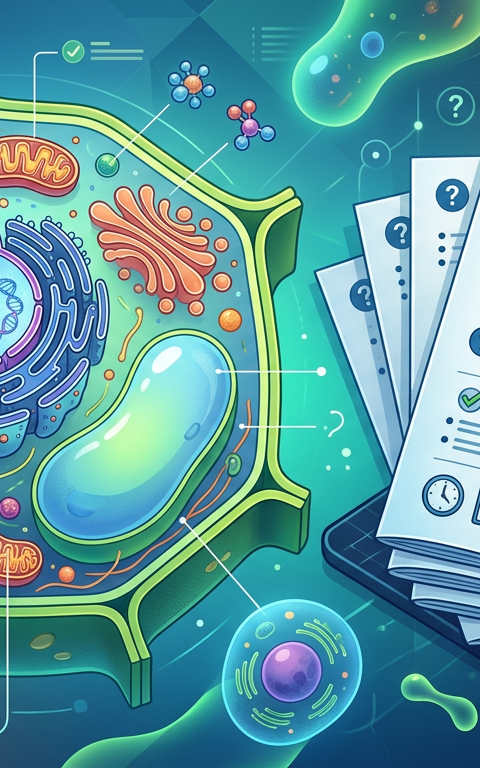
Hard Cell Structure Practice Questions Practice Questions
Challenge your understanding of cell biology with these hard cell structure practice questions, complete with solved examples, detailed answers, and a quick quiz.
Apr 25, 2026
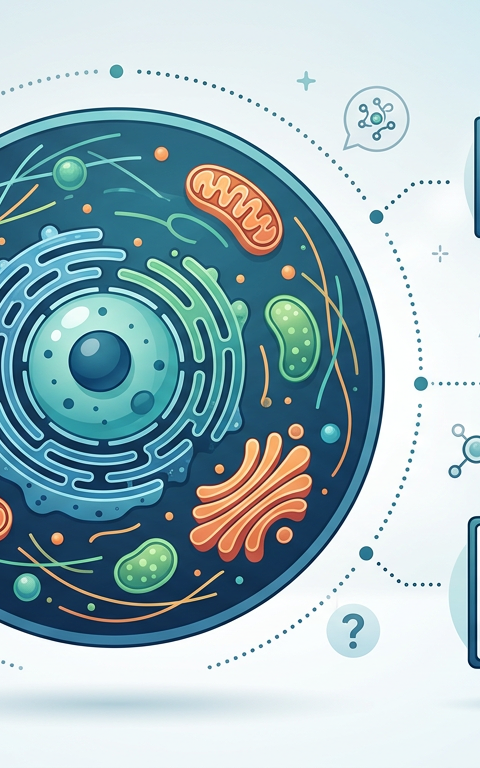
Medium Cell Structure Practice Questions Practice Questions
Master cell biology with these medium cell structure practice questions. Get detailed explanations and solved examples to boost your understanding.
Apr 25, 2026
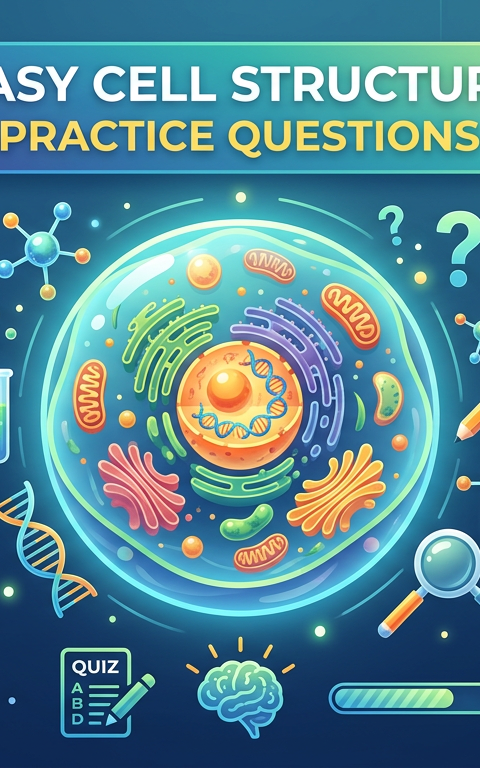
Easy Cell Structure Practice Questions Practice Questions
Master the basics of biology with our easy cell structure practice questions. This guide includes clear explanations, solved examples, and a quiz to test your knowledge.
Apr 25, 2026
Hard Microbiology Practice Questions Practice Questions
Hard Microbiology Practice Questions Practice Questions
Apr 26, 2026
Medium Microbiology Practice Questions Practice Questions
Master microbiology with our medium-level practice questions covering bacterial growth, genetics, and metabolism. Includes solved examples and a quick quiz.
Apr 26, 2026
Easy Microbiology Practice Questions Practice Questions
Easy Microbiology Practice Questions Practice Questions
Apr 26, 2026

Hard Enzyme Questions Practice Questions
Master complex biochemistry with these hard enzyme questions. Cover Michaelis-Menten kinetics, inhibition types, and Lineweaver-Burk plots with solved examples.
Apr 26, 2026
Medium Enzyme Questions Practice Questions
Master enzyme kinetics and regulation with our Medium Enzyme Questions Practice Questions. Includes solved examples, detailed explanations, and a quick quiz.
Apr 26, 2026