Nervous System Questions Practice Questions with Answers
Concept Explanation
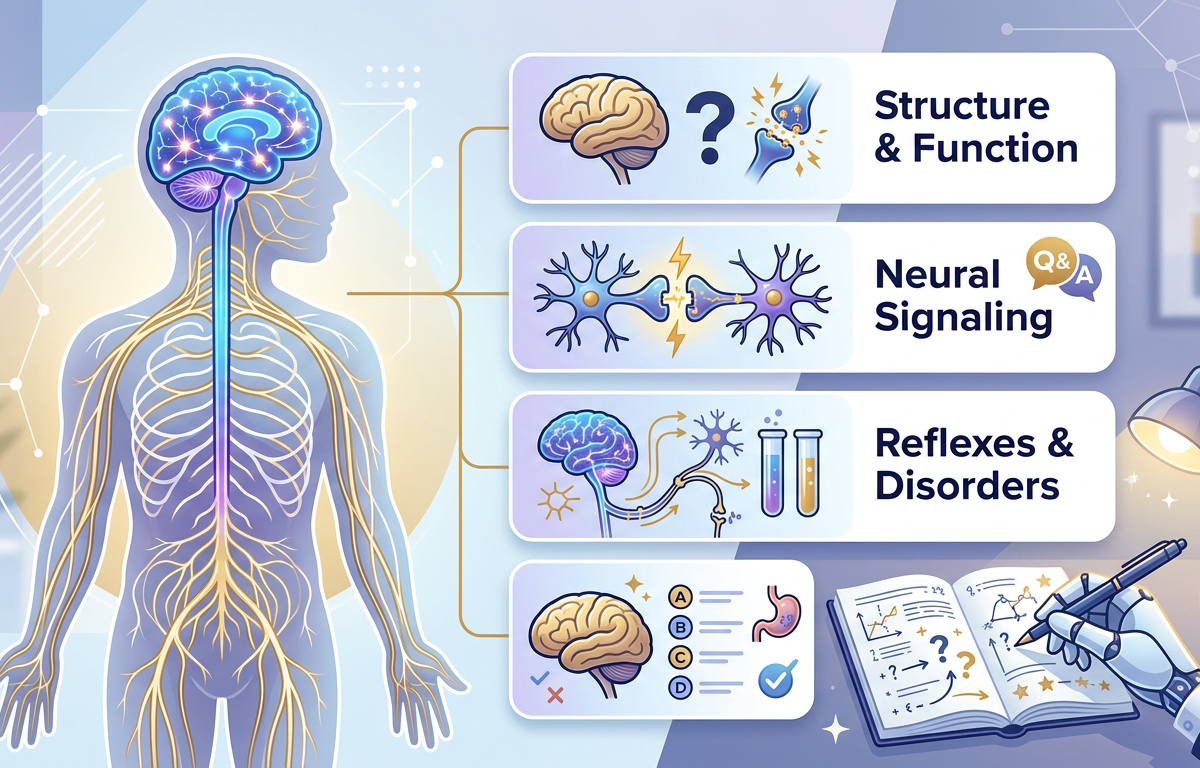
The nervous system is the body's primary communication and control network, responsible for processing sensory information, coordinating muscle movements, and maintaining homeostasis through electrical and chemical signals. This complex system is divided into two main branches: the Central Nervous System (CNS), consisting of the brain and spinal cord, and the Peripheral Nervous System (PNS), which includes all the nerves branching out to the rest of the body. At the cellular level, the functional unit is the neuron, which transmits impulses via an action potential. Understanding how these signals travel across synapses is as fundamental to biology as understanding cell membrane functions and transport mechanisms. The Nature Journal provides extensive research on how these neural pathways facilitate everything from basic reflexes to complex cognitive thought processes.
Key Components of the Nervous System
- Neurons: Specialized cells that transmit nerve impulses. They consist of a cell body, dendrites (receivers), and an axon (transmitter).
- Synapse: The microscopic gap between two neurons where neurotransmitters are released to pass the signal.
- Myelin Sheath: An insulating layer around axons that increases the speed of electrical transmission.
- Autonomic Nervous System: A division of the PNS that controls involuntary actions, further split into the sympathetic (fight or flight) and parasympathetic (rest and digest) systems.
Solved Examples
Reviewing solved examples helps clarify how physiological concepts translate into testable questions. These examples demonstrate the logic required to solve Nervous System Questions effectively.
Example 1: The Reflex Arc
Trace the path of a nerve impulse in a simple spinal reflex, such as pulling your hand away from a hot stove.
- Receptor: Sensory receptors in the skin detect the heat stimulus.
- Sensory Neuron: The impulse travels from the receptor toward the spinal cord.
- Interneuron: Located in the gray matter of the spinal cord, it processes the signal and immediately relays it to a motor neuron.
- Motor Neuron: The impulse travels away from the spinal cord to the effector.
- Effector: The muscle in the arm contracts, moving the hand away.
Example 2: Resting Membrane Potential
Explain how the sodium-potassium pump maintains the resting potential of a neuron at approximately -70mV.
- The pump actively transports 3 Sodium (Na+) ions out of the cell for every 2 Potassium (K+) ions it brings in.
- This creates a concentration gradient where Na+ is higher outside and K+ is higher inside.
- Because more positive charge is moved out than in, the interior of the cell becomes negatively charged relative to the exterior.
- This process requires ATP, making it a form of active transport similar to concepts found in cell transport problems.
Example 3: Neurotransmitter Action
What happens to a neurotransmitter like Acetylcholine (ACh) after it has bound to the postsynaptic receptor?
- The neurotransmitter must be removed to prevent continuous stimulation of the postsynaptic neuron.
- Enzymatic degradation: An enzyme (Acetylcholinesterase) breaks down ACh into choline and acetate.
- Reuptake: Some neurotransmitters are pumped back into the presynaptic neuron for reuse.
- Diffusion: The substance simply drifts away from the synaptic cleft.
Practice Questions
Test your knowledge with these Nervous System Questions ranging from basic anatomy to complex physiology.
- Which part of the brain is primarily responsible for coordinating fine motor skills, balance, and posture?
- Describe the difference between an afferent neuron and an efferent neuron.
- During an action potential, what specific event causes the rapid depolarization of the neuronal membrane?
- What is the function of the nodes of Ranvier in a myelinated axon?
- Which division of the autonomic nervous system is activated during a "fight or flight" response, and what is one physiological effect?
- The blood-brain barrier is formed primarily by which type of glial cell?
- Explain the "All-or-None" law regarding nerve impulse transmission.
- Damage to the Broca’s area in the left cerebral hemisphere would most likely result in what specific impairment?
- What ions enter the axon terminal to trigger the release of neurotransmitter vesicles into the synaptic cleft?
- Identify the three layers of the meninges from the outermost to the innermost layer.
Answers & Explanations
- Cerebellum: While the cerebrum handles higher-order thinking, the cerebellum is the "little brain" at the rear that manages motor coordination and balance.
- Afferent vs. Efferent: Afferent (sensory) neurons carry information toward the CNS from receptors, while efferent (motor) neurons carry instructions away from the CNS to effectors like muscles.
- Sodium Influx: Depolarization occurs when voltage-gated sodium channels open, allowing Na+ ions to rush into the cell, making the inside more positive.
- Saltatory Conduction: The nodes of Ranvier are gaps in the myelin sheath. They allow the action potential to "jump" from node to node, significantly increasing the speed of the impulse.
- Sympathetic Nervous System: This system prepares the body for stress. Physiological effects include increased heart rate, pupil dilation, and inhibition of digestion.
- Astrocytes: These star-shaped glial cells provide structural support and help form the blood-brain barrier by wrapping around capillaries to regulate the chemical environment. More information on cellular structures can be found in our guide on organelles and their functions.
- All-or-None Law: This principle states that if a stimulus is strong enough to reach the threshold, an action potential will fire at full strength; if it does not reach the threshold, no impulse is fired at all. There is no "partial" impulse.
- Speech Production: Broca’s area is crucial for motor speech. Damage leads to expressive aphasia, where a person understands language but struggles to produce spoken words.
- Calcium (Ca2+): When the action potential reaches the axon terminal, voltage-gated calcium channels open. The entry of Ca2+ triggers the exocytosis of neurotransmitter vesicles.
- Dura Mater, Arachnoid Mater, Pia Mater: These three protective membranes surround the brain and spinal cord. The Dura is the tough outer layer, the Arachnoid is the web-like middle, and the Pia is the delicate inner layer.
1. Which part of the neuron receives incoming signals from other neurons?
Frequently Asked Questions
What is the difference between the CNS and the PNS?
The Central Nervous System (CNS) consists of the brain and spinal cord and acts as the integration center. The Peripheral Nervous System (PNS) consists of all nerves outside the CNS that connect the brain and spine to the rest of the body.
How does a synapse work?
A synapse is a junction where a signal passes from one neuron to another. When an electrical impulse reaches the end of an axon, it triggers the release of chemical neurotransmitters that cross the gap and bind to receptors on the next cell.
What is the threshold potential?
The threshold potential is the critical level (usually around -55mV) to which a membrane potential must be depolarized to initiate an action potential. If the stimulus is too weak to reach this level, no signal is sent.
What role does the myelin sheath play?
The myelin sheath acts as an electrical insulator for axons. It allows electrical impulses to transmit quickly and efficiently along the nerve cells by preventing signal loss and enabling saltatory conduction.
What are the four main lobes of the cerebrum?
The four lobes are the Frontal (reasoning and motor control), Parietal (sensory integration), Temporal (hearing and memory), and Occipital (vision). Each lobe specializes in different aspects of human cognition and perception, as detailed by the National Institute of Neurological Disorders and Stroke.
Enjoyed this article?
Share it with others who might find it helpful.
Related Articles
Hard Le Chatelier’s Principle Practice Questions
Master Hard Le Chatelier’s Principle Practice Questions with our comprehensive guide featuring solved examples, practice problems, and detailed explanations.
Mar 30, 2026

Hard Reaction Quotient (Q) Practice Questions
Hard Reaction Quotient (Q) Practice Questions
Mar 30, 2026
Grams to Moles Practice Questions with Answers
Master grams to moles conversions with our comprehensive guide. Includes step-by-step examples, practice questions, and detailed answers for chemistry students.
Mar 26, 2026
Avogadro’s Number Practice Questions with Answers
Master the mole concept with our Avogadro’s Number practice questions. Includes step-by-step solved examples, a quick quiz, and detailed explanations.
Mar 26, 2026
Empirical Formulas: Solving Ratios from Mass and Percent Data
Master empirical formula calculations with 10 practice questions, worked answers, and a free step-by-step calculator for mass, percentage, and combustion problems.
Mar 26, 2026