Anatomy Practice Questions Practice Questions with Answers
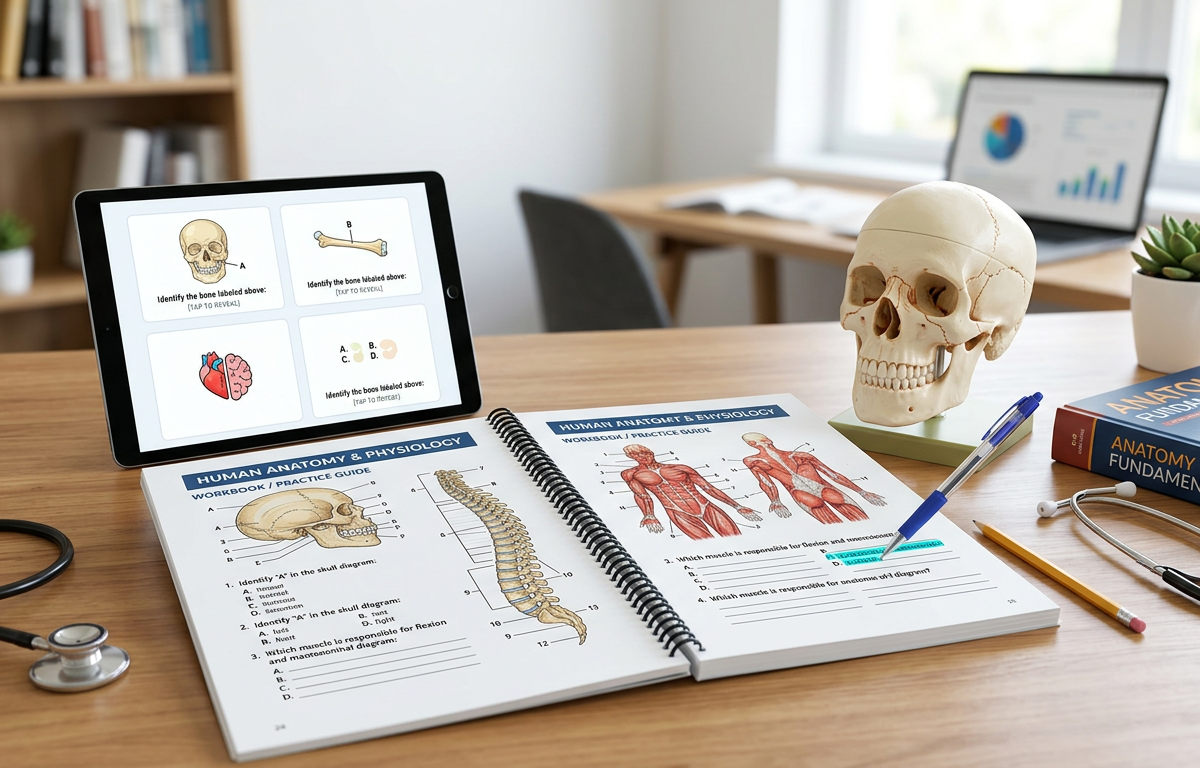
Anatomy is the scientific study of the structures of the human body and the physical relationships between its various parts. Mastering this field requires a deep understanding of everything from microscopic cellular structures to large-scale organ systems. Using Anatomy Practice Questions is one of the most effective ways to reinforce your memory and prepare for medical or biological examinations. By testing your knowledge of terminology, location, and function, you can identify gaps in your understanding of how the body is built and how it maintains homeostasis.
Concept Explanation
Human anatomy is categorized into two primary fields: gross anatomy, which involves structures visible to the naked eye, and microscopic anatomy, which includes histology and cytology. To navigate the body, healthcare professionals use a specialized language of directional terms, planes, and regions. For instance, understanding the cell structure of a tissue is essential for understanding how that tissue contributes to a larger organ like the heart or lungs. Key concepts include the hierarchy of organization—atoms, molecules, organelles, cells, tissues, organs, organ systems, and the organism—as well as the 11 major organ systems that work in concert to sustain life. According to the Visible Body educational resources, mastering anatomical position is the foundational step for all medical communication.
Solved Examples
Review these solved examples to understand how to approach common anatomy problems and anatomical terminology.
Identify the correct anatomical term for a structure located toward the front of the body.
Identify the standard anatomical position as a reference.
Recall directional terms: Anterior (front), Posterior (back), Superior (above), Inferior (below).
Solution: The correct term is Anterior (or Ventral).
Which organ system is primarily responsible for the production of red blood cells?
Analyze the functions of major systems: Integumentary (protection), Skeletal (support/blood cell production), Muscular (movement).
Locate where hematopoiesis occurs, which is the red bone marrow.
Solution: The Skeletal System is responsible for red blood cell production.
Describe the relationship between the wrist and the elbow using directional terms.
Determine the point of attachment to the trunk (the shoulder).
Use terms related to limb distance: Proximal (closer to attachment) and Distal (farther from attachment).
The wrist is farther from the shoulder than the elbow.
Solution: The wrist is distal to the elbow.
Practice Questions
Test your knowledge with these Anatomy Practice Questions ranging from basic terminology to complex system interactions.
1. Which plane divides the body into equal right and left halves?
2. The heart is located in which specific body cavity?
3. Name the four primary types of tissues found in the human body.
Start Learning Smarter Today
Join thousands of students using AI-powered study tools to achieve better results.
Get Started Free4. Which layer of the skin is known for being avascular (lacking blood vessels)?
5. What are the two main divisions of the skeletal system?
6. In the respiratory system, where does the actual gas exchange occur?
7. Which anatomical term refers to the back of the knee?
8. What is the functional unit of the kidney responsible for filtering blood?
9. The pituitary gland is a part of which organ system?
10. Which serous membrane covers the surface of the lungs?
Answers & Explanations
Midsagittal (or Median) Plane: This plane passes through the midline, dividing the body into symmetrical left and right halves. A parasagittal plane also divides the body into left and right, but the halves are unequal.
Pericardial Cavity: While the heart is in the thoracic cavity and the mediastinum, the specific fluid-filled space surrounding the heart is the pericardial cavity.
Epithelial, Connective, Muscle, and Nervous: These four categories encompass all tissues in the body. For more on the microscopic components of these tissues, see our guide on organelles questions.
Epidermis: The outermost layer of the skin is avascular; it receives nutrients via diffusion from the underlying dermis.
Axial and Appendicular: The axial skeleton includes the skull, vertebral column, and thoracic cage. The appendicular skeleton includes the limbs and girdles.
Alveoli: These tiny air sacs are the site where oxygen enters the blood and carbon dioxide leaves it. This process is similar to how molecules move across a cell membrane via diffusion.
Popliteal: The popliteal region refers specifically to the posterior aspect of the knee.
Nephron: Each kidney contains about one million nephrons that perform the essential tasks of filtration, reabsorption, and secretion.
Endocrine System: The pituitary gland is often called the \"master gland\" because it regulates many other endocrine glands through hormone secretion.
Visceral Pleura: Serous membranes consist of two layers; the visceral layer covers the organ itself, while the parietal layer lines the cavity wall.
1. Which of the following is the correct sequence of levels of structural organization from simplest to most complex?
Frequently Asked Questions
What is the difference between anatomy and physiology?
Anatomy focuses on the physical structure and identification of body parts, while physiology explores the chemistry and physics of how those structures function and work together to support life. Essentially, anatomy is the \"map\" of the body, and physiology is the \"manual\" for how it operates.
What is the standard anatomical position?
The standard anatomical position describes a person standing erect, facing the observer, with feet flat on the floor, arms at the sides, and palms turned forward. This consistent reference point ensures that directional terms like "left" and "right" always refer to the subject's sides, not the observer's. Detailed diagrams can be found through NIH SEER Training.
Why are directional terms important in anatomy?
Directional terms provide a precise language for describing the location of one body part in relation to another, minimizing the risk of medical errors. For example, using terms like \"proximal\" or \"distal\" allows surgeons to pinpoint exactly where a fracture or lesion is located on a limb.
How many organ systems are in the human body?
The human body is typically divided into 11 major organ systems: integumentary, skeletal, muscular, nervous, endocrine, cardiovascular, lymphatic, respiratory, digestive, urinary, and reproductive. Some classifications combine the skeletal and muscular systems into the musculoskeletal system.
What are the three main planes of the body?
The three primary planes are the sagittal plane (dividing left from right), the frontal or coronal plane (dividing front from back), and the transverse or horizontal plane (dividing top from bottom). These planes are essential for interpreting medical imaging like CT scans and MRIs, as noted by the Radiological Society of North America.
Start Learning Smarter Today
Join thousands of students using AI-powered study tools to achieve better results.
Get Started FreeEnjoyed this article?
Share it with others who might find it helpful.
Related Articles

Medium Anatomy Practice Questions Practice Questions
Medium Anatomy Practice Questions Practice Questions
Apr 25, 2026

Easy Anatomy Practice Questions Practice Questions
Easy Anatomy Practice Questions Practice Questions
Apr 25, 2026
Hard Anatomy Practice Questions Practice Questions
Master advanced human anatomy with our comprehensive guide featuring hard practice questions, detailed solved examples, and clinical correlations for medical students.
Apr 25, 2026

Hard Microbiology Practice Questions Practice Questions
Hard Microbiology Practice Questions Practice Questions
Apr 26, 2026

Medium Microbiology Practice Questions Practice Questions
Master microbiology with our medium-level practice questions covering bacterial growth, genetics, and metabolism. Includes solved examples and a quick quiz.
Apr 26, 2026

Easy Microbiology Practice Questions Practice Questions
Easy Microbiology Practice Questions Practice Questions
Apr 26, 2026

Hard Enzyme Questions Practice Questions
Master complex biochemistry with these hard enzyme questions. Cover Michaelis-Menten kinetics, inhibition types, and Lineweaver-Burk plots with solved examples.
Apr 26, 2026

Medium Enzyme Questions Practice Questions
Master enzyme kinetics and regulation with our Medium Enzyme Questions Practice Questions. Includes solved examples, detailed explanations, and a quick quiz.
Apr 26, 2026