Organelles Questions Practice Questions with Answers
Concept Explanation
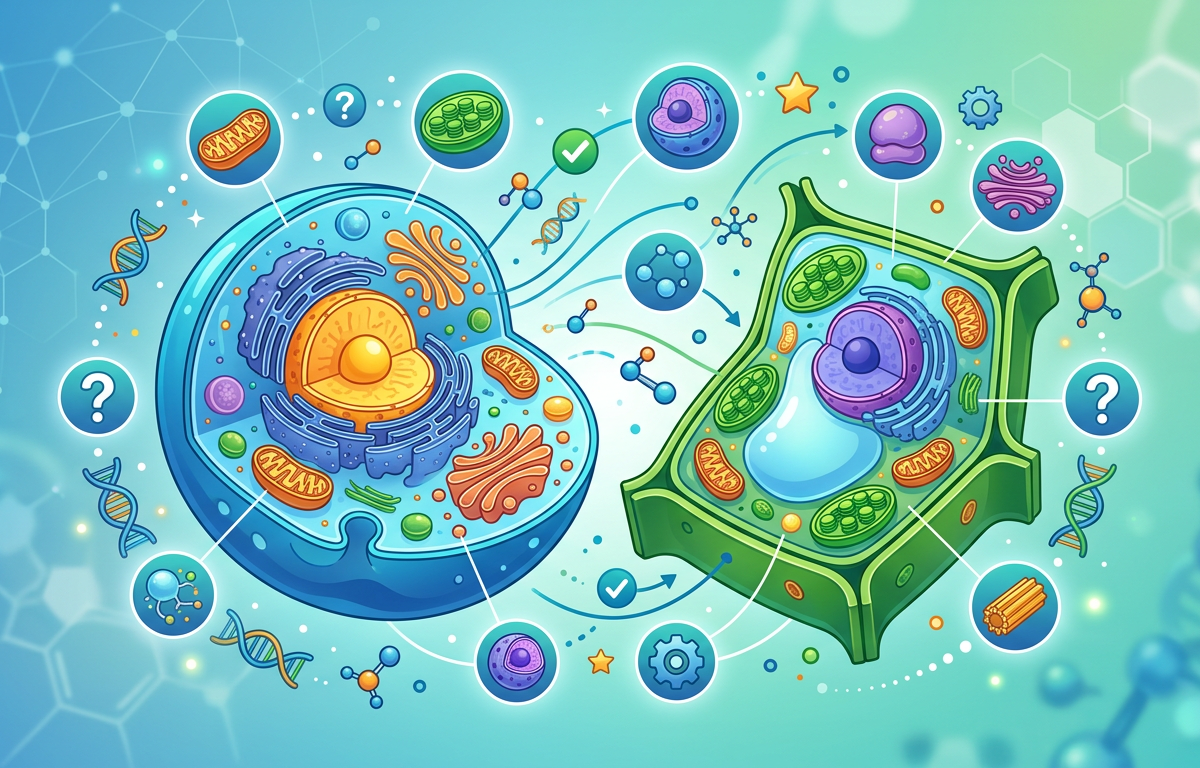
Organelles are specialized, membrane-bound structures within a cell that perform specific functions necessary for the cell's survival, growth, and reproduction. Just as the human body relies on organs like the heart and lungs to maintain homeostasis, a cell utilizes its organelles to manage tasks such as energy production, protein synthesis, and waste disposal. These structures are primarily found in eukaryotic cells, which include plant and animal cells, whereas prokaryotic cells lack most membrane-bound organelles. Understanding Organelles Questions is fundamental for students of biology, as it provides the framework for how life operates at the microscopic level.
To master this topic, it is helpful to categorize organelles by their primary roles:
Genetic Control: The nucleus acts as the command center, housing DNA and coordinating activities like growth and replication. The nucleolus, located within the nucleus, is responsible for ribosome production.
Manufacturing and Distribution: Ribosomes are the sites of protein synthesis. The Endoplasmic Reticulum (ER) comes in two forms: Rough ER (studded with ribosomes for protein transport) and Smooth ER (lipid synthesis and detoxification). The Golgi apparatus acts as a shipping center, modifying and packaging proteins into vesicles.
Energy Processing: Mitochondria are the "powerhouses" of the cell, converting chemical energy from food into Adenosine Triphosphate (ATP) through cellular respiration. In plants, chloroplasts perform photosynthesis to convert sunlight into glucose.
Structural Support and Breakdown: Lysosomes contain digestive enzymes to break down waste. Vacuoles serve as storage sacs for water and nutrients. The cytoskeleton, composed of microfilaments and microtubules, provides structural integrity.
For more foundational science practice, you might also find Unit Conversion Practice Questions useful when calculating cellular dimensions. High-quality resources like Nature Scitable and Khan Academy provide excellent visual diagrams to supplement your study of these complex structures.
Solved Examples
Review these step-by-step solutions to common Organelles Questions to prepare for your exams.
Question: A cell is observed to have an unusually high concentration of Smooth Endoplasmic Reticulum. What is the most likely function of this cell?
Identify the primary functions of the Smooth ER: lipid synthesis, carbohydrate metabolism, and detoxification.
Analyze the context: If a cell has a large amount of this organelle, it must be specialized for one of those tasks.
Conclusion: This cell is likely located in the liver (detoxification) or in an endocrine gland (steroid hormone/lipid production).
Question: Trace the path of a protein intended for secretion, starting from its synthesis.
Synthesis begins on a ribosome attached to the Rough Endoplasmic Reticulum.
The protein enters the lumen of the ER for folding and initial modification.
It is packaged into a transport vesicle and sent to the Golgi apparatus.
The Golgi modifies, sorts, and tags the protein before packaging it into a secretory vesicle.
The vesicle fuses with the plasma membrane to release the protein outside the cell.
Question: Why do muscle cells contain significantly more mitochondria than skin cells?
Define the role of mitochondria: ATP (energy) production via cellular respiration.
Assess the energy demands of the tissues: Muscle cells require constant, high levels of energy for contraction and movement.
Compare: Skin cells have lower metabolic demands compared to active muscle tissue.
Conclusion: Muscle cells have more mitochondria to meet their higher ATP requirements.
Practice Questions
Test your knowledge with these Organelles Questions ranging from basic identification to functional analysis.
Which organelle is responsible for the digestion of worn-out organelles and foreign substances?
Explain the primary difference between the Rough Endoplasmic Reticulum and the Smooth Endoplasmic Reticulum in terms of structure and function.
A plant cell becomes wilted due to a lack of water. Which specific organelle is responsible for maintaining the turgor pressure that prevents wilting?
Which organelle contains its own DNA and is thought to have evolved through endosymbiosis?
In a eukaryotic cell, where is the specific site of ribosomal RNA (rRNA) synthesis?
Cyanide is a toxin that inhibits the enzymes involved in ATP production. Which organelle does cyanide primarily target?
What is the role of the Golgi apparatus in a cell that produces large amounts of mucus?
Compare and contrast the functions of the cell wall and the cell membrane.
How do the vacuoles in animal cells differ from the central vacuole in plant cells?
Which organelle would be most abundant in a white blood cell that specializes in phagocytosis (engulfing bacteria)?
Answers & Explanations
Lysosome: These organelles contain hydrolytic enzymes that break down macromolecules, damaged organelles, and pathogens. They are the cell's recycling and waste disposal units.
Rough vs. Smooth ER: The Rough ER has ribosomes attached to its surface, giving it a "rough" appearance; it is primarily involved in protein synthesis and folding. The Smooth ER lacks ribosomes and is responsible for lipid synthesis, calcium storage, and detoxification.
Central Vacuole: In plant cells, the large central vacuole stores water. When full, it exerts turgor pressure against the cell wall, keeping the plant upright. When water is scarce, the vacuole shrinks and the plant wilts.
Mitochondria (or Chloroplasts): Both organelles contain their own circular DNA and double membranes, supporting the endosymbiotic theory that they were once independent prokaryotes.
Nucleolus: Located inside the nucleus, the nucleolus is a dense region where rRNA is synthesized and combined with proteins to form ribosomal subunits.
Mitochondria: Because mitochondria are the site of the Electron Transport Chain and ATP synthesis, toxins like cyanide that block energy production directly impair mitochondrial function.
Packaging and Secretion: The Golgi apparatus modifies the proteins and lipids produced by the ER and packages them into vesicles for secretion. In mucus-producing cells, the Golgi is highly active in glycosylating proteins to form mucin.
Cell Wall vs. Membrane: The cell membrane is a flexible phospholipid bilayer found in all cells that regulates transport. The cell wall is a rigid outer layer (made of cellulose in plants) that provides structural support and protection; it is not found in animal cells.
Vacuole Differences: Plant cells typically have one large central vacuole that maintains pressure and stores nutrients. Animal cells have several smaller, temporary vacuoles used for transport or storage of smaller molecules.
Lysosomes: Phagocytic cells need many lysosomes to merge with the phagosomes (the vesicles containing the engulfed bacteria) to digest and destroy the pathogens.
1. Which organelle is often referred to as the "shipping and receiving center" of the cell?
Frequently Asked Questions
What is the difference between a prokaryotic and eukaryotic cell regarding organelles?
Eukaryotic cells contain membrane-bound organelles like the nucleus and mitochondria, which allow for compartmentalization of cellular processes. Prokaryotic cells lack these membrane-bound structures, though they do contain ribosomes and genetic material located in a nucleoid region.
Why are ribosomes not always considered "true" organelles?
In strict biological definitions, an organelle is a membrane-bound structure. Since ribosomes lack a surrounding lipid membrane, some scientists classify them as multi-protein complexes rather than true organelles, though they are functionally categorized as such in most introductory biology courses.
Can a cell survive without mitochondria?
Most eukaryotic cells cannot survive without mitochondria because they rely on them for ATP production. However, some specialized cells, like mature human red blood cells, lack mitochondria to maximize space for hemoglobin and rely on anaerobic glycolysis for energy.
What happens if lysosomes rupture inside a cell?
If many lysosomes rupture simultaneously, the released digestive enzymes can begin to break down the cell's own proteins and organelles, leading to a process called autolysis or "self-digestion." This is often a controlled part of programmed cell death, or apoptosis.
How do organelles move within the cell?
Organelles move along the tracks of the cytoskeleton, specifically microtubules and microfilaments. Motor proteins like kinesin and dynein use energy from ATP to "walk" vesicles and organelles to their required destinations within the cytoplasm.
Are organelles the same in all eukaryotic cells?
While most eukaryotes share core organelles like the nucleus and ER, specific types vary by kingdom. For example, plant cells have chloroplasts and a large central vacuole, while animal cells have centrioles and more numerous lysosomes.
If you are exploring other scientific topics, you might want to check out Work, Energy, Power Practice Questions to understand the physics of energy, or Fraction Practice Questions to help with the ratios often found in biological concentrations. For a deeper look at cellular biology research, visit the National Institutes of Health (NIH) website.
Enjoyed this article?
Share it with others who might find it helpful.
Related Articles
Hard Le Chatelier’s Principle Practice Questions
Master Hard Le Chatelier’s Principle Practice Questions with our comprehensive guide featuring solved examples, practice problems, and detailed explanations.
Mar 30, 2026
Hard Reaction Quotient (Q) Practice Questions
Hard Reaction Quotient (Q) Practice Questions
Mar 30, 2026
Grams to Moles Practice Questions with Answers
Master grams to moles conversions with our comprehensive guide. Includes step-by-step examples, practice questions, and detailed answers for chemistry students.
Mar 26, 2026
Avogadro’s Number Practice Questions with Answers
Master the mole concept with our Avogadro’s Number practice questions. Includes step-by-step solved examples, a quick quiz, and detailed explanations.
Mar 26, 2026
Empirical Formulas: Solving Ratios from Mass and Percent Data
Master empirical formula calculations with 10 practice questions, worked answers, and a free step-by-step calculator for mass, percentage, and combustion problems.
Mar 26, 2026