Medium Percent Concentration Practice Questions
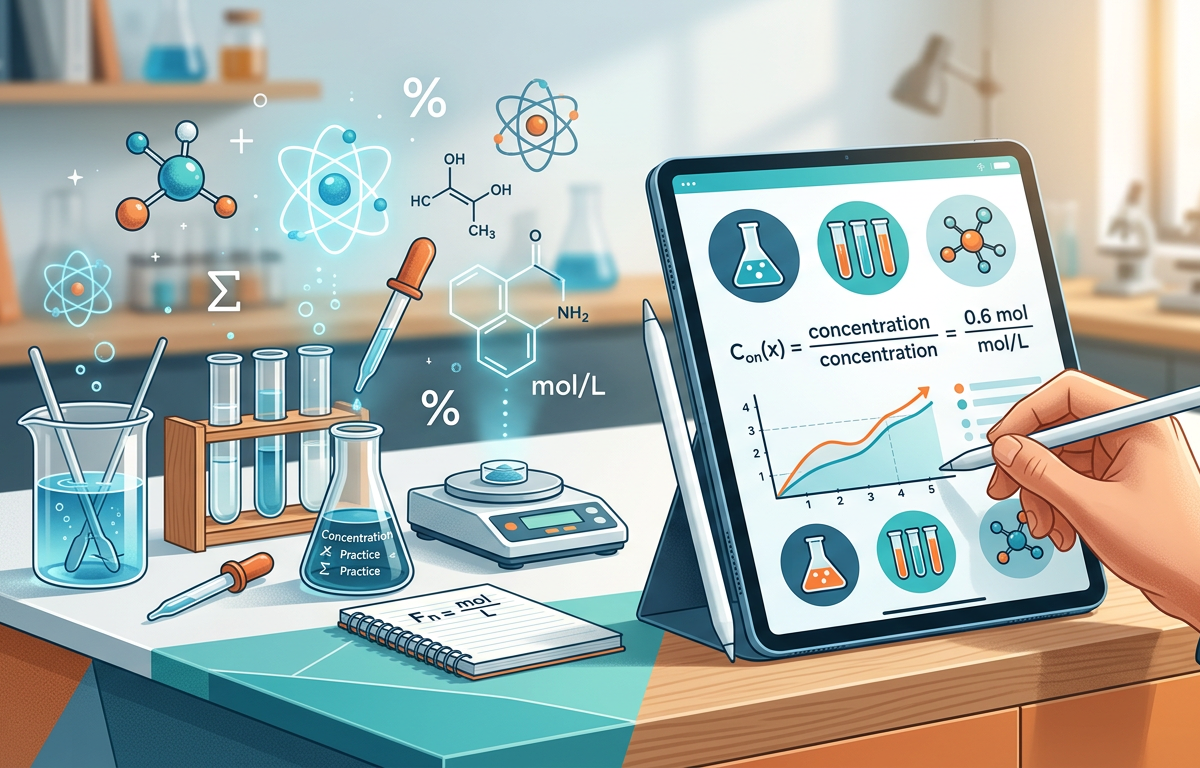
Mastering medium percent concentration practice questions is a vital step for students transitioning from basic chemistry concepts to more complex laboratory applications. Whether you are preparing for a midterm or working on analytical chemistry reports, understanding how to express the ratio of solute to solution is fundamental to your success.
Concept Explanation
Percent concentration is a measure of the amount of solute present in a given amount of solution, expressed as a percentage of the total. Generally, there are three main ways to express this: mass percent (m/m), volume percent (v/v), and mass-volume percent (m/v). These calculations are essential in pharmaceutical dosing, food science, and industrial manufacturing. Unlike molarity, which depends on the number of moles, percent concentration focuses on physical measurements like grams and milliliters.
The general formula for percent concentration is:
Percent Concentration = (Amount of Solute / Amount of Solution) × 100
It is critical to remember that the Solution represents the sum of the Solute and the Solvent. For example, if you dissolve 10g of salt in 90g of water, your total solution mass is 100g, not 90g. This is a common area where students make errors, similar to the common molarity mistakes seen in higher-level chemistry. For more information on the physical properties of solutions, you can refer to the IUPAC Gold Book for official chemical terminology.
Types of Percent Concentration
Mass Percent (% m/m): Used when both solute and solvent are solids or when weighing is more accurate. (Mass of Solute / Total Mass of Solution) × 100.
Volume Percent (% v/v): Common for liquid-liquid mixtures, such as rubbing alcohol or vinegar. (Volume of Solute / Total Volume of Solution) × 100.
Mass-Volume Percent (% m/v): Frequently used in medical settings for IV fluids. (Mass of Solute in grams / Volume of Solution in mL) × 100.
Solved Examples
Review these step-by-step solutions to understand the logic behind medium-level problems.
Problem: A saline solution is prepared by dissolving 12.5 grams of NaCl in 237.5 grams of water. Calculate the mass percent (% m/m) of the solution.
Identify the mass of the solute: 12.5 g.
Calculate the total mass of the solution: 12.5 g (solute) + 237.5 g (solvent) = 250.0 g.
Apply the formula: (12.5 / 250.0) × 100.
Final Answer: 5.0% (m/m).
Problem: How many milliliters of pure ethanol are contained in a 750 mL bottle of wine that is labeled as 13.5% (v/v) alcohol?
Identify the given values: Total Volume = 750 mL, % Concentration = 13.5%.
Rearrange the formula to solve for solute volume: Volume of Solute = (Percent × Total Volume) / 100.
Calculate: (13.5 × 750) / 100 = 101.25.
Final Answer: 101.25 mL of ethanol.
Problem: A student needs to prepare 500 mL of a 2.5% (m/v) glucose solution. How many grams of glucose are required?
Identify the target volume: 500 mL.
Identify the target concentration: 2.5 g per 100 mL.
Set up the calculation: (2.5 g / 100 mL) × 500 mL.
Final Answer: 12.5 grams of glucose.
Practice Questions
Test your knowledge with these medium percent concentration practice questions. Ensure you pay close attention to whether the problem provides the mass of the solvent or the total solution.
A solution is made by mixing 45.0 g of acetone with 105.0 g of water. What is the mass percent of acetone in this solution?
A 250 mL bottle of hydrogen peroxide solution contains 7.5 g of H2O2. What is the mass-volume percent (% m/v) of the solution?
How much water (in grams) must be added to 20.0 g of sugar to create a 15.0% (m/m) sugar solution?
Want unlimited practice questions like these?
Generate AI-powered questions with step-by-step solutions on any topic.
Try Question Generator Free →A chemist has a 12.0% (v/v) solution of isopropyl alcohol in water. If the total volume of the solution is 1.5 liters, what is the volume of the alcohol in milliliters?
Calculate the mass of solute needed to produce 325 g of an 8.50% (m/m) sodium chloride solution.
What is the concentration in % (v/v) if 35 mL of methanol is diluted with enough water to make 450 mL of solution?
If you have 50.0 g of a 10.0% (m/m) solution, how many grams of solute are present?
A vinegar solution is 5.0% (m/v) acetic acid. If a recipe calls for 15 g of acetic acid, how many milliliters of vinegar should be used?
A solution is prepared by dissolving 18.0 g of potassium chloride in 72.0 g of water. What is the mass percent of the solute?
How many grams of a 6.0% (m/m) NaOH solution can be made using 30.0 g of NaOH?
Answers & Explanations
Compare your answers with the detailed explanations below to identify any areas for improvement.
30.0% (m/m): Total solution mass = 45.0 g + 105.0 g = 150.0 g. Calculation: (45.0 / 150.0) × 100 = 30%.
3.0% (m/v): Calculation: (7.5 g / 250 mL) × 100 = 3.0%. Note that the volume is already the total solution volume.
113.3 g of water: Use the formula: Percent = (Solute / [Solute + Solvent]) × 100. 15 = (20 / [20 + x]) × 100. Solving for x: 0.15(20 + x) = 20 → 3 + 0.15x = 20 → 0.15x = 17 → x = 113.33 g.
180 mL: Convert 1.5 L to 1500 mL. Calculation: (12.0 / 100) × 1500 mL = 180 mL.
27.6 g: Calculation: (8.50 / 100) × 325 g = 27.625 g. Rounded to three significant figures, it is 27.6 g.
7.78% (v/v): Calculation: (35 mL / 450 mL) × 100 = 7.777...%. Rounding to three significant figures gives 7.78%.
5.0 g: Calculation: (10.0 / 100) × 50.0 g = 5.0 g. This is a straightforward application of the mass percent formula.
300 mL: Use the (m/v) formula: 5.0 = (15 / Volume) × 100. Rearranging: Volume = (15 × 100) / 5.0 = 300 mL.
20.0% (m/m): Total mass = 18.0 + 72.0 = 90.0 g. Calculation: (18.0 / 90.0) × 100 = 20.0%.
500 g: Use the formula: 6.0 = (30.0 / Total Mass) × 100. Rearranging: Total Mass = (30.0 × 100) / 6.0 = 500 g.
1. Which formula correctly represents mass-volume percent?
Frequently Asked Questions
What is the difference between mass percent and mass-volume percent?
Mass percent compares the mass of the solute to the total mass of the solution (g/g), while mass-volume percent compares the mass of the solute to the total volume of the solution (g/mL).
Is percent concentration the same as molarity?
No, percent concentration measures mass or volume ratios, whereas molarity measures the number of moles per liter of solution. Molarity requires knowing the molar mass of the substance, while percent concentration does not.
Why do we add the solute and solvent mass for % m/m calculations?
The denominator in any percent concentration formula must represent the entire mixture (the solution), which is the sum of the substance being dissolved and the liquid doing the dissolving.
How do you convert a decimal to a percentage in these problems?
You multiply the decimal result of the division (solute/solution) by 100, which effectively moves the decimal point two places to the right.
Can percent concentration be higher than 100%?
In standard chemical solutions, the concentration cannot exceed 100% because the solute is a part of the total solution; however, some industrial supersaturated labels may use different conventions.
Does temperature affect percent concentration?
Mass percent (% m/m) is independent of temperature because mass does not change, but mass-volume percent (% m/v) can change slightly as the volume of the liquid expands or contracts with heat. You can learn more about temperature effects on the Khan Academy chemistry pages.
Want unlimited practice questions like these?
Generate AI-powered questions with step-by-step solutions on any topic.
Try Question Generator Free →
Want unlimited practice questions like these?
Generate AI-powered questions with step-by-step solutions on any topic.
Try Question Generator Free →Enjoyed this article?
Share it with others who might find it helpful.
Related Articles
Hard Le Chatelier’s Principle Practice Questions
Master Hard Le Chatelier’s Principle Practice Questions with our comprehensive guide featuring solved examples, practice problems, and detailed explanations.
Mar 30, 2026
Hard Reaction Quotient (Q) Practice Questions
Hard Reaction Quotient (Q) Practice Questions
Mar 30, 2026
Grams to Moles Practice Questions with Answers
Master grams to moles conversions with our comprehensive guide. Includes step-by-step examples, practice questions, and detailed answers for chemistry students.
Mar 26, 2026
Avogadro’s Number Practice Questions with Answers
Master the mole concept with our Avogadro’s Number practice questions. Includes step-by-step solved examples, a quick quiz, and detailed explanations.
Mar 26, 2026
Empirical Formulas: Solving Ratios from Mass and Percent Data
Master empirical formula calculations with 10 practice questions, worked answers, and a free step-by-step calculator for mass, percentage, and combustion problems.
Mar 26, 2026